
Delaware River shad run: timing, access, and tactics for April
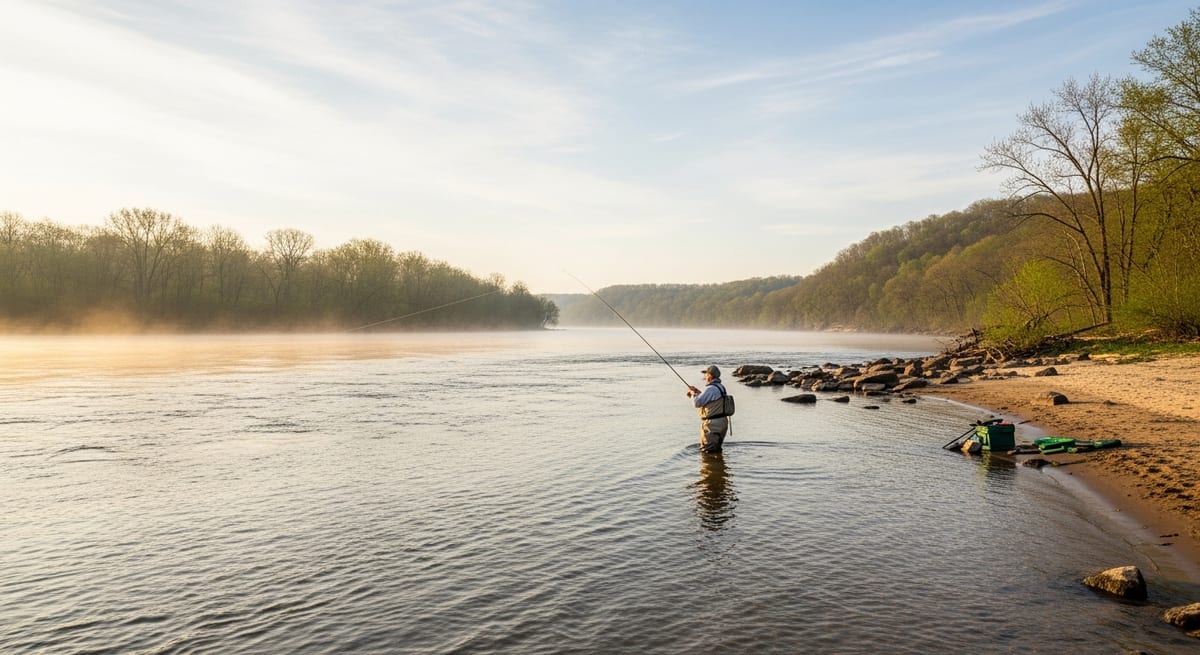
Every spring, when the forsythia finishes blooming and the Delaware River climbs into the low 50s Fahrenheit, anglers from three states converge on stretches of water that most of the country overlooks. While the [Connecticut River shad run](/blog/connecticut-river-shad-fishing) draws enormous media attention in New England, reports from anglers across Pennsylvania, New Jersey, and New York consistently describe the Delaware as a quieter, and often more productive, fishery that peaks a week or two later and rewards a different set of skills. The community consensus points to late April through mid-May as the heart of the action, with dart color and current seam positioning as the variables that most reliably separate limits from blank days.
When the run peaks: water temperature windows and what regulars watch for
American shad (Alosa sapidissima) are anadromous, leaving the Atlantic and ascending freshwater rivers to spawn. On the Delaware, community reports and historical fishery data consistently link run timing to river temperature rather than calendar date. The consensus among long-term regulars is that serious action begins when water temps cross 50°F at mid-river gauges, often around the third week of April, and peaks in the 55-60°F band.
Practical signals that experienced Delaware shad anglers monitor:
- Water temperature at USGS gauges: The Trenton gauge (USGS 01463500) and the Delaware Water Gap gauge (01438500) are the two most-cited references in online reports. When Trenton reads 52-56°F, reports from shad forums describe the lower river switching from spotty to consistent.
- Forsythia and lilac timing: Regional fishing logs note that full lilac bloom in the Delaware Valley historically coincides with the front edge of the run. A rough heuristic, but one that appears repeatedly across decades of trip records.
- Bait balls and bird activity: Tournament anglers and fly fishers both report watching for herring schools and diving terns near tributary mouths as real-time indicators that shad are actively moving upriver.
- River flow: Flood-stage flows push fish to the banks and kill the bite. Anglers report that flows in the 4,000-7,000 cfs range at Trenton produce more consistent seam fishing than either very low or very high water.
The run typically winds down by late May as water temps approach 68°F, though fish in the upper river can linger into early June in cooler years. Feedback from multi-year regulars suggests the window is shorter than most anglers expect, four to six productive weeks, making temperature data a more reliable trip-planning tool than any fixed calendar date. On the lower river near Trenton, regulars also report a tidal influence from Delaware Bay that affects current pace as far north as the tidal limit, with morning and late-afternoon windows described as more active in that zone.
Best access points from Trenton to Easton on both banks
The Delaware forms the state line between Pennsylvania and New Jersey across this entire stretch, giving anglers double the bank access of a single-state river, and double the regulatory complexity. Community trip reports identify consistently productive access points spread across roughly 70 miles of water.
Lower river (Trenton to Washington Crossing)
- Trenton waterfront / Route 29 corridor (NJ side): Bank access near the Calhoun Street Bridge is frequently cited in tournament reports. Current seams behind the bridge pilings concentrate migrating shad and allow productive drift fishing with darts.
- Washington Crossing State Park (NJ and PA): A well-known wade fishery with a gravel bar on the NJ side. Reports indicate reliable shad access at average flows; high water floods the bar and makes wading hazardous.
- Bulls Island Recreation Area (NJ): One of the most consistently cited bank access points in online shad reports, with the Delaware and Raritan Canal State Park trail providing extensive walking access above and below the boat ramp.
Mid-river (New Hope to Easton)
- New Hope / Lambertville (PA and NJ): Anglers describe this stretch as among the most productive on the river at peak run. Multiple public access points on both banks; current structure around the bridge piers creates textbook shad lies.
- Point Pleasant, PA (Tohickon Creek confluence): Tributary mouths are consistently described as staging areas where shad pause before pushing upriver. Fly angler reports specifically mention the Tohickon mouth as a reliable early-season spot.
- Riegelsville / Milford: Pennsylvania anglers note solid wade access at moderate flows near the Riegelsville bridge, with the NJ bank at Milford offering additional options.
- Easton / Phillipsburg (Lehigh River confluence): Community consensus rates the Lehigh confluence among the best holding water on the entire river. Shad stage at tributary junctions, and reports from wading and kayak anglers describe reliable action in the seam where the Lehigh's cooler flow meets the main stem.
Kayak anglers report good floating access through the mid-river section with multiple put-in and take-out combinations, though community notes consistently flag the Delaware's rapid rise during spring storms as a hazard worth checking before launching.
Darts, spoons, and fly rigs: what the Delaware shad community swears by
A clear community consensus has settled around a few core approaches for Delaware shad, with dart color selection and current seam presentation described repeatedly as the variables that drive outcomes.
Shad darts
The shad dart. A small, weighted jig with a painted lead head and bucktail or synthetic tail, is universally described as the primary producer on the Delaware. Color selection is treated as non-negotiable in community reports:
- Chartreuse and white are the most-cited starting point under clear-to-slightly-stained conditions.
- Hot pink (alone or paired with white) is consistently described as the go-to when visibility drops in off-color water.
- Red and yellow: traditional Delaware colors per local club records, performs particularly well during cold-water early-season periods.
- Tandem dart rigs (two darts on a dropper loop, 18-24 inches apart) are mentioned repeatedly in tournament reports as a significant advantage, allowing simultaneous testing of two colors or sizes.
Dart weight tracks current speed. Reports from anglers fishing from bridges and elevated banks recommend 1/4 oz in moderate current, 1/8 oz in slower water, and 3/8 oz when working the fast seams below Trenton.
Spoons and spinners
Kastmaster-style spoons in 1/4 to 3/8 oz are frequently mentioned by anglers covering water quickly. The flash appears to be the draw more than any specific color, with gold and silver cited most often. Spoons are described as more effective than darts in very fast current where a light dart sinks through the strike zone too quickly to stay in the fish's window.
Fly fishing setups
Sink-tip or full-sink lines in the 200-300 grain range are described as necessary for reaching fish in the seam. Pattern consensus centers on Clouser minnow variations in chartreuse/white and pink/white, small Deceiver patterns at two to three inches, and epoxy-body shad flies, which club reports describe as outproducing general-purpose saltwater patterns in clear conditions. The fly fishing community's consistent emphasis is on position over pattern: getting the fly to swing through the current seam at the right depth is described as the primary determinant of success, and Delaware fly anglers note that shad rarely move far to intercept a presentation.
Across all methods, the variable cited most often in Delaware shad reports is reading current structure. Shad hold where fast water meets slow water: behind pilings, on the edges of gravel bars, downstream of points and boulders. Presentations cast slightly upstream and allowed to swing through the seam at fish level are described as far more productive than retrieves made outside or above the holding zone.
Regulations and license requirements across the PA/NJ state line
The Delaware's state-line geography creates a licensing situation that catches unprepared anglers every season. Conservation officers patrol both banks actively during the run, and community reports note citations issued to anglers who assumed one state's license covered both banks.
License requirements
- Anglers fishing from the Pennsylvania bank need a Pennsylvania fishing license (pfbc.pa.gov).
- Anglers fishing from the New Jersey bank need a New Jersey fishing license (nj.gov/dep/fgw).
- Anglers in a boat on the river may use either state's license but must comply with the regulations of the state whose license they hold.
- Reports from multi-day anglers who fish both banks note that purchasing both licenses is a common and worthwhile precaution.
Shad-specific rules (verify current season before fishing)
- Pennsylvania does not maintain a traditional closed season on American shad on the Delaware, but regulations have been revised in recent seasons; the PFBC regulation summary is the authoritative source before any trip.
- New Jersey has historically permitted shad harvest with specific bag and size limits; NJDEP Fish & Wildlife updates these rules annually.
- Hickory shad regulations differ from American shad rules in both states, hickory shad typically arrive slightly earlier in April and are often present alongside the main American shad run.
- The Delaware River Basin Commission (DRBC) publishes annual interstate shad fishery reports covering population data and any emergency restrictions; regulars recommend consulting DRBC resources alongside each state's regulation guide.
EVERY SATURDAY MORNING
Weekly fishing intelligence
Nationwide conditions, what's biting, and honest gear deals. One email, no noise.
No spam. Unsubscribe anytime.