
CT Shore Casters at Watch Hill, Niantic Bay, and the LIS Surf Report Braid-to-Leader Connections Fail Mid-Run More Often Than Terminal Knots, what LIS Shore Communities, Farmington TMA Guides, and CTFA Bench Sessions Reveal About the Five Knot Connections CT Anglers Actually Reach For
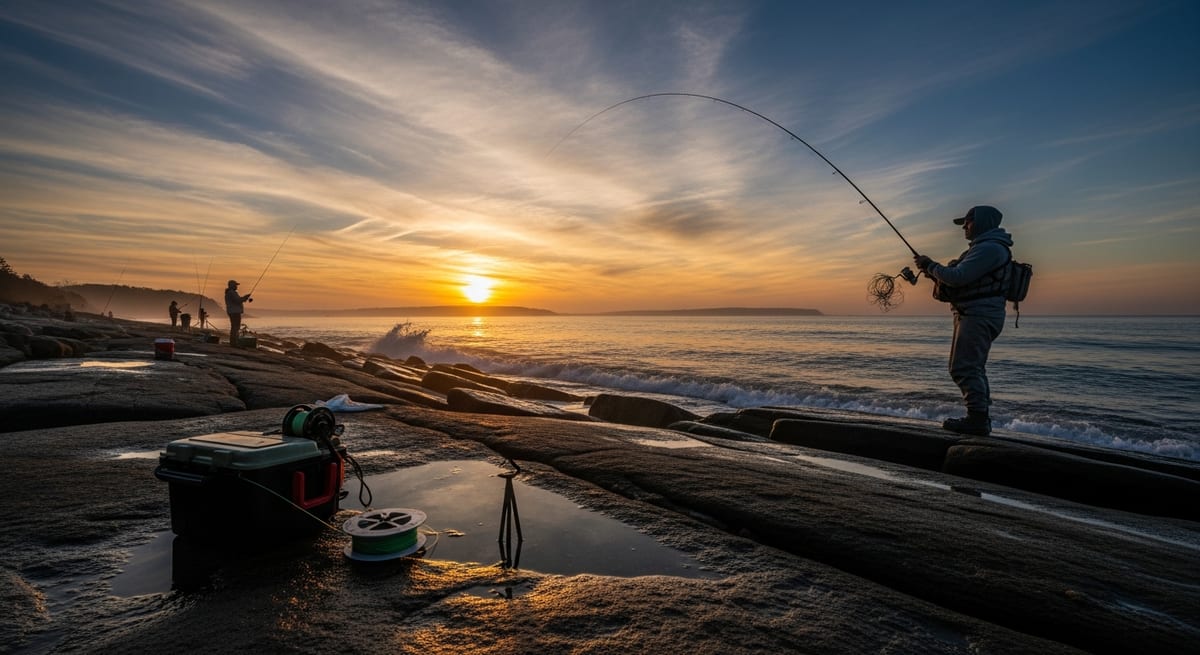
CT surf casters working the Watch Hill to Niantic shoreline report that braid-to-fluorocarbon connection failures account for more lost fish during the striper run than knot-to-hook failures at the terminal end. That observation appears consistently across the LIS inshore community and matches what Farmington TMA guides report when clients lose fish on long nymphing leaders: the failure point is almost always the mid-system leader connection, not the fly knot or lure tie that most anglers pull on first after a break-off. Five connections cover the range of situations CT anglers face across salt and fresh contexts. Which knot you choose matters less than understanding where each one belongs in the system, and what typically goes wrong when line diameter, material, or temperature changes it.
What CT Freshwater and Coastal Anglers Use at the Hook End
The improved clinch is the standard terminal connection for monofilament and fluorocarbon to hook or lure eyes in the 6 lb to 30 lb range. Farmington TMA nymphing regulars and Housatonic streamer anglers use it for tippet-to-fly connections across most tippet sizes. For freshwater bass work on Candlewood Lake or Bantam, anglers fishing fluorocarbon leader material to finesse jigs and drop-shot hooks report it holds reliably when tied carefully and wetted before tightening.
How to tie: Thread 6 inches of line through the eye of the hook. Double back parallel to the main line and make 5 to 6 wraps around the standing line (use fewer wraps with line above 20 lb). Thread the tag end through the small loop nearest the eye, then back through the large loop just formed. Wet the knot with saliva and pull the main line and tag end simultaneously until the coils seat against the eye. Trim the tag end to about 1/16 inch.
Where this knot underperforms: CT surf casters and anyone fishing braid to terminal tackle should switch to the Palomar instead. The improved clinch tends to slip on modern high-PE braids under sustained load. The consensus among LIS shore anglers is to treat the improved clinch as a mono and fluoro knot only, and to retie it after any fish that made a prolonged run.
The Braid Connection CT Shore Casters Prefer for Plugs and Jigs
The Palomar tests at or near full line strength for most line materials and is the preferred terminal connection among CT surf casters from Bluff Point to Watch Hill for braid-to-lure connections where no fluorocarbon leader is in use. It works equally well for fluorocarbon and monofilament and is the knot most commonly cited in LIS striper forum threads when anglers compare terminal connections for clip-on plugs and bucktails.
How to tie: Double 6 inches of line and pass the loop through the eye of the hook or lure. Tie a loose overhand knot in the doubled line. Pass the loop completely over the hook or lure, for lures with treble hooks, thread the entire lure through the loop rather than passing the loop over the eye only. Wet and pull both the main line and doubled tag end until the knot snugs against the eye. Trim the tag end close.
Nuance for braid users: Anglers fishing lighter braid in the 10 to 15 lb range on smaller jig hooks report the Palomar can be inconsistent when the hook eye is too small to pass a doubled loop cleanly. In those cases, the LIS shore community often uses a 5-turn uni knot rather than force a doubled loop through a small eye. For standard plug clips and jig heads common to CT bass and bluefish work, the Palomar is the more reliable choice when the hardware allows it.
Note on CT DEEP tackle context: Connecticut's 2025-2026 marine regulations do not restrict knot type, but wire leader requirements for certain species and circle hook provisions for others affect what you are tying to. The current DEEP Marine Fisheries guide has species-specific terminal tackle notes worth checking before rigging for anything with regulatory nuance.
Why Farmington Guides and Soft-Plastic Anglers Switch to a Free-Swing Loop at the Terminal End
A loop knot does not cinch tight to the lure or fly eye. It leaves a small fixed loop that lets the lure pivot freely, which changes the presentation for any pattern where action depends on free movement rather than a locked attachment. Farmington TMA guides who fish lightly weighted soft-hackles and unweighted nymphs on tight leaders report switching to a loop connection when they want the fly to respond to current rather than track with the leader.
For LIS soft-plastic work, including paddle tails and swimbaits for stripers off the Niantic River mouth and eastern LIS structure, anglers who use loop connections report that the tail kick is noticeably freer than with a standard cinch connection. The practical difference is most visible on slower retrieves where the lure would otherwise plane rather than pulse.
The Non-Slip Loop Knot: Tie a loose overhand knot in the main line about 10 inches from the end, leaving an open loop. Pass the tag end through the lure or fly eye and back through the overhand knot from the same direction it entered. Wrap the tag end around the main line 4 to 6 times. Pass the tag end back through the overhand knot from the same direction as before. Wet and pull both the main line and tag end to tighten. The loop size can be adjusted before final tightening. Most CT surf applications call for a loop around 1/4 inch in diameter. Tighten to the desired size first, then pull both ends firmly to lock it.
This is a terminal connection only. It is not used as a line-to-line join.
The Mid-System Connection: Joining Braid to Fluorocarbon for CT Shore and River Work
The double uni is the standard method for connecting braided main line to a fluorocarbon or monofilament leader. CT shore anglers running 20 to 30 lb braid with 25 to 40 lb fluorocarbon leaders for LIS striper work report it as the most reliable mid-system join that still passes through rod guides without snagging. It is also used for building leaders on Farmington and Housatonic streamer rigs where the running line transitions to a short fluorocarbon section before the fly.
How to tie: Overlap the two lines by about 8 inches, running parallel in opposite directions. With one line, form a loop and make 4 to 6 wraps around both lines through that loop. Pull tight to seat a uni knot on that line. Repeat with the other line going in the opposite direction, 4 to 6 wraps, and pull tight. Wet both knots and pull the two main lines in opposite directions until the knots slide toward each other and seat firmly together. Trim both tag ends close.
For braid-to-fluoro specifically, the LIS inshore community generally uses 8 wraps on the braid side and 4 to 5 wraps on the fluorocarbon side. The asymmetric wrap count compensates for the diameter difference and produces a more balanced knot that rolls through guides cleanly. Using equal wrap counts on both sides when diameters differ significantly is a common reason a finished knot catches in the tip guide mid-cast. Anglers who have rebuilt the connection using the asymmetric count report the problem resolves immediately.
Building a Tapered Leader Section by Section: What Farmington and Housatonic TMA Fly Anglers Use Between Diameter Steps
The blood knot is the standard for joining two sections of similar-diameter monofilament or fluorocarbon, and it is the connection most commonly described in CTFA bench sessions and Housatonic Fly Fishermen's Association reports when the subject is building hand-tied tapered leaders. A five-section tapered leader requires four blood knot connections stepping down in diameter toward the tippet. The blood knot produces a slim, symmetrical profile that does not catch in guides and does not create a hinge in the leader the way a heavier knot can.
How to tie: Overlap the two lines by 6 inches. With one line, wrap 5 times around the other and pass the tag end between the two lines at the center point. Repeat with the other line in the opposite direction, 5 wraps, with the tag end passing through the same center gap in the opposite direction. The two tag ends should point away from each other through the center gap. Wet and pull both main lines simultaneously, drawing the coils inward evenly until the knot seats. Trim both tag ends close.
Where this knot is not appropriate: the blood knot is not reliable for braid-to-mono or braid-to-fluoro connections. The surface texture of braid causes the wraps to slip under load. For those connections, the double uni described in the previous section is the correct choice. The blood knot is a same-material, similar-diameter connection for leader construction only.
What Experienced CT Anglers Do Differently Before the First Cast
The consistent observation across LIS surf anglers, Farmington TMA regulars, and CTFA members is that connection failures trace back almost entirely to dry tightening and rushed inspection, not knot choice. A few practices separate anglers who rarely break off at the connection from those who do it regularly.
Wet every knot before tightening. Monofilament and fluorocarbon both generate heat from friction when drawn tight without lubrication. The heat weakens the line at the knot, often to a degree that is not visible. Saliva or water applied before tightening is not optional, and the step is especially easy to skip on cold Farmington mornings when hands are numb and the window before legal light is short.
Pull steadily to a firm stop rather than snapping the knot tight. Snapping causes wraps to jump over each other rather than seat in sequence. CT kayak bass anglers on Candlewood who fish light fluorocarbon to drop-shot rigs report this is the most common reason a knot that looks properly formed still rolls under the pressure of a fish turning against resistance.
Inspect the finished knot under slight tension. The coils should be even and the tag end should not slide back through. If any coil looks out of sequence, retie. This matters most on cold mornings when dexterity is reduced and a poorly tied tippet knot is discovered only when a Farmington brown tests it.
Pull-test mid-system connections after any significant snag or bottom contact. The double uni is strong when properly seated, but the wraps can loosen slightly under sudden shock load. After freeing a plug from Housatonic bottom structure or a Watch Hill boulder, anglers report it is worth a quick pull test on the braid-to-fluoro connection before continuing.
Practice knots on shore and off-season, not while rigging on the water. The ability to tie by feel, in low light or with gloves on, is the standard working condition for both a pre-dawn LIS surf session and a winter trout morning on the Farmington.
EVERY SATURDAY MORNING
Weekly fishing intelligence
Nationwide conditions, what's biting, and honest gear deals. One email, no noise.
No spam. Unsubscribe anytime.