
Fishing Line Guide: How to Choose the Right Line for Every Situation
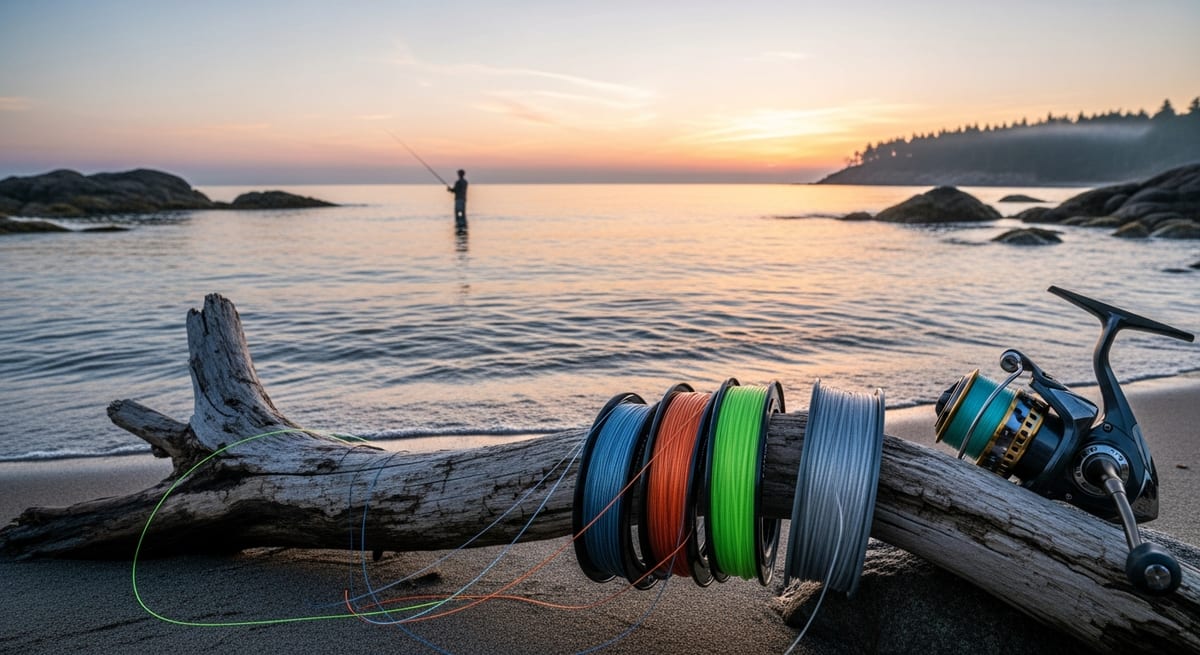
Fishing line is where many beginners make avoidable mistakes, either using the wrong line type for the situation or not understanding why experienced anglers choose one line over another. Three main categories dominate the market: monofilament, fluorocarbon, and braided line. Each has distinct properties that make it better suited to specific applications. This guide explains the science, the trade-offs, and the practical setups that work.
Monofilament: The Original
Monofilament is a single strand of nylon extruded in various diameters. It was the only option available to most anglers until fluorocarbon and braid emerged in the 1990s. Physical properties: Monofilament stretches 15-30% under load. This stretch acts as a shock absorber, beneficial when using treble-hook lures (stretch prevents hooks from pulling on sudden surges), harmful when long-distance hooksets are required (the stretch absorbs some hookset energy). Monofilament absorbs water over time, which changes its properties slightly. It degrades with UV exposure, line that sits on an exposed spool in sunlight weakens faster than stored line. Density: Mono is slightly buoyant to neutral in water. It floats or sinks very slowly. This makes it excellent for topwater fishing, where you want the line to stay above the surface. Cost: The most affordable option by a wide margin. Ideal applications: Beginners, topwater lure fishing, applications where shock absorption is beneficial (crankbait fishing, thin-wire hooks), fishing where line visibility is less critical, budget situations. CT applications: General freshwater fishing for beginners, topwater surface lure fishing, casual panfish and trout fishing.
Fluorocarbon: The Clear Choice
Fluorocarbon is a denser material with properties significantly different from monofilament, particularly its near-invisibility underwater and its sink rate. Physical properties: Fluorocarbon has a refractive index very close to water (1.42 vs. water's 1.33), making it almost invisible when submerged. It sinks, which is useful for bottom fishing presentations. It stretches less than monofilament (around 6-8%) but more than braid. It's highly resistant to abrasion. It doesn't absorb water and doesn't degrade with UV exposure, giving it significantly longer shelf life than mono. Cost: More expensive than monofilament, less than premium braid. Primary use: Leader material. Most experienced anglers use braid as main line and attach a fluorocarbon leader of 12-36 inches. The braid provides sensitivity and strength; the fluorocarbon provides invisibility and abrasion resistance at the business end. Using 100% fluorocarbon as main line on a spinning reel can cause issues with line memory and coiling. Ideal applications: Clear-water fishing where fish visibility of line is a concern, leader material in virtually all scenarios, bottom fishing where abrasion resistance matters. CT applications: Clear CT lakes for bass in summer, as leader material for all striper and fluke fishing, trout fishing in clear rivers.
Braided Line: The Performance Option
Modern braided line (multiple strands of gel-spun polyethylene fiber woven together) has transformed fishing since its widespread adoption in the 1990s and early 2000s. Physical properties: Braid has virtually zero stretch, hooksets are telegraphed directly from rod tip to hook. This makes it extraordinarily sensitive. You feel every tick, every rock, every piece of grass. It has a much thinner diameter than mono or fluoro of equivalent strength: 30 lb braid is approximately the diameter of 8 lb mono. This thin diameter allows deeper penetration in current (important for deep-water fishing) and fits more line on a spool. It's extremely strong and abrasion-resistant against structure. Cost: More expensive up front, but lasts for years. A spool of quality braid can last 3-5 years of heavy use versus mono that should be replaced annually. Trade-offs: No stretch means hard hooksets can pull treble hooks or bend them, braid is less ideal for topwater fishing with treble hooks (mono or fluoro is better). Braid is visible in clear water, which is why a fluorocarbon leader is almost always used. Braid can cause casting issues on spinning reels without proper technique. Ideal applications: Bass fishing in heavy cover, fluke and striper fishing, any long-distance or deep-water application, kayak fishing where sensitivity is important. CT applications: Nearly all CT bass fishing, fluke and striper fishing in the Sound, offshore bottom fishing.
The Standard Modern Fishing Setup
The most common setup among experienced Connecticut anglers across most fishing situations: Main line: 15-30 lb braided line fills the reel spool (leaving room for backing if needed). Leader: 12-36 inches of 12-25 lb fluorocarbon, connected with a double uni knot or FG knot. The leader length varies with water clarity and fish behavior, longer leaders in clearer water, shorter in stained water or heavy cover. This setup provides: Sensitivity of braid throughout the cast and retrieve. Invisibility of fluorocarbon where fish can inspect the terminal tackle. Abrasion resistance of fluorocarbon at the point most likely to contact structure or teeth. The thin diameter of braid for maximum line capacity and casting distance. The FG knot: The FG knot is the strongest and slimmest braid-to-fluorocarbon connection. It passes through guides without catching and tests near 100% of line strength. It's more complex to tie than the double uni but worth learning. Many serious anglers use only the FG knot for all braid-to-leader connections.
Practical Line Selection Checklists
Use these decision frameworks for common CT fishing situations. Freshwater bass fishing: 20-30 lb braid main line + 15-20 lb fluorocarbon leader. Adjust leader diameter for water clarity. In very clear water (Saugatuck Reservoir), go to 12 lb fluorocarbon. In stained or dark water, 20 lb fluorocarbon is fine. CT trout fishing: 4-8 lb monofilament (mono floats, which helps suspending nymph rigs) OR braid + fluorocarbon leader for a more sensitive setup. The Farmington River TMA water is clear, lighter leader tippet is important. Striper surf fishing: 20-30 lb braid + 25-30 lb fluorocarbon 4-foot leader. The leader needs to handle rocky jetties and structure. Heavy braid resists current drag. Fluke fishing: 20-30 lb braid + 20 lb fluorocarbon 3-foot leader. Standard setup for most CT Sound bottom fishing. Ice fishing: Dedicated ice fishing line (supple monofilament or fluorocarbon designed to remain limp in near-freezing temperatures). 4-10 lb test depending on target species. Standard braid and mono become stiff in extreme cold and coil unpredictably.
EVERY SATURDAY MORNING
Weekly fishing intelligence
Nationwide conditions, what's biting, and honest gear deals. One email, no noise.
No spam. Unsubscribe anytime.