
How to fish the spring shad run on California's Sacramento River
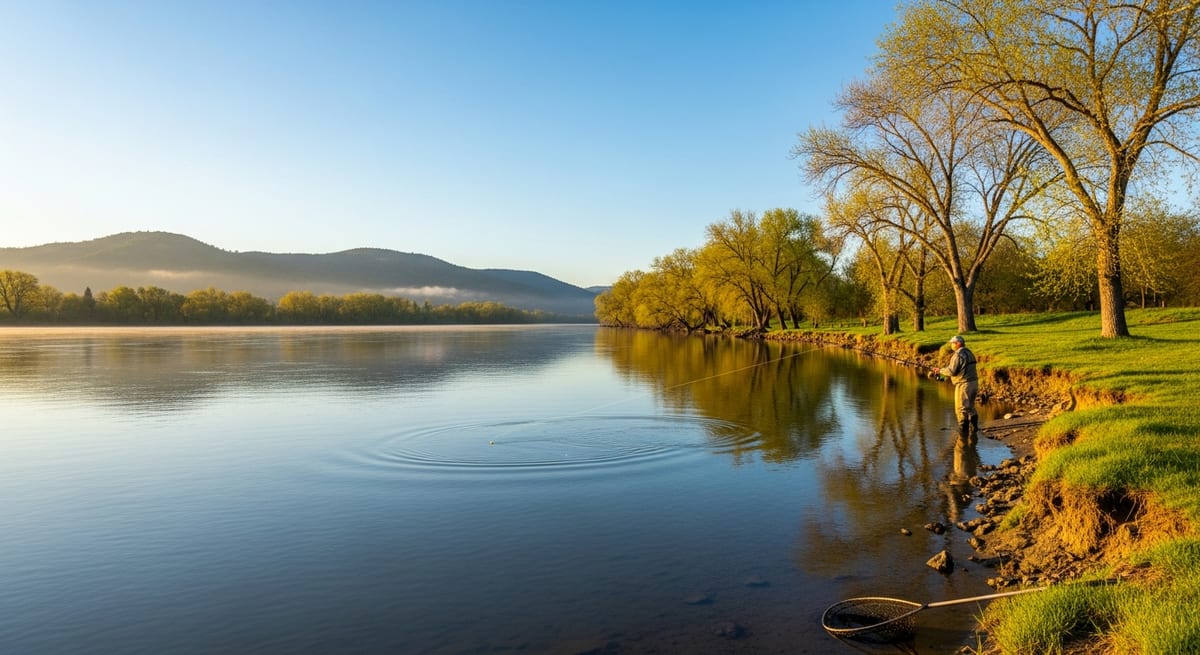
Every April, somewhere between the fog-shrouded tule marshes of the Sacramento-San Joaquin Delta and the gravel bars north of Chico, [American shad](/blog//blog/connecticut-river-shad-fishing) begin stacking in numbers that anglers who grew up on the river describe as one of the great overlooked spectacles in western fishing. Sacramento River shad fishing is not a secret, but the specific mechanics of fishing it productively are poorly documented outside regional trip reports, and the gap between anglers who consistently limit out and those who go home empty-handed often comes down to a single variable: dart weight matched to current speed at the right staging hole.
When the fish arrive: Sacramento shad run timing from April through June
Shad are anadromous fish that use the Sacramento as a migration corridor from the San Francisco Bay estuary to their spawning gravel in the upper river. Regional fishing reports from the past decade consistently document the vanguard of the run appearing in the lower river, around the Rio Vista area, as early as mid-April, though water temperature is a more reliable trigger than the calendar. Anglers tracking the run note that fish movements accelerate once river temps stabilize in the 55-62°F range.
The peak of the Sacramento River shad fishing window is typically late May through mid-June, when fish are stacked from Verona north through Colusa. CDFW creel surveys and fishing report aggregators document this window as the most productive for consistent limits. By late June, the majority of fish have pushed into their spawning areas or begun dropping back, and catch rates decline sharply even at historically reliable access points.
Water year matters more on the Sacramento than on many western shad rivers. In high-runoff years, cold snowmelt pushes the peak run two to three weeks later than the median timing. Low-water years tend to concentrate fish in fewer, deeper holding lies, which can actually improve catch rates at those specific spots, even as navigation and access become more technical.
Key timing benchmarks that anglers reference across California fishing reports:
- Mid-April: First fish reported in the lower Delta and Rio Vista corridor
- Late April-early May: Fish moving into the Sacramento near Verona and the lower Feather River mouth
- Late May-mid-June: Peak staging at the Feather River confluence and middle river holes
- Late June: Run disperses upriver or drops back; catch rates fall across the corridor
Where to find fish: top access points from Verona to Red Bluff
The Sacramento supports shad fishing across a long corridor, but access points are not created equal. Boat anglers have an obvious mobility advantage, but bank access at certain publicly managed sites produces consistent results that regional reports rank among the most reliable stretches of the run.
Verona sits near the confluence of the Feather River and the Sacramento and is the single most referenced location in California fishing reports during the shad run. The boat launch here provides access to both rivers, and the mixing zone creates the kind of current seams that shad use as navigation channels. Bank anglers working the riprap downstream of the launch report steady action during peak migration weeks.
Moving north, Knights Landing offers a public boat ramp and bank access on a stretch where the river narrows enough to create consistent current structure. Anglers familiar with this reach describe it as a reliable alternative when Verona weekend crowds push fish into shyer behavior.
Colusa and the area managed by the Colusa-Sacramento River State Recreation Area provide launch facilities and bank access on a stretch that trip report contributors describe as productive mid-run, when fish are transitioning between the lower staging areas and the upper river. The gravel bars here create shallow-to-deep transitions that hold fish in low-water years.
Further north, Hamilton City and the stretch approaching Red Bluff represent the upper extent of consistent shad fishing in most years. Fish do reach the Red Bluff Diversion Dam area, and the tailwater below the dam has historically produced well when flows cooperate, though reports indicate this reach is more variable than the middle river.
For anglers without boats, the publicly accessible bank at Colusa, the Meridian gravel bars, and the riprap at Verona are the most consistently documented walk-in options. Access conditions change with water levels, confirming current CDFW access information before the drive saves wasted trips.
The Feather River confluence: why regional reports keep returning to the same spot
Experienced Sacramento shad anglers identify the Feather River confluence zone, roughly from Verona downstream a few miles, as the most reliably productive staging area in the system. Regional fishing reports surface this location with a consistency that general western shad guides rarely capture or explain.
The reason the confluence matters is structural. Shad migrating upriver from the Delta encounter the combined outflow of two major rivers, creating a complex current regime with distinct seams, eddies, and depth transitions. Fish moving against heavy current seek relief in slack water on the downstream edges of current seams, then push upstream when the hydraulics ease. Anglers who have spent multiple seasons at this confluence describe a pattern where fish stack in predictable holding lies just outside the main channel push, exactly the locations where a correctly weighted dart or spoon can be swung through the strike zone repeatedly.
What separates productive anglers from fishless trips at the confluence is dart weight calibration to current speed. This detail surfaces in Sacramento-area fishing reports far more consistently than in general shad literature, which tends to offer static gear recommendations independent of flow conditions. The documented principle: in high, fast water, common during April and early May, heavier darts in the 1/4 oz to 3/8 oz range are needed to maintain depth through the strike zone. As flows drop through June and current moderates, anglers shift down to 1/8 oz or 1/16 oz darts, which swing more naturally and trigger more strikes from fish that have longer to inspect the presentation in slower water.
The confluence also creates a temperature mixing zone that shad use as a holding area during cold-water pulses from the Feather. When snowmelt pushes the Feather cold, shad that were actively migrating upriver will stage just below the confluence mouth, waiting for temperatures to equalize. Experienced local anglers report exploiting this by fishing the lower edge of the mixing zone rather than moving upriver with the general crowd.
Gear and rigs: darts, spoons, and fly patterns that produce
The gear consensus from western shad anglers is narrower than newcomers expect. Shad are not structure feeders or bait hunters in the traditional sense. They respond to visual triggers on a spawning migration, and tackle choices reflect that.
Shad darts are the dominant tool across all Sacramento reports. Color opinions are strong and regional: chartreuse and white are the most cited early-season colors in turbid high-water conditions, while pink, red, and orange gain favor as flows drop and visibility improves. A tandem dart rig, with a heavier dart providing depth and a lighter dart trailing 12-18 inches behind on a dropper, is cited frequently in Verona-area trip reports as a meaningful strike multiplier.
Key dart rigging details from regional reports:
- Weight range: 1/16 oz to 3/8 oz, calibrated to current speed at the specific fishing location
- Leader: 6-8 lb fluorocarbon; drop to 4 lb in low, clear conditions
- Color: Chartreuse/white in turbid high water; pink/red/orange in clear low flows
- Tandem rig: Heavier dart anchors depth, lighter trailing dart often takes the majority of strikes
Spoons receive consistent mentions from boat anglers drifting deeper channel edges. Small wobbling spoons in silver or gold, 1/8 to 1/4 oz, are described as effective on fish that have been pressured on darts. The different profile and flash signature produces strikes from fish that are ignoring the more common presentation.
Fly fishing for Sacramento shad has a dedicated following among valley anglers who cross over from trout fishing. Productive patterns documented in fly fishing reports include:
- Clouser-style shad flies in chartreuse/white or pink/white, hook size 4-6
- Epoxy-head shad darts tied to mimic the hard-dart swimming action on a fly rod
- Estaz or crystal chenille bodies with flashabou tails, brightness triggers the strike response, not pattern realism
Sink-tip lines matched to current speed are the consistent fly fishing recommendation; floating lines with weighted flies lose depth too quickly in the main current zones. Anglers report that 5- to 7-weight rods handle shad well without exhausting fish before release.
Reading current and presenting to staging fish
The technical core of Sacramento shad fishing is current reading, and regional reports consistently identify it as the skill that transfers most directly to improved catch rates.
Shad staging in high-current environments hold in a narrow band. The seam where moving water meets a slower zone. These seams are visible as surface disturbances, color transitions, or as the line where surface foam and drift debris slow and collect. Anglers describe fish as holding on the downstream edge of the seam, meaning the dart or spoon must enter the fast water, sink to the correct depth, and swing from the fast side to the slow side. The strike almost always comes during that transition.
For bank anglers, the standard cast is quartered upstream or directly across current, allowing the presentation to sink before reaching the seam and then swing naturally through it. Mending upstream immediately after the cast extends sink time and prevents the presentation from riding too high in the water column. Strikes register as a thump at the end of the swing or a subtle load on the rod mid-swing.
For boat anglers, the most-reported technique is a controlled drift with the dart held just below the boat. The current swings the presentation while the boat moves at slightly below current speed. Backrowing to slow the drift relative to current is described as the single biggest mechanical advantage boat anglers hold over bank anglers in fast spring flows.
Technique details that surface consistently in local reports:
- Depth is mandatory: Shad are mid-column fish; presentations near the surface produce far fewer strikes regardless of color or action
- Vary retrieve speed in slow current: A two-turn retrieve between swings triggers strikes on fish that ignored a dead swing
- Watch line entry into the water: Many strikes in fast current register as a line hesitation before the rod loads, missing this visual cue costs significant fish
- Move after 15-20 unproductive casts: Shad cover ground during active migration; fish don't hold indefinitely in any single spot
- Weight adjustment is a live process: Carry a range and adjust on the water, not before launching
The weight-selection benchmark that Sacramento-area reports converge on: a correctly weighted dart should tick or briefly touch bottom at the apex of the swing, then lift naturally as it crosses into the slower seam. Dragging through the full swing means going lighter; never reaching mid-column means going heavier. The window is narrow, and calibrating it to the specific hole being fished, not to a general recommendation from a guide written without reference to that day's flow gauge reading, is what separates consistent Sacramento River shad fishing from a day of guesswork.
EVERY SATURDAY MORNING
Weekly fishing intelligence
Nationwide conditions, what's biting, and honest gear deals. One email, no noise.
No spam. Unsubscribe anytime.