
CT Impoundment Bass Move Shallow When October's Shad Schools Consolidate. What Candlewood, Bantam, and Lillinonah Anglers Report About the Fall Feeding Window, Baitfish Patterns, and Lures Before Water Hits 50°F
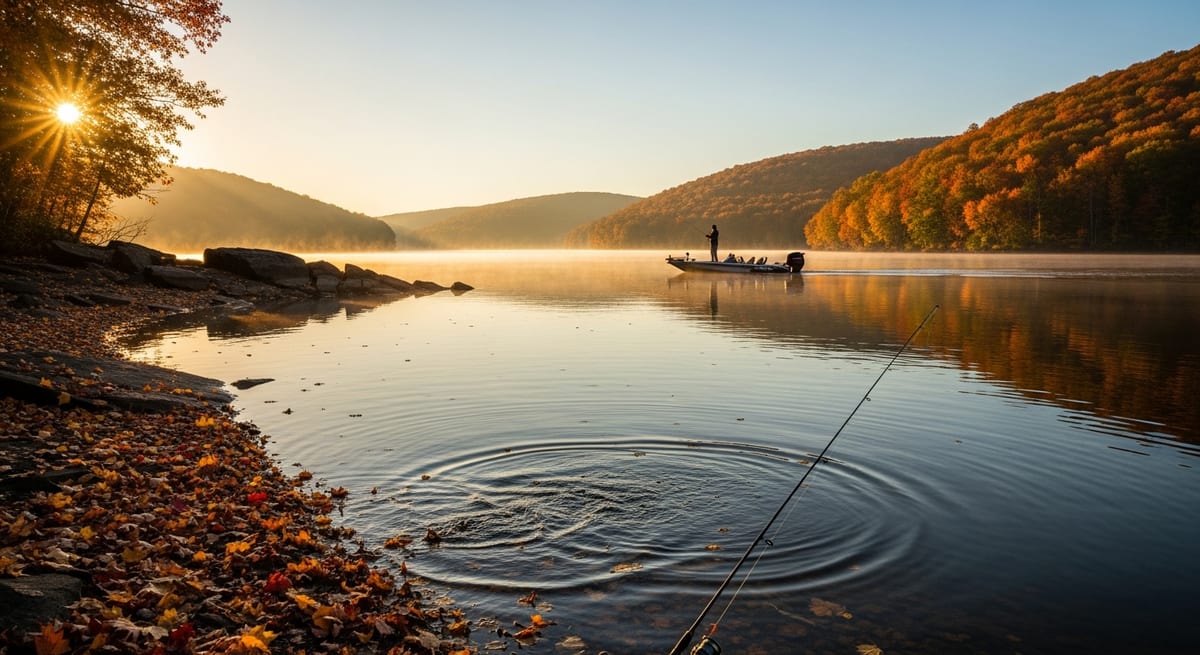
Anglers fishing Candlewood's main basin and Bantam Lake's grass lines in October consistently report better catch rates than the same spots in July. A pattern CT impoundment communities attribute to baitfish consolidation after summer's thermal stratification collapses. Once surface temperatures drop into the upper 60s°F, typically through September and into early October, shad and perch fry that scattered across open water all summer begin tightening into visible schools near creek arms and coves. CT bass communities active on regional forums describe fish moving shallower and feeding more aggressively during this window than at most other points in the season. Fishing pressure on major impoundments drops sharply after Labor Day, and anglers targeting fall-staging bass on Lillinonah, Moodus Reservoir, and Bantam through October and early November frequently report ramps that are nearly empty by mid-morning.
When CT Impoundments Flip: The October Shift Bass Communities Talk About
The fall transition on CT impoundments isn't a gradual drift, communities fishing Candlewood and Lillinonah describe a noticeable pattern shift that tends to happen once surface temperatures fall consistently below 70°F, typically in late September or early October on deeper impoundments. Baitfish that spent summer suspended in open water begin schooling near the surface in protected coves and creek arms. Bass that held deep through the hottest weeks of summer move onto flats and points that were too warm to hold fish in July.
CT DEEP research on major impoundments confirms this general seasonal pattern, though timing varies by water body, bantam, being shallower, tends to transition earlier than Candlewood's main basin. Communities fishing Moodus Reservoir and Lake Lillinonah report similar staging behavior, with bass appearing on shallow wood and rocky points from mid-September onward in most years. The active feeding window typically runs four to six weeks before water temperatures push below 55°F and fish transition to winter holding behavior.
Reading the Baitfish Schools on CT Impoundments
Fall bass fishing on CT waters is primarily a baitfish-reading exercise. Communities fishing Candlewood, Bantam, and Salmon Cove on the Connecticut River report the same signal: where bait schools are visible, bass are close.
Surface activity: Baitfish dimpling the surface on calm mornings, birds working over concentrated schools, and visible swirls pushing up from below are all reliable indicators. CT impoundment anglers report bait schools show on electronics as dense mid-column clouds, often with larger marks beneath.
The back of coves: Baitfish schools move into coves and creek arms as water cools. Bass follow. On Candlewood, communities report coves off the northern basin and creek arms near Macedonia Brook as consistent October staging areas.
Shallow points and flats: Anglers on Bantam Lake and Moodus Reservoir describe largemouth stacking on grass-adjacent flats and sand points once water falls into the low 60s°F. The same structure that held fish in spring often becomes productive again during this window.
What CT Impoundment Anglers Throw When Bass Are Locked on Shad
Shad-imitating crankbaits: Anglers on Candlewood and Lillinonah report that chrome/blue and white/chartreuse medium-diving crankbaits worked through or just beneath a visible school trigger the most consistent reaction strikes. Retrieve speed is typically varied until fish respond, communities note faster retrieves often outperform slow rolls when water is still in the mid-60s°F range.
Spinnerbaits: A white 3/8 oz spinnerbait with tandem willowleaf blades remains a reliable choice for CT impoundment anglers targeting fall bass in open water. The profile and flash closely imitate fleeing shad, and CT bass communities report it's particularly effective when fish are actively chasing schools rather than suspending beneath them.
Topwater: When bait schools are erupting at the surface, common on Candlewood and Bantam on calm October mornings, walking baits and large poppers fished through the commotion draw explosive strikes. CT anglers report this window is typically short: the first two hours of light and the last hour before dark, and most reliable when surface temperatures are still above 60°F.
Swimbaits: A 4-5" paddle-tail swimbait in a shad color on a 1/4 oz head, retrieved at medium speed, continues to produce when other presentations slow mid-day. Communities fishing Moodus and Bantam report this presentation holds up after a weather system passes and fish have dropped slightly deeper.
November on CT Impoundments: When the Shad Chase Ends and Structure Takes Over
As water temperatures push below 55°F, which communities on Candlewood's deeper basins report typically happens in mid-to-late November, later than shallower bodies like Bantam. The open-water shad-chasing pattern fades. Bass that were schooling in coves and on flats begin consolidating on deep structural features: rocky points, underwater humps, and submerged timber.
Anglers fishing Candlewood's deeper points and Lake Lillinonah's rocky mid-lake structure in November report that bass group predictably on these features, making location more reliable even as overall activity slows. A 3/8 oz football jig dragged slowly along rocky points and humps in 10-20 feet of water, or a drop shot rig fished just above bottom structure, are the presentations CT late-fall communities most consistently describe. Fish are not actively chasing. The jig or drop shot needs to stay in the strike zone longer than it would in October.
CT bass communities generally describe November as slower fishing than October's bait-school activity, but fish concentrated on winter-staging structure are reliably located once the angler identifies the right depth and bottom composition.
Rigging for the Full Fall Window: What CT Anglers Bring to Cover Both Months
Fall bass fishing spans enough technique variation that communities fishing Candlewood and Bantam through October and November typically rig for two distinct patterns rather than one.
For bait-school presentations (crankbaits, spinnerbaits, swimbaits): A medium-heavy 7' baitcaster with 14 lb monofilament and a 6.4:1 reel covers most of the open-water work. Monofilament's stretch buffers hooksets on fast-moving crankbaits. CT anglers report the same setup handles spinnerbaits and swimbaits without modification.
For topwater: Communities fishing calm October mornings on Bantam and Candlewood typically run the same baitcaster setup with 15 lb fluorocarbon, noting less surface interference and improved hookset feel on long casts.
For late-fall deep presentations: A medium-heavy baitcaster with 15 lb fluorocarbon handles jig work on Candlewood's rocky structure. A medium-light spinning rod with 10 lb braid and an 8 lb fluorocarbon leader covers drop-shot fishing over deep humps and points.
CT impoundment communities generally report that anglers who arrive with two rods, one for open-water bait-school work and one rigged for structure, cover the full fall window without re-rigging when conditions shift.
EVERY SATURDAY MORNING
Weekly fishing intelligence
Nationwide conditions, what's biting, and honest gear deals. One email, no noise.
No spam. Unsubscribe anytime.