
The Largemouth Bass in CT's Sub-25-Acre Ponds Respond Differently Than Reservoir Fish. What Glasgo Pond, Uncas Pond, and Pachaug-Area Shore Communities Report About Tight-Water Presentation, Pressure Cycles, and the DEEP Small-Pond Access Network
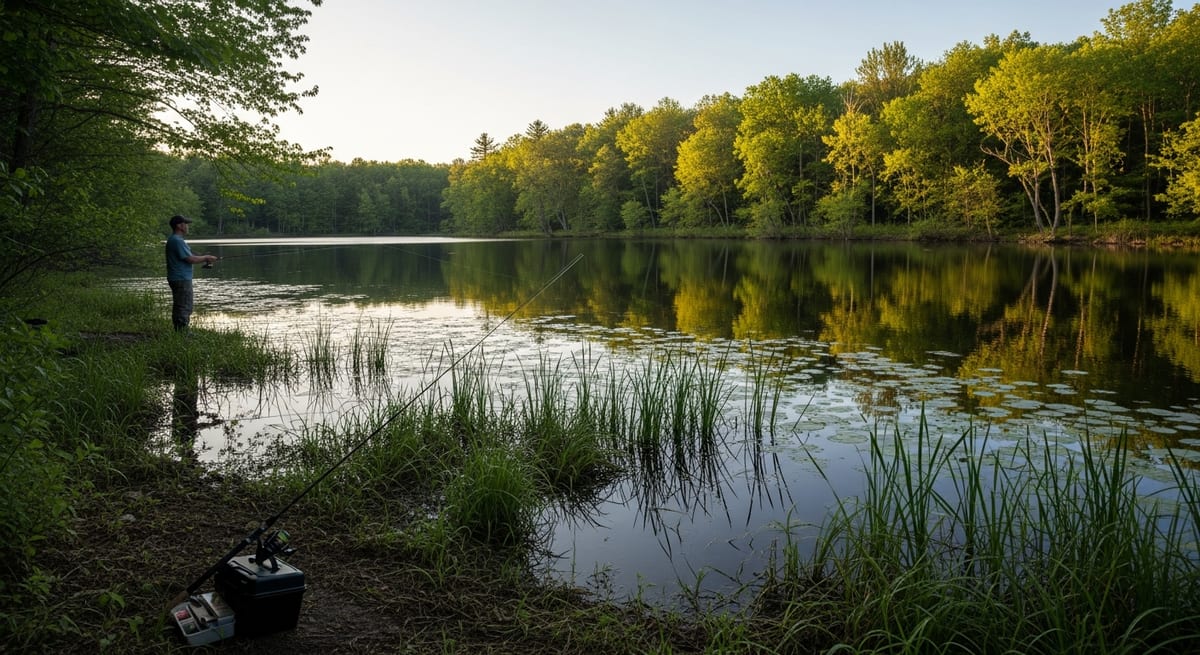
Shore anglers who fish Glasgo Pond in Griswold report consistent largemouth action through late October, weeks after comparable pressure on Gardner Lake and the major impoundments pushes fish deep and makes them lock up. The pattern holds across CT's smaller public fisheries: sub-25-acre ponds with limited boat access see far less angler effort than the headline lakes, and the bass in them hold in predictable spots that shore anglers can work systematically across a season. The catch is approach, not lure selection. Pond regulars across the eastern district note that bank position and stealth before the first cast determine more than what's tied to the line in tight water where the bass can see the shoreline clearly. Tackle shop staff near the Pachaug corridor describe pressure on Glasgo, Uncas Pond, and the surrounding DEEP-managed small water as light enough midweek that fish haven't been conditioned to avoid common presentations. A different behavioral situation than what anglers find on Candlewood or Bantam on a Saturday.
Why Pond Largemouth Hold Where They Hold
In a 5-acre pond, there are only so many places a bass can be. The dock, the brush pile, the one weed edge along the north bank. Fish aren't scattered across dozens of equivalent spots the way they are on a major impoundment. Shore anglers who fish the same small ponds across multiple seasons report that the productive spots are consistent year to year: a specific laydown on Glasgo's western bank, a drain pipe corner on a Windham County DEEP pond, the shaded dock edge on a southeastern CT municipal water body.
That predictability is the structural advantage of small water. Once anglers learn the reliable spots on a given pond, each trip becomes systematic rather than exploratory.
Communities on regional fishing forums note that some of CT's lesser-known DEEP ponds go weeks between significant fishing pressure, particularly midweek. Pond regulars in eastern CT describe fish behavior that reflects it. Bass holding in shallower structure, less spooked by lure profile, more willing to commit on the first pass than fish on heavily pressured water.
Reading a CT Pond in the First Ten Minutes
Bank anglers familiar with CT's small-pond fisheries describe a consistent pre-cast routine: walk the perimeter first, cast second. Ten minutes of observation reveals more than an hour of blind retrieves.
Structure: Any dock, fallen tree, brush pile, or large rock will concentrate fish year-round. In CT ponds, storm-deposited wood accumulates along northern and eastern banks where prevailing winds push debris. The corners that look least promising from the parking lot are often the most productive.
Vegetation: Lily pad edges and emergent vegetation hold largemouth in warm months. The transition where pads end and open water begins is often the most productive casting lane, not the middle of the pad field, not open water, but the edge itself.
Depth breaks: Where the bank drops steeply into water versus where it slopes gradually onto a flat. Shore anglers on Uncas Pond in New London County note that steep banks adjacent to deep water produce more consistently in summer, while gradual flats closer to the water's surface are more active during the spring pre-spawn window.
Inflows: Where a pipe, ditch, or stream enters the pond concentrates oxygenated water and moves baitfish. These spots hold bass regardless of season and are worth fishing first.
Sun exposure in spring: The south-facing bank on any CT pond warms earliest. Anglers fishing small-pond largemouth in April and early May report that positioning on the warmest available bank before noon often determines whether fish are catchable that day.
Bank Position: The Variable Most Shore Anglers Underweight
CT shore anglers who fish tight ponds describe a recurring problem: footfall on a wooden dock, a shadow crossing the shallows, or a silhouette standing upright on the bank alerts bass before a lure hits the water. In a 10-acre pond, the fish can see the entire shoreline. Approach is not a secondary consideration.
Parallel casting along structure is more productive than perpendicular retrieves from the bank. A cast parallel to a dock or weed edge keeps the lure in the productive zone for the full retrieve. A perpendicular cast from shore spends most of its arc over unproductive open water before reaching the target.
Short, accurate casts outperform distance in small ponds. Pond regulars consistently report that a 20-foot cast placed accurately next to a brush pile produces more than a 50-foot cast that misses the target by five feet. Specifically: the ability to skip a lure under a dock or drop it tight to a laydown is the skill that experienced small-water anglers in CT cite most often.
Low approach angle: On ponds where bass are skittish from even moderate pressure, shore anglers report crouching low and approaching from an angle that keeps them off the water's edge before reaching the casting position, not after. Moving slowly before the cast, not just during the retrieve, is what the consistent small-pond contingent in eastern CT emphasizes.
Lure Selection When the Bass Can See the Shore
Weightless stick bait: A 5" stick bait (Yamamoto Senko or equivalent) rigged Texas-style with no weight is the most consistently reported producer among CT small-pond shore anglers across all seasons. It falls slowly, triggers strikes from inactive fish, and works from any bank position without requiring a long cast. Let it sink on a slack line. The natural fall does more than the retrieve.
Spinnerbait along weed edges: A 3/8 oz white or chartreuse spinnerbait covers open water between structure efficiently. Shore anglers use it to probe the lanes between weed beds and trigger reaction bites from bass sitting motionless in warm-weather conditions. In clear water under 6 feet, slow-rolling just above bottom tends to outperform a faster blade tempo.
Small topwater at low light: A small walking bait or popper worked along the far bank or across lily pads at dawn and dusk produces explosive strikes in small ponds. Pond regulars note that topwater remains viable in CT small ponds through October when water temperatures hold in the 55-65°F range, later than most anglers abandon the technique.
Texas-rigged worm on visible structure: A 6" worm dropped directly onto a dock piling, submerged log, or brush pile and worked out slowly is a year-round reliable option. In clear water, the community consensus favors lighter colors, green pumpkin, watermelon red, over dark patterns that create a more visible silhouette against a pale bottom.
The CT DEEP Small-Pond Access Network
CT DEEP's Inland Fisheries division manages dozens of public fishing areas on small ponds statewide. Many under 50 acres, listed in the annual CT Freshwater Fishing Guide by town. Anglers who work through the list find ponds with minimal infrastructure: unpaved lots, no formal launch, sometimes just a gap in the shoreline vegetation marking the access path. The fishing quality is often the inverse of the amenities.
Glasgo Pond in Griswold (approximately 20 acres, within the Pachaug State Forest corridor) is accessible on foot and sees a fraction of the pressure of nearby larger impoundments. Uncas Pond in New London County offers shore access without boat competition. Both appear in the DEEP public fishing area list for their respective towns.
Before fishing any CT pond, verify current regulations via the CT DEEP Freshwater Fishing Guide for the current season. General freshwater regulations for largemouth bass in Connecticut include a 12-inch minimum size and a 5-fish daily bag limit on most waters, but specific ponds carry special regulations, catch-and-release-only designations, seasonal closures, or reduced bag limits that differ from the statewide default. Check the current edition, not a cached version from a prior year.
Local tackle shops in the eastern district, griswold, Windham County, the Pachaug corridor, are the fastest source for which small ponds are currently producing and whether access conditions have changed. That conversation covers information that doesn't appear in any online report for water that doesn't get wide coverage.
EVERY SATURDAY MORNING
Weekly fishing intelligence
Nationwide conditions, what's biting, and honest gear deals. One email, no noise.
No spam. Unsubscribe anytime.