
Bass Tournaments on Candlewood and Bantam Run Differently Than Most Newcomers Expect. What CT BASS Federation Nation Format Rules, DEEP Minimum-Size Regulations, and Club-Circuit Regulars Report About Entry-Level Competition and Getting Weight to the Scale
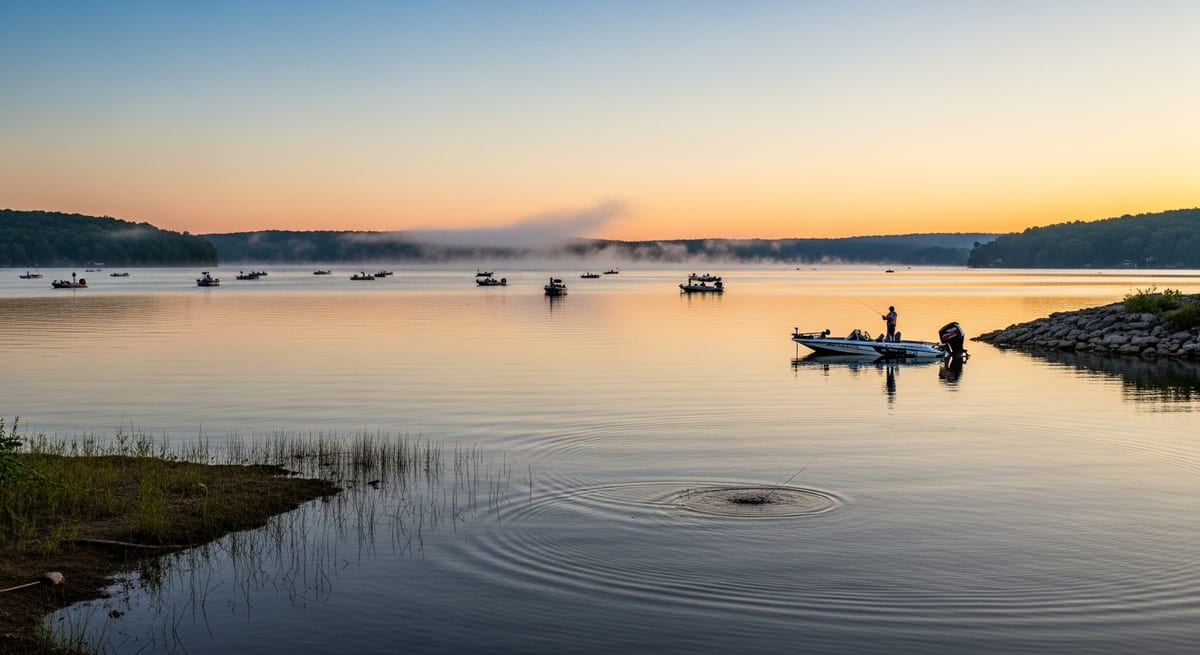
Anglers who enter their first club tournament on Candlewood or Bantam typically report the same surprise: the weigh-in procedure is the most organized part of the day, and the field at most club events includes regulars who have been fishing the same coves and ledge drops for a decade. The Connecticut BASS Federation Nation and the local club circuits operating across CT's major impoundments follow a consistent format, single-day events running 7-8 hours on most full-size waters, five-fish limit weighed alive, standardized weigh-in procedures that the regulars know cold. The learning curve, according to experienced club-circuit competitors, has almost nothing to do with tournament procedure. It comes down to livewell management in August heat and the discipline to fish known spots rather than running unfamiliar water.
How Club Events Run on CT Impoundments
The standard club format is a one-day event where anglers fish independently or as two-person teams in a co-angler draw. On CT's larger waters, candlewood, Bantam, Lillinonah, events typically run 7-8 hours. Smaller impoundments or evening club formats may run 4-5 hours; the event listing specifies. All participants return to a central launch for a live weigh-in. The scoring limit is five bass weighed alive, dead fish carry a penalty deduction (typically 4 oz per dead fish on most CT club circuits, though verify with the specific event). Big bass side pot: Most club events award a separate prize for the single heaviest bass of the day. On a field of 8-12 boats, this secondary award is genuinely accessible regardless of overall standing. Anglers fishing known big-fish structure on Candlewood's standing timber or Bantam's grass lines have taken the big bass award while finishing mid-pack overall. Co-angler format: Many CT club events accept non-boater entries at a reduced fee alongside the boater division. You draw a boater partner at check-in, fish from their vessel, and weigh your own five-fish limit separately. This is the standard entry point for anglers without a tournament-rigged bass boat.
The CT Tournament Calendar: CT BASS Federation Nation, Club Circuits, and Open Events
The Connecticut BASS Federation Nation (CT BASS), affiliated with the national B.A.S.S. organization, runs a competitive season on multiple CT lakes and hosts qualifiers for the BASS Nation Championship. Events are open to paid members; the current schedule and membership information are posted at the CT BASS website. Local club circuits: Club-level tournaments operate from April through October across Candlewood, Bantam, Lillinonah, Highland, Waramaug, and dozens of smaller CT impoundments. Many clubs welcome non-member entries on a day-of or pre-registered basis. Entry fees at club events typically run $20-$60 per boat; regional Federation Nation events run higher and vary by format. Finding events: BassFishin.com and the iBass360 app list CT-area tournament dates and host waters updated through the season. Local tackle shops, including Rays Bait and Tackle in New Milford, close to the Candlewood circuit, post flyers for lake-specific club events. Registration: Most club events require pre-registration by the week before the event. Confirming in advance also gives you the format specifics, the tournament's minimum size (which may differ from state minimums on waters with special regulations), and the exact launch location.
Livewell Management in CT Summer Heat
Keeping fish alive through a full day in August is both a competitive requirement and a responsibility under CT DEEP's catch-and-release expectations for tournament-held fish. Candlewood's surface temperature regularly exceeds 80°F in July and August; livewell water pulled directly from that surface layer stresses bass within an hour. Temperature control: Adding bags of ice gradually through the day, not dumped all at once, is standard practice among experienced Candlewood and Bantam tournament competitors. Club regulars target livewell water below 70°F. This is difficult but achievable on the hottest days with consistent management. Aeration: Run the aerator continuously during any period the boat is stationary or idling. A sealed livewell depletes available oxygen faster than most anglers expect under summer conditions. Additives: Tournament-grade livewell formulas (T-H Marine G-Juice, Atlas Mike's Catch & Release) are commonly used on the CT club circuit during summer events, not required by most club rules, but standard practice on hot days. Monitoring: Opening the livewell every 30-45 minutes to check fish condition is a habit among CT club regulars. A fish floating nose-up needs immediate action, add ice, increase aeration, and if the fish is near death, present it at the weigh-in immediately rather than waiting for the scheduled window.
What Club-Circuit Competitors Report About Pre-Practice and Strategy
The pattern that experienced CT club anglers consistently describe when recounting how first-tournament competitors fall short is the same across nearly every account: trying to cover too much water. On a lake like Candlewood: 8.4 miles long with standing timber, ledge drops, coves, and points. An angler without pre-practice will almost always finish below competitors who know three or four productive spots cold. Pre-practice separates the field. Anglers who regularly place on the Candlewood and Bantam circuits describe fishing the tournament water 2-3 times in the week or two before the event, marking exact waypoints, and establishing a stop rotation. On tournament day, the goal is to execute that rotation, not to explore. Build the bag first, cull up second. Getting five legal fish in the livewell early, even smaller fish, and then culling (swapping smaller fish for larger ones as the day progresses) is the approach club regulars recommend for first events. Waiting for a five-fish bag of quality fish while the clock runs is the most common first-tournament error. Structure knowledge outperforms broad-pattern fishing on CT impoundments. The fish in Candlewood's ledges and Bantam's eastern grass flats have encountered most major lure categories across a full season. Anglers who know the exact depth a ledge breaks, which side of a point produces in southeast wind, or which cove mouth holds shad in August carry a consistent edge over anglers running unfamiliar patterns.
CT DEEP Regulations, Tournament Minimum Sizes, and Weigh-In Protocol
State regulations apply inside tournament rules. Competing in a club or Federation event does not supersede CT DEEP bass regulations. The statewide largemouth minimum is 12" on most CT waters; some waters carry special regulations with higher minimums or slot restrictions. The statewide smallmouth minimum is also 12" on most CT impoundments. Confirm the rules for your tournament's specific host water in the current CT DEEP Freshwater Fishing Regulations Guide before the event, tournament rules set the competitive floor, state law controls. Measuring at the boat: Bump boards (measuring boards) are standard equipment for club anglers. Measure every fish at the boat before it goes in the livewell. A fish that measures 11¾" is a releasable fish regardless of how substantial it feels, presenting undersized fish at the weigh-in carries penalty weight under most CT club formats and draws attention in a small community. Weigh-in procedure: Fish are transferred to aerated weigh-in bags for the final approach to the ramp. Weigh-in bags are smaller than livewells, so ice management becomes more critical in the last 30 minutes. Most CT club weigh-ins take 20-30 minutes for a full field and run in queued order called by the tournament director. Polygraph testing: Some competitive Federation Nation events conduct polygraph tests on top finishers. This is disclosed in advance on the registration documents. The CT club fishing community is small enough that an angler's reputation carries across multiple circuits and several seasons. Etiquette on the water: If you arrive at a planned spot and another competitor is already fishing it, find another location. Idling through a competitor's cast or anchoring tight to an occupied point is noticed and remembered.
EVERY SATURDAY MORNING
Weekly fishing intelligence
Nationwide conditions, what's biting, and honest gear deals. One email, no noise.
No spam. Unsubscribe anytime.