
Wild Brook Trout in Connecticut Hold to a Short List of Heritage Streams. Salmon Creek, Blackberry River, Eightmile River, and What CT DEEP 2025-2026 Freshwater Regulations, Temperature Survey Data, and Northwest CT Stream Anglers Report About Finding Native Brookies in Small Headwaters.
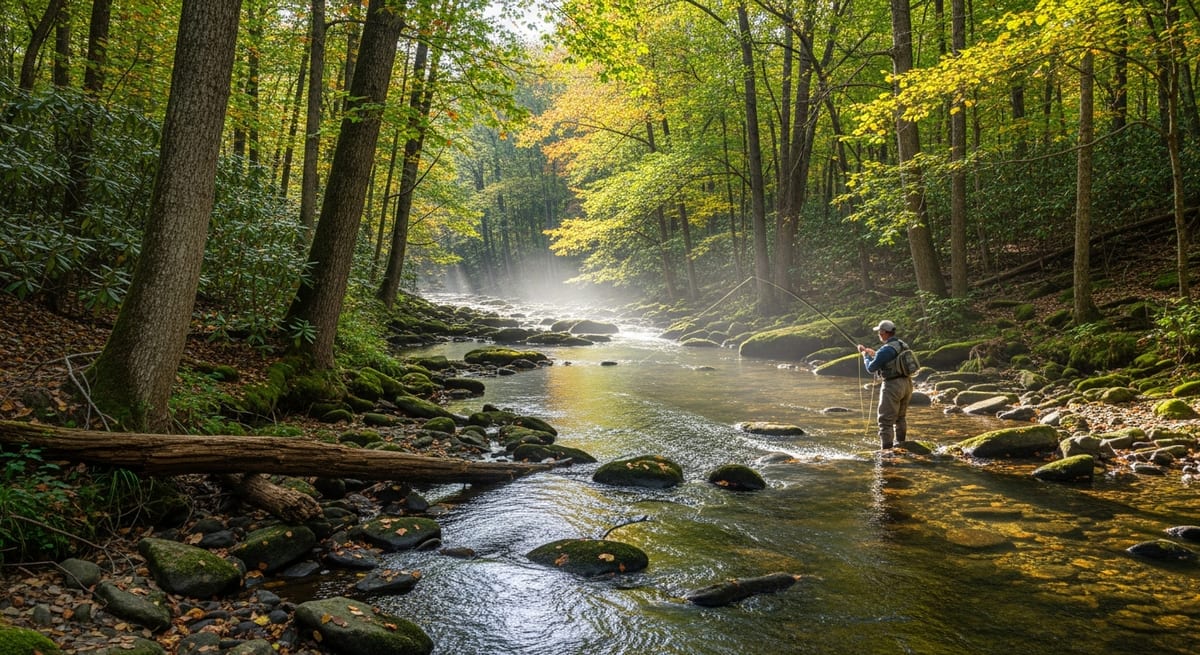
CT DEEP designates a short list of Heritage Trout Waterways in the 2025-2026 Freshwater Fishing Regulations: streams where wild brook trout populations are self-sustaining and warrant stricter harvest rules than standard trout waters. Salmon Creek (Salisbury), Blackberry River (Norfolk to North Canaan corridor), and Eightmile River (East Haddam and Lyme) are among the named designations. The statewide brook trout minimum is 8 inches with a 5-fish daily bag limit; Heritage Waterways carry additional restrictions listed by stream name in the regulations guide. Brook trout are Connecticut's only native trout species, per CT DEEP species documentation. Anglers who fish these streams consistently report that their presence is inseparable from water quality: a wild brookie holding in a CT headwater signals a stream running cold, clean, and well-oxygenated year-round. Northwest CT stream anglers describe meaningful wild populations beyond the Heritage list, in unnamed tributaries of the Natchaug drainage, Mad River feeders in the Litchfield Hills, and headwater corridors inside Pachaug State Forest.
Salmon Creek, Blackberry River, Eightmile River: What CT DEEP's Heritage Waterway List Actually Covers
CT DEEP publishes the Heritage Trout Waterway list in the annual Freshwater Fishing Regulations guide, available as a free PDF on the DEEP website. The 2025-2026 edition names Salmon Creek (Salisbury/Sharon drainage), Blackberry River (Norfolk to North Canaan), and Eightmile River (East Haddam and Lyme) as waters with established self-sustaining wild trout populations and special harvest rules. The full list changes as population surveys update; consult the current regulations before treating any stream as a Heritage designation.
Beyond the named Heritage waters, Northwest CT stream anglers report consistent wild brookie encounters in streams carrying no special designation, because DEEP doesn't stock them and they don't appear on any stocking report. Bigelow Brook (Eastford/Pomfret, within Natchaug State Forest), the upper Natchaug River headwaters, and several unnamed Pachaug tributaries in the Voluntown area all hold documented wild populations per DEEP fisheries survey data. These streams are found through legwork: topo map study (small perennial-stream lines originating in forested, north-facing drainages), then confirming public access via state forest boundaries or water authority permit maps.
MDC and SCCRWA water company land: Metropolitan District Commission (Hartford-area watershed) and South Central Connecticut Regional Water Authority (New Haven-area watershed) both open forested land to licensed anglers with free annual permits. Both authorities publish permit applications and access maps on their websites. Anglers who fish these tracts report consistent wild brook trout encounters in streams that receive no stocking pressure, particularly in north-facing headwater corridors where canopy is dense and stream temperatures hold below 65°F through summer.
Quiet Corner drainages: Windham and Tolland County headwaters hold strong wild populations, particularly in streams flowing through Natchaug and Mohegan State Forests. CT DEEP fisheries survey data documents wild brookie presence in multiple drainages across both forest units. Access is free on state forest land; trail and stream maps are available through the DEEP website.
2025-2026 CT DEEP Regulations: Heritage Waterway Rules and What They Change on the Ground
The statewide 2025-2026 CT DEEP Freshwater Fishing Regulations set brook trout at an 8-inch minimum size with a 5-fish daily bag limit. Heritage Trout Waterways carry additional restrictions beyond that baseline: some sections are catch-and-release only for portions of the season, some restrict terminal tackle to artificial lures only, and some carry modified season dates to protect spring spawning. The regulations guide lists each Heritage Waterway by name with its specific rules; the statewide numbers are a floor, not the full picture on designated streams.
The tackle restriction matters practically. Several of the most productive wild brookie streams in Connecticut are artificial-lure-only for all or part of the season. Fishing worm-and-split-shot on Salmon Creek or Blackberry River during a restricted period is a regulations violation, even though natural bait is legal on most stocked trout waters. Verify the specific rules for each stream in the 2025-2026 regulations before selecting terminal tackle.
On the question of keeping fish, the consensus among CT headwater trout anglers runs strongly toward releasing wild brook trout regardless of what the regulations permit. Wild CT brookies typically measure 5-9 inches in small headwater streams, and anglers discussing the fishery on CT freshwater forums broadly describe catch-and-release on wild fish as a baseline practice, not a regulation.
Size in context: A 9-inch wild brook trout in a small CT headwater is a large fish for that environment. These are not stocked fish that grew to size on hatchery pellets; wild fish this size represent multiple seasons of survival in a resource-limited stream. The angling community treats them accordingly, and the Heritage Waterway regulations reflect the same logic.
Reading Small CT Headwaters: What Experienced Stream Anglers Do Differently
Stream anglers who regularly fish CT's small wild-trout waters describe a consistent set of observations separating productive from unproductive approaches. The near-universal finding: wild brookies in small headwaters hold in predictable spots, and knowing those spots matters more than lure selection or presentation refinement.
Pool anatomy in CT headwaters: The deepest section just below where current enters a pool is where water oxygenates and brookies station to feed. Undercut banks beneath overhanging roots or eroded soil matter more than mid-channel rocks on most CT streams, where bank vegetation provides the primary overhead cover. Anglers who fish Blackledge River and Jeremy River tributaries note that undercut-bank fish respond better to a float presentation drifted upstream from below than to a cast that disturbs the canopy overhead.
Upstream approach, downstream cast: Moving upstream and presenting ahead into pools is near-universal practice among experienced CT stream anglers. Brook trout face into current; approaching from downstream keeps the angler in their blind spot. In late August and early September low-flow conditions, common on CT headwaters, anglers report needing to approach through the stream corridor with shadows kept entirely off the water before making a presentation.
One pool, multiple fish: A productive headwater pool often holds 3-5 fish. CT stream anglers consistently report that after catching one fish, waiting 5-10 minutes before re-presenting produces additional fish from the same pool. Disturbing the pool temporarily scatters fish; they settle back into feeding lies if given time.
Water temperature window: Wild CT brook trout feed actively in the 50-65°F range. CT DEEP trout habitat guidance sets the sustained upper thermal limit at 68°F; above that, dissolved oxygen drops and feeding activity declines with it. Anglers targeting late-summer brookies on CT headwaters report that morning sessions, before stream temperatures climb from overnight lows, outproduce afternoon attempts by a wide margin on most years.
Gear Scaled to CT Brush: What Small-Stream Anglers Actually Carry
Small headwater fishing in Connecticut is a gear-reduction problem. Litchfield County stream anglers describe typical approaches to productive pools as 10- to 20-minute bushwhacks through second-growth alder and silky dogwood. Casting space is measured in feet, not yards, and standard trout rod lengths create real problems under full canopy.
Rod: A 5- to 5'6" ultralight spinning rod handles the underhand and sidearm casts required in tight corridors. Anglers fishing the Blackberry River corridor and Salmon Creek tributaries frequently cite 5'6" ultralights as the practical ceiling; anything over 6 feet creates problems under closed canopy. For fly anglers, a 7-foot 2-weight or 3-weight works on pools with backcast clearance. Dedicated small-stream fly anglers in CT describe tenkara setups (typically 11-13 feet of fixed line, no casting stroke required) as particularly well-suited to low-overhead conditions, since presentation can be made vertically through canopy gaps rather than with a backcast.
Line: 2-4 lb fluorocarbon or monofilament for spinning. Clear fluorocarbon in 3-4 lb is the near-consensus recommendation from CT small-stream anglers for the clear, low-flow conditions common in summer and early fall. Anglers note that the visibility difference between standard monofilament and fluorocarbon is pronounced in gin-clear headwater pools.
Lures: Mepps #0 and #1 inline spinners and Panther Martin #2 are the most consistently mentioned lures in CT small-stream trout discussions. Micro jigs (1/64-1/32 oz) tipped with a small plastic or wax worm also produce well. Natural bait is effective but prohibited on Heritage Waterway artificial-only sections; verify the current regulations for each specific stream before rigging with bait.
Hook handling: Size 10-14 single hooks for bait presentations. Pinching barbs or fishing barbless is standard practice among CT brookie anglers, both as a conservation measure and a practical one: brookies swallow hooks quickly on hesitant takes, and barbless allows hook removal without lifting the fish from the water.
Brook Trout as a Water Quality Signal: What CT DEEP Data and Trout Unlimited Stream Work Show
Brook trout (Salvelinus fontinalis) are char, not true trout. The distinction is taxonomic, but it carries practical meaning: they are among the most temperature-sensitive salmonids in the Northeast. CT DEEP trout habitat guidance sets the sustained upper thermal limit at 68°F; above that, dissolved oxygen drops below the threshold brookies require and populations decline or disappear from affected reaches.
Connecticut's wild brook trout distribution contracted significantly through the mid-20th century as agricultural runoff, logging, and development altered drainage patterns and removed the canopy cover that keeps small streams cold. The Northwest Highlands and Quiet Corner populations that remain are concentrated in drainages where forested cover has recovered. Trout Unlimited's Connecticut chapters, including the Farmington River Watershed Association and Northwest CT TU, have documented temperature recovery in several headwaters following riparian buffer restoration projects; their stream survey data are publicly accessible through DEEP's inland fisheries research reports.
DEEP and TU stream improvement work: DEEP's fisheries division and CT TU chapters have conducted cold-water habitat surveys and in-stream improvement projects on Heritage Waterways and adjacent tributaries. These surveys produced population estimates and temperature profiles; the data confirm wild brookie presence in dozens of streams beyond the Heritage Waterway list. DEEP publishes summary reports through its fisheries research series.
Reporting habitat issues: CT DEEP's Environmental Conservation Police and Inland Fisheries division both accept reports of sedimentation, thermal pollution, and riparian disturbance in cold-water drainages. Wild brook trout function as an early-warning indicator for watershed health; their disappearance from a historically occupied stream is a documented water quality signal. DEEP's online reporting form is the recommended channel.
Handling: Wet hands before contact, minimize air exposure, and return fish at the waterline. The slime coat is the fish's primary barrier against fungal and bacterial infection; dry hands strip it in seconds. The standard among CT brookie anglers: photos taken with the fish just above the waterline, not lifted into the air, and back in the water within seconds of the shot.
EVERY SATURDAY MORNING
Weekly fishing intelligence
Nationwide conditions, what's biting, and honest gear deals. One email, no noise.
No spam. Unsubscribe anytime.