
CT Fly Anglers at Riverton, the Route 44 Pools, and the Hogback Tailwater Corridor Report Wild Browns on Dam-Timed Flows Year-Round. What DEEP 2025-2026 Freshwater Regulations, Wild Trout Survey Records, and Farmington River TMA Regulars Reveal About Matching Hatches on Connecticut's Cold-Water Tailwater
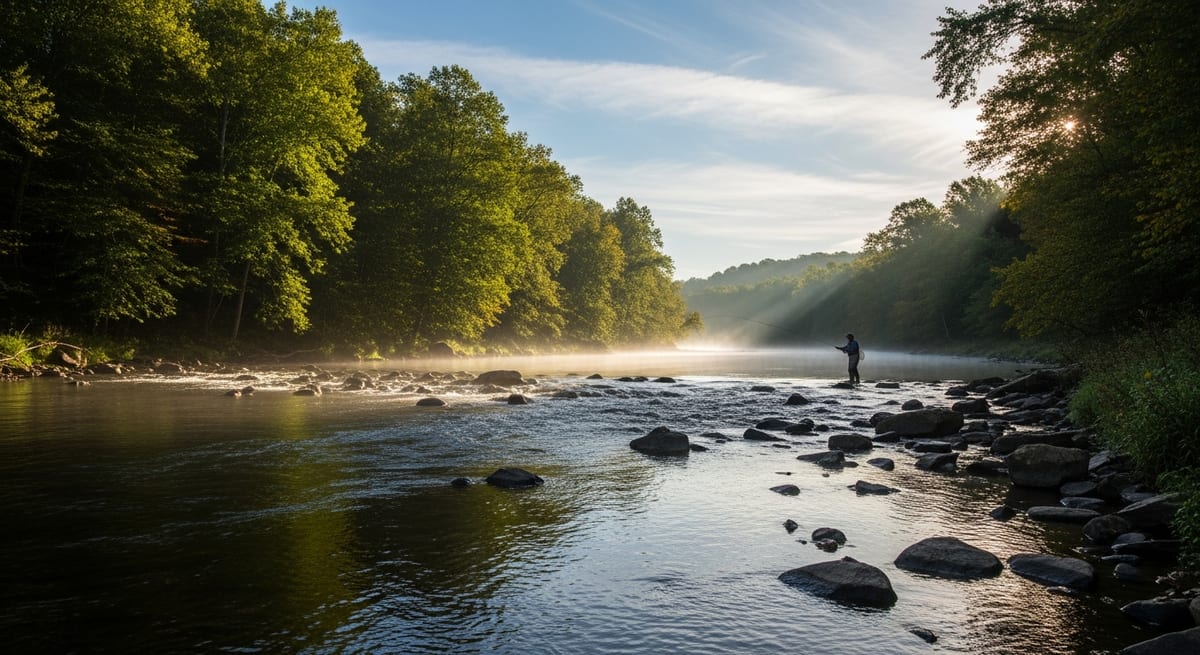
Flows on the Farmington River TMA stay cold enough for year-round trout fishing because Hogback Mountain Dam, located in Barkhamsted, draws from the reservoir's thermocline: a hydrological condition that keeps water temperatures fishable even in July, when most Connecticut rivers have warmed past trout tolerance. That dam-controlled consistency is documented in DEEP wild trout surveys, which record self-sustaining brown trout populations in the catch-and-release corridor stretching from the dam base through the Riverton and New Hartford access corridor along Route 44. Anglers who fish the TMA regularly report wild brown trout. Fish born and raised in the river, not hatchery-stocked, running through a typical catch-and-release size range, with community reports from Farmington River Watershed Association angler logs and Northeast CT fly fishing forums documenting occasional fish exceeding 20 inches. The wild status of the population is what distinguishes the Farmington TMA from most New England trout water; the hatch cycle, the technical presentations those fish require, and the year-round catch-and-release designation under DEEP 2025-2026 Freshwater Regulations compound that distinction. This guide covers the TMA specifically: the artificial-lures-and-flies-only, catch-and-release section that CT fly fishing regulars treat as a benchmark river for matching hatches and reading technical tailwater.
Dam Flows, USGS Gauge Data, and the DEEP 2025-2026 Regulations That Define the TMA Corridor
The Trout Management Area on the Farmington runs approximately 2 miles from the base of Hogback Mountain Dam in Barkhamsted downstream through the New Hartford and Riverton corridor, accessible primarily along Route 44.
DEEP 2025-2026 Freshwater Regulations designate the TMA as catch-and-release, artificial lures and flies only, year-round. The boundary is marked, but anglers are responsible for knowing exactly where it ends. Downstream from the TMA boundary, standard stocked-trout regulations apply. The line matters, and it is the angler's obligation to know it.
Pre-trip flow checks are standard practice among Farmington regulars. Hogback Mountain Dam controls all releases, making USGS gauge 01186000 a non-optional first stop before any TMA trip. Flows in the 100-200 CFS range represent the most productive wading window per community reports: enough water to distribute fish through holding lanes without current velocity that compromises precise presentation. Above 400 CFS, wading becomes dangerous and technical fly fishing is largely unworkable; experienced TMA anglers report using high-water windows for bank-side streamer work rather than wading.
Named access areas along Route 44 include the Riverton pools near the dam, Route 44 pullouts through the upper TMA corridor, and the Pool Road area near New Hartford Center. State fishing easements and water company land grants wading access throughout the TMA corridor. Access roads and pullouts can fill on spring weekends during major hatches.
Catch-and-release TMA fishing is open year-round; the hatch cycle and daily water temperature determine which techniques produce in any given season.
The Farmington Hatch Calendar: What CT Fly Anglers Track From April Hendricksons Through October Caddis
The Farmington TMA's documented hatch sequence is the primary reason CT fly anglers return to it year after year. Matching what fish are actively feeding on is the technical challenge that separates productive days from blank ones, and the Farmington's calendar is specific enough to plan around.
Spring (April-May): Blue-winged olive (BWO) hatches begin in April during cool, overcast afternoons when light levels drop. The Hendrickson hatch (Ephemerella subvaria) is the marquee spring event. Farmington regulars broadly document it running mid-April through late May, typically 1-4 PM, with the densest surface activity concentrated in the first two weeks of May. March Browns overlap into late May.
Late spring and early summer (June): Sulphur hatches come on in late May and June. Lighter Cahill and caddis hatches run concurrently. CT fly fishing reports from June consistently note that the evening hour before dark often produces more surface feeding than the full afternoon.
Summer (July-August): Terrestrial season. Ants, beetles, and hoppers on the surface produce from July into September. Community reports from Farmington TMA regulars note that undercut bank presentations with ant patterns during low, clear summer flows frequently outperform hatch-matching approaches when no hatch is active. Trico spinner falls can generate intense morning surface feeding on calm days. Caddis continue through summer evenings.
Fall (September-October): October caddis (Psilotreta frontalis) is the fall signature. These large, orange-bodied caddis bring wild browns to the surface through October. BWOs resume as temperatures drop. Farmington River Watershed Association angler logs and CT fly fishing community reports flag October as a consistently productive month for targeting larger wild fish, which feed heavily before winter cooling reduces metabolic demand.
Winter (November-March): Midge hatches occur on mild days above 40 degrees F. Nymphing and streamer techniques are the primary approach through the cold months. Wild brown trout remain catchable in the TMA's temperature-stabilized flows through winter, though daily feeding windows are often shorter.
Nymphs First, Then Dry Flies: The Pattern Hierarchy CT Regulars Follow on the Farmington TMA
CT fly fishing regulars who fish the Farmington TMA consistently report that a tighter pattern set outperforms a comprehensive assortment. The hatch selectivity of wild, pressured fish rewards anglers who carry a focused box matched to the hatch calendar.
Dry flies:
- Parachute Adams (sizes 14-18): Universal mayfly imitation when specific-hatch patterns aren't producing
- Hendrickson dry (size 12-14): Non-negotiable for the April-May hatch window
- Parachute Sulphur (size 16-18): June through September evening sessions
- Elk Hair Caddis (size 14-16): The single most versatile dry fly on the Farmington across all seasons, per community consensus
- CDC Trico (size 20-24): Summer morning spinner falls; requires fine tippet and calm-water presentations
Nymphs (the majority of Farmington TMA fish are caught subsurface; experienced TMA anglers typically lead with nymph rigs and switch to dry flies only when a hatch develops):
- Hare's Ear nymph (sizes 12-18): Standard attractor, effective between hatches
- Pheasant Tail nymph (sizes 14-18): Slim-profile match for most Farmington mayfly nymphs
- Soft Hackle Wet (sizes 14-16): Swung through current to intercept fish rising just below the film
- Sowbug or Scud imitation (sizes 12-16): Matches crustaceans present in the cold-water releases below Hogback Mountain Dam
Streamers (for targeting larger browns at low light and through fall):
- Woolly Bugger in olive or black (sizes 6-10): Year-round utility streamer
- White or chartreuse Clouser Minnow: Fast-water strip retrieve through the heads of pools
- Muddler Minnow: Classic fall Farmington pattern; CT fly anglers associate it specifically with the October caddis period on this river
Where TMA Browns Hold: Seams, Undercut Banks, and the Riffles Most Anglers Wade Past
Wild Farmington TMA brown trout have been exposed to sustained angling pressure across multiple seasons. DEEP wild trout survey data and consistent community observation agree that fish in heavily-pressured tailwaters develop holding positions that differ meaningfully from stocked fish. Learning those positions is the foundation of productive TMA days.
The seams: Where fast current meets slow water is the primary feeding station. Fish hold on the slow side, using the seam edge to intercept drifting food without maintaining position in full current velocity. CT fly anglers who fish the Farmington TMA consistently report that presentations landing precisely on the seam boundary outperform those that drift through flat slow water or race unchecked through the fast side.
Head-of-pool transitions: Where riffles run into deeper pools and decelerate, fish stack to intercept nymphs and emergers. The turbulent transition zone just above where current slows is productive through most of the day, particularly in the upper Route 44 corridor pools accessible from the Riverton and New Hartford sections.
Undercut banks: Wild brown trout on pressured tailwaters use undercut banks as cover through daylight hours, particularly in low, clear summer conditions when flows drop below 100 CFS. Farmington regulars frequently report using 12-14 foot leaders in summer to reach bank-edge fish with drag-free presentations. Fish holding under banks are often invisible until the take.
Shallow gravel riffles: Six to eighteen inches of fast, broken water holds actively feeding trout that most anglers wade through without targeting. Nymphing short drifts through riffles during BWO and Hendrickson periods is a technique Farmington TMA regulars cite as underutilized by visiting anglers unfamiliar with how wild trout use fast, shallow water.
Stream Etiquette and the Conservation Standards the Farmington TMA Angling Community Maintains
The Farmington TMA is one of the most-fished public trout streams in Connecticut. The angling community that regularly fishes it has developed etiquette standards that visiting anglers are expected to observe.
Give anglers space: Do not approach a pool another angler is actively working. The commonly cited courtesy distance among Farmington regulars is 50-100 feet minimum. Approaching within 30 feet of someone fishing a pool is considered poor form; crowding is the complaint most frequently raised in TMA angling community forums about behavior on the river.
Move upstream, not downstream: When done with a pool, exit and move upstream, or to a completely separate section. Walking through water upstream of a fishing angler disturbs holding fish and ruins presentations. Experienced Farmington anglers consistently cite this as the stream etiquette violation that generates the most friction in the TMA community.
Handle fish with care under DEEP 2025-2026 catch-and-release requirements: Each wild brown in the TMA represents multiple years of river survival and documented wild trout population value per DEEP survey records. Wet hands, in-water handling, minimum air exposure, and full revival before release are the standards the Farmington angling community maintains. Fish held out of water beyond a few seconds show measurably higher post-release stress in published trout handling research.
Leave no trace: Pack out all waste. Do not cut bankside vegetation or move rocks to create artificial holding pools. The TMA's habitat integrity, specifically cold oxygenated riffles, stable banks, and clear gravel spawning beds, sustains the wild trout population. The anglers who fish the Farmington regularly are among its most active stewards.
EVERY SATURDAY MORNING
Weekly fishing intelligence
Nationwide conditions, what's biting, and honest gear deals. One email, no noise.
No spam. Unsubscribe anytime.