
CT Trout Regulars on the Farmington, Housatonic, and Willimantic Report That Seams and Riffle Tails Hold Active Fish After Stocked Trout Redistribute Out of Main Pools Within the First Week. What DEEP Stocking Records, TMA Boundary Maps, and CT Fly Fishing Communities Reveal About Reading Moving Water
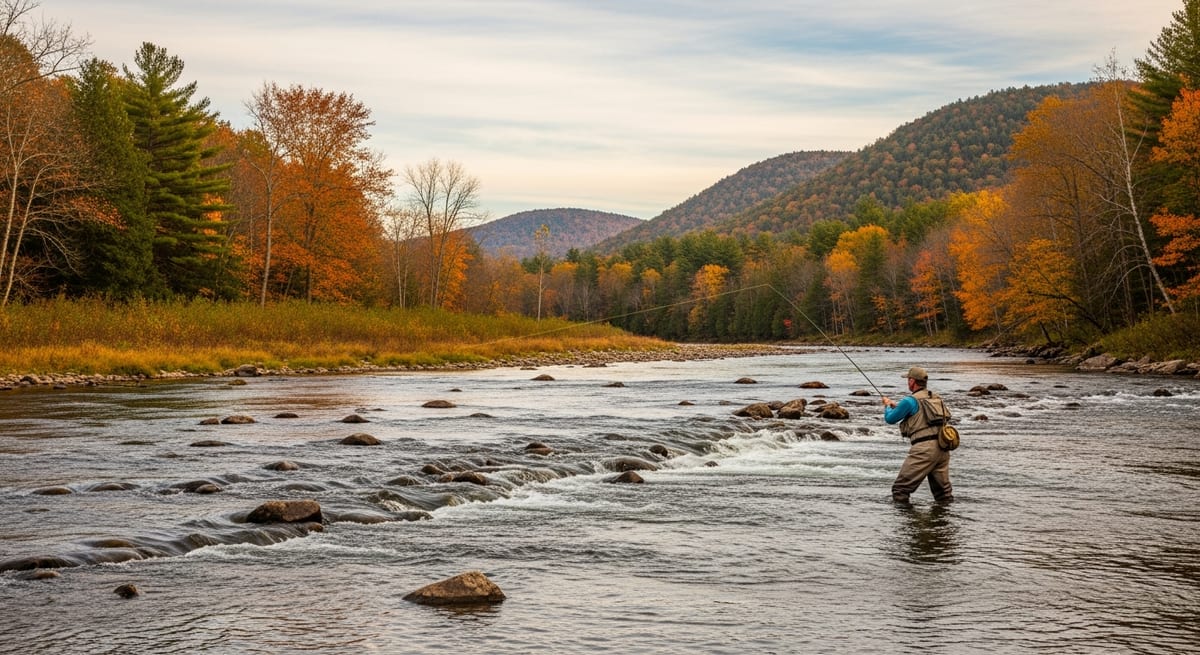
Anglers who fish the Farmington TMA during spring stocking weeks report a consistent pattern: the same pool that concentrates a dozen trout on a Tuesday morning can go quiet by Thursday, not because the fish left, but because they redistributed into current seams and undercut banks that most rods never target. CT trout communities and public DEEP stocking reach data point to the same conclusion: learning to read current structure changes results far more than covering additional water.
Why CT Trout Hold Where They Do on the Farmington and Housatonic
Anglers who fish the Farmington regularly note that trout positioning in moving water follows a consistent logic: fish need food delivered by current, enough protection from that current to conserve energy, and some form of depth or overhead cover against predators. These three conditions rarely occupy the same spot, and reading water is the exercise of finding where they converge.
On the Farmington, community reports from the stretch below the Still River confluence describe fish concentrating where faster water carrying insect drift slows at the edge of a gravel bar, creating a lane where trout can hold without fighting full current. Anglers at Housatonic Meadows in Sharon report similar patterns at the downstream ends of pools, where depth provides cover and current still delivers food.
DEEP stocking maps show fish planted in accessible, easy-wading pools, but experienced anglers on CT fly fishing forums note that stocked trout redistribute quickly, often within 48-72 hours of a stocking run, into current seams and structural lies that wild and holdover fish have always favored. The fish visible in a pool on opening weekend are often not the same fish in that pool a week later.
Riffles, Runs, and Pools: How the Farmington and Willimantic Break Down
The three primary water types appear on every CT trout river, but their productivity varies by season, temperature, and river character.
Riffles (shallow, turbulent water over rocky substrate) are oxygen-rich and food-producing zones on rivers like the upper Farmington and Willimantic. The broken surface provides overhead cover even at depths of 10-12 inches. Nymph anglers on the Farmington report riffles as consistent producers when Hendrickson or Blue-Winged Olive hatches are active in April and May, with small trout and holdovers concentrating here during active emergence.
Runs (deeper, steadier current between riffles and pools) are what Farmington River Anglers Association members often describe as the workhorse water: reliable depth, moderate current, consistent food delivery. Brown trout, which make up a meaningful share of holdover fish in CT TMA stretches, often favor runs over slick pool bottoms during non-hatch periods.
Pools hold fish during thermal stress, post-frontal pressure, and the middle of bright days. On the Farmington and Housatonic, the deep pools near TMA boundary markers tend to concentrate fish that have redistributed from higher-pressure access points. CT regulars report that working the heads and seamed edges of these pools, rather than the still center, produces more consistent results, a pattern noted in Farmington River Anglers Association trip reports from recent seasons.
Current Seams, Undercut Banks, and Boulder Pockets on CT Rivers
Within any water type, trout concentrate at specific structural features. CT regulars consistently identify the following:
Seams, the boundary between fast and slow water, are among the most reliable structures on the Farmington below Collinsville and the upper Housatonic. Trout hold in the slower water and intercept food crossing the seam. The strike zone typically runs within 12-18 inches of the seam itself; casts landing well into slack water or fast current often produce fewer takes.
Boulder pockets: the slower cushion immediately in front of large boulders and the eddy immediately behind. Both faces produce fish. Anglers on the Housatonic above Covered Bridge note that boulder pockets are among the most consistent early-season producers, particularly for holdover brown trout that settle into specific structures and remain there across multiple seasons.
Undercut banks: where current has eroded the bank beneath a sod or root mat, creating overhead protection. CT regulars report that the most significant holdover fish on the upper Farmington often come from undercut bank lies on outside bends where current has been cutting for years. Approach from upstream to avoid casting shadow over the undercut.
Woody debris: log jams and fallen trees create ambush points. The upstream edge of any significant wood structure is where trout typically hold, facing current. On smaller CT streams like the Salmon Creek, the West Branch Salmon River, and the Eight Mile River, woody debris is often the dominant holding feature in stretches without significant boulder structure.
Water Temperature and Holding Position: What Changes Below 50°F and Above 65°F
Anglers who carry a stream thermometer on CT rivers report meaningfully better session outcomes than those fishing by calendar alone. Temperature shifts trout holding position in ways that are not always predictable by date.
Below 50°F: trout metabolism slows. Fish concentrate in the slowest water that still delivers food, including pool heads with some current entering and deep eddies behind major boulders. Farmington regulars describe mid-winter fishing from December through early March as often concentrating action in a narrow band of slow runs and pool tails, with fish holding almost stationary. The DEEP 2025-2026 guide does not schedule stocking runs during this window for most rivers.
50-65°F: the prime feeding window on most CT rivers, and the condition the Farmington and Housatonic typically reach between April and early June. Trout can hold nearly anywhere food is present, including riffle tails, seams, and edges of runs. Community reports from Farmington regulars during the Hendrickson hatch window, which typically aligns with water in this range, describe fish rising in water types that go quiet outside it.
Above 65°F: anglers who fish the Farmington through July and August report trout concentrating near cold-water inputs, including spring seeps, small tributaries, and riffled sections with higher dissolved oxygen. The DEEP 2025-2026 fishing guide advises minimizing handling when water temperatures exceed 68°F, noting reduced survival rates for released fish under thermal stress. Dawn sessions in faster, more oxygenated water are standard practice among CT anglers who fish the river through summer.
After heavy rain: turbidity pushes trout to the margins. CT regulars report productive strips often running within 6-10 feet of the bank in 12-18 inches of water during high flows, water that looks unproductive under normal conditions.
Riffle Tails: Why CT Fly Fishers Work the Transition Zone on the Farmington
The tail of a riffle, where fast shallow water slows and deepens into the next pool, receives consistent attention from CT fly fishing communities for reasons that hold across multiple rivers and seasons. Food carried by riffle current concentrates as velocity drops, dissolved oxygen stays high, and the broken surface provides cover even where depth is only 12-18 inches.
Farmington River Anglers Association reports describe riffle tails as reliable producers during dry-fly conditions specifically. Trout in these zones are actively feeding and tend to respond to a well-placed comparadun or parachute Adams in ways that pool fish often will not. The catch-and-release TMA stretch through Burlington sees concentrated riffle-tail attention during Hendrickson and Sulphur hatch periods, typically late April through early June.
On the Willimantic and Salmon Creek, riffle tails tend to be shorter and narrower than on the Farmington, but the same principle applies: the transition zone concentrates feeding fish. For anglers building water-reading skills, CT community members on regional fly fishing forums suggest starting at identifiable riffle tails rather than larger pools. Approach from downstream, keep a low profile, and present the fly 3-4 feet ahead of where fast water begins to slow.
Reading the River Before the First Cast: What CT Regulars Notice First
Anglers who fish high-pressure water like the Farmington TMA report that 3-5 minutes of observation before the first cast consistently changes where they end up fishing. The impulse to wade in and start working a run is understandable, but CT regulars note it frequently bypasses visible fish in transition zones and feeding lanes.
Rising fish: surface rings or dimples indicate actively feeding trout. On glassy pool tails in late May, rising fish on the Farmington are often visible from 40-50 feet, and walking past them toward better-looking water is a commonly noted missed opportunity in community trip reports.
Feeding lanes: lines of surface foam and debris that converge in current. Current concentrates food in these lanes, and trout stack along or just below them. On the Housatonic through Housatonic Meadows, primary feeding lanes are predictable year to year and shift only modestly with water levels. Regulars report knowing their positions by name.
Visible fish: on clear-water stretches including the upper Farmington above Riverton and the lower Farmington through Collinsville on low summer days, trout are often visible on the bottom. A spotted fish is almost always catchable given a clean presentation; the risk is a poorly placed cast that spooks it before the fly arrives.
Baitfish activity: panicked emerald shiners, fallfish, or small dace signal predators below. CT regulars note this is a particularly reliable indicator for large brown trout on the Housatonic in fall, when browns become more aggressive as the spawning period approaches, a behavior noted in DEEP brown trout population survey observations from the lower Housatonic drainage.
EVERY SATURDAY MORNING
Weekly fishing intelligence
Nationwide conditions, what's biting, and honest gear deals. One email, no noise.
No spam. Unsubscribe anytime.