
Dropping Water Temps Trigger the Most Productive CT Freshwater Season. Most Anglers Miss It.
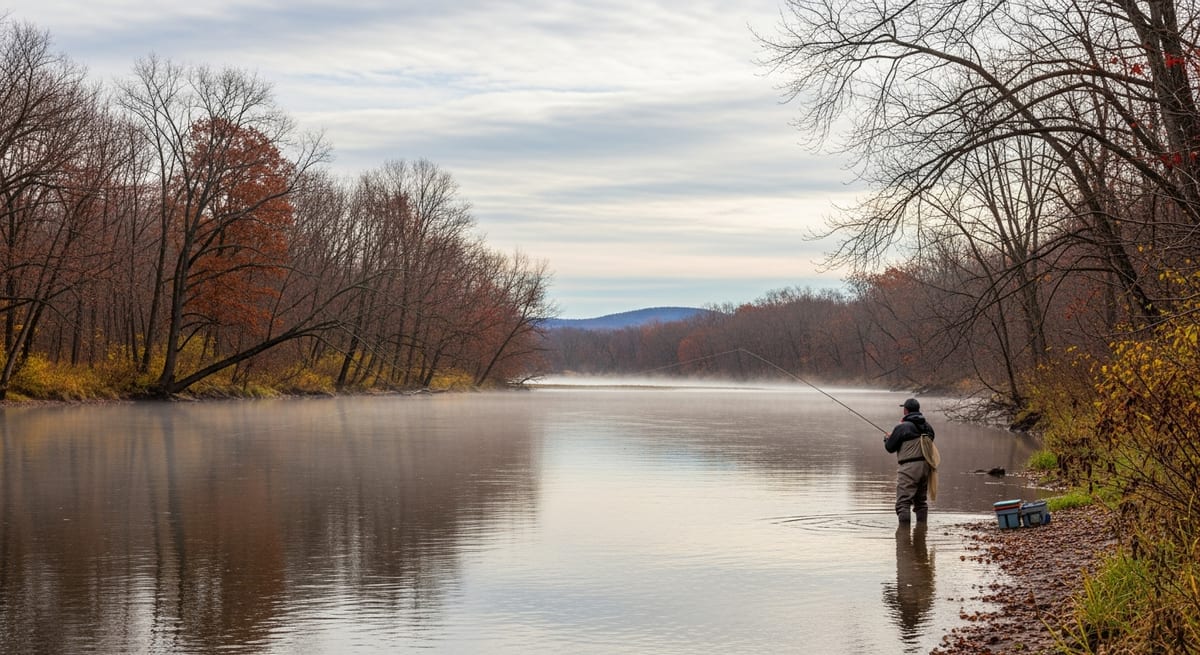
Anglers who fish CT's major lake systems through October consistently note the same pattern: catch rates that rival spring, with a fraction of the boat traffic. Observations from Connecticut fishing communities and regional guide reports put October among the lowest-pressure months on most public lakes, right when water temperatures have cooled enough to trigger broad, aggressive pre-winter feeding across multiple species. Water temperatures on CT lake systems typically ease from summer peaks, often in the mid-70s by late August, through the 60s in September and into the 50s by November. That cooling window activates largemouth and smallmouth bass, chain pickerel, northern pike, and both stocked and wild trout, often simultaneously, in conditions that favor the anglers still showing up. The crowds left after Labor Day. The fish don't follow the same schedule.
The Thermal Trigger: What's Behind the Fall Feeding Surge
The driver is thermal. As CT lake and river temperatures fall from summer peaks, fish that held deep or in slow current seams during warm months begin moving shallower, feeding more aggressively, and concentrating in predictable locations.
Baitfish concentrate first. Shad, perch, and shiners school up as temperatures drop, gathering near tributary inlets, bay mouths, and main lake points. Predators follow. CT fishing community reports from waters like the Salmon River corridor and Moodus Reservoir consistently describe diving birds, surface-feeding disturbances, and visible bait schools as reliable fall location indicators that hold season after season.
Structure that was unproductive in summer fills back in. Bass that pushed offshore during peak heat return to rock piles, wood cover, and shallow lake points as temperatures cool. Community-sourced reports from CT lake anglers describe fish moving back into the five-to-eight-foot zone by late September on waters that were largely empty at those depths in August.
Pressure drops at exactly the wrong time, for the fish. CT fishing forum reports and notes from regional guides consistently describe October as one of the quietest months on most CT public lakes. Less pressure means less-educated fish that are more willing to commit to a bait. The gap between peak feeding conditions and peak angling effort is the window that serious fall anglers are targeting.
Bass: From Aggressive September Chases to Methodical November Jigs
Fall bass fishing in Connecticut runs from late August through mid-November, but the character of the fishing changes meaningfully as temperatures drop.
When water is in the mid-to-low 60s: typically September through early October on most CT lakes. Bass are aggressive and wide-ranging. They're tracking baitfish along main lake points, weed-line transitions, and shallow structure. Moving presentations cover water efficiently and draw reaction strikes from fish that are actively feeding. CT anglers who fish Barkhamsted Reservoir and Lake Lillinonah during this window regularly report topwater and fast-moving bait action that outperforms anything they see during the summer months. Swimbaits, mid-running crankbaits, and spinnerbaits are the consistent producers.
As water drops into the low 60s and below: often by mid-October. Bass slow down and presentations need to follow. Jigs worked methodically along bottom structure, soft plastic craws on a Texas rig, and drop shots near visible cover outproduce faster-moving baits. The best action window of the day typically shifts to midday hours when temperatures are highest.
Key fall bass access points:
- Lake Lillinonah (Newtown/Bridgewater): CT DEEP boat launch off Route 133 in Bridgewater. Strong fall bass population on main lake points and coves connecting deeper basins.
- Salmon River Corridor (East Haddam/Colchester): Public pull-offs along Route 149 and Route 16. The Comstock Bridge area is a frequently cited community access point for fall smallmouth.
- Moodus Reservoir (East Haddam): Public launch off Johnsonville Road (Route 151). Bass and pickerel share the same weed-edge structure through October and into November.
CT DEEP regulations for bass: Largemouth and smallmouth bass carry a 12-inch minimum size limit statewide, with a 6-fish daily creel limit in most general regulation waters. Some designated trophy waters carry more restrictive rules. Verify the regulations for your specific water at portal.ct.gov/DEEP before you go.
Pickerel and Pike: Weed Edges, Wire Leaders, and Fall's Best Strikes
Fall is prime time for chain pickerel and northern pike in Connecticut. Both are ambush predators that feed more aggressively as water cools, and both will take larger presentations that might underperform in other seasons.
Chain pickerel are CT's most accessible esox species, present statewide in slow-moving rivers, shallow lakes, and vegetated ponds. Fall pickerel concentrate along weed edges that are dying back, using remaining green vegetation as ambush cover. Anglers fishing CT ponds and backwater sloughs through October report that pickerel are among the most predictably locatable fall fish in the state: find a healthy weed edge on a pond that has cooled down, and there are typically fish holding it.
Blade-style spinnerbaits, inline spinners, and four-to-six-inch swimbaits retrieved at medium speed produce explosive strikes. Use a 12-18 inch wire leader or 30 lb+ fluorocarbon, pickerel teeth cut through unprotected monofilament reliably.
Best CT pickerel access:
- Moodus Reservoir (East Haddam): Launch off Johnsonville Road off Route 151; northern shallows hold pickerel into late October.
- Salmon River corridor: Pull-offs along Route 149 between East Haddam and Colchester. Pickerel use slower backwater pools through October.
- Glastonbury area ponds: Several CT DEEP-managed ponds accessible in the Glastonbury/Hebron corridor, including Diamond Lake with DEEP access off Raymond Road. Weed-edge pickerel are common through mid-November.
Northern pike in Connecticut are localized and less abundant than pickerel. They appear in the Connecticut River and in select lakes that have received DEEP stocking, but pike distribution shifts with DEEP stocking decisions from year to year, and current availability varies. The CT DEEP fisheries stocking reports at portal.ct.gov/DEEP are the reliable current-season source for which waters are holding pike. Large six-to-nine-inch swimbaits, jointed pike lures, and bucktail spinners are the standard approach when pike are present.
CT DEEP regulations: Chain pickerel have no statewide minimum size limit in general regulation waters. Northern pike carry a 24-inch minimum size limit and a 2-fish daily creel limit statewide. Confirm current rules at portal.ct.gov/DEEP before targeting pike specifically.
Stocked and Wild Trout: Two Different Fall Fisheries Under One License
Connecticut's fall trout stocking program runs September through October on select rivers, ponds, and lake sections. The 2024 stocking schedule and real-time updates are published at portal.ct.gov/DEEP/Fishing/Freshwater/Stocking-Report. The only current-season source worth relying on for which waters are actually stocked and when.
Freshly stocked trout are active and relatively approachable the first week post-stocking. Small spinners (Panther Martin or Rooster Tail in sizes 0-2), egg-pattern flies, and PowerBait on a slip-sinker rig all produce in stocked sections. Fish typically hold near stocking sites for the first several days before dispersing along the waterway.
Wild and holdover trout on rivers like the Farmington and Salmon River are a different proposition entirely. October and into November is when large brown trout on CT's quality trout rivers become most active. A feeding surge that often precedes upstream spawning movement. The consensus among CT trout guides who regularly fish the Farmington River's catch-and-release section is that streamers produce the year's largest fish during fall low-light windows. Woolly Buggers, articulated patterns, and large soft hackles fished across-and-downstream are the standard fall approach on that water.
On fall hatches: Late September and October can produce blue-winged olive hatches on CT's better trout rivers. BWOs are small mayflies (Baetis spp.), not midges, and fall hatches tend to peak on overcast afternoons with light drizzle. Small caddis are also present on some CT rivers through October, though timing varies considerably by water and year. Reports from the Farmington River Watershed Association describe mid-to-late October as the most consistent window for fall dry-fly opportunities on the Farmington specifically.
Farmington River access: The Route 44 corridor between New Hartford and Collinsville provides multiple pull-offs and public access. The catch-and-release section between People's State Forest and Route 219 in Barkhamsted is designated fly fishing only and carries special size regulations, confirm current rules at portal.ct.gov/DEEP before your trip.
CT DEEP regulations for trout: General stocked trout waters carry a 9-inch minimum size limit and a 5-fish daily creel limit during open season. Special regulation waters like the Farmington's C&R section operate under different rules. Season closure dates vary by water, confirm open/closed status for your specific water at portal.ct.gov/DEEP before you go. A Connecticut fishing license is required for all anglers age 16 and older.
EVERY SATURDAY MORNING
Weekly fishing intelligence
Nationwide conditions, what's biting, and honest gear deals. One email, no noise.
No spam. Unsubscribe anytime.