
CT Estuarine Regulars on the Niantic River, Housatonic Mouth, and Lower Thames Report the Tidal Window Matters More Than Location Once You Learn the Current Breaks. What Shore Communities, ASMFC Weakfish Assessments, and DEEP 2025-2026 Marine Regulations Reveal About CT Tidal River Fishing
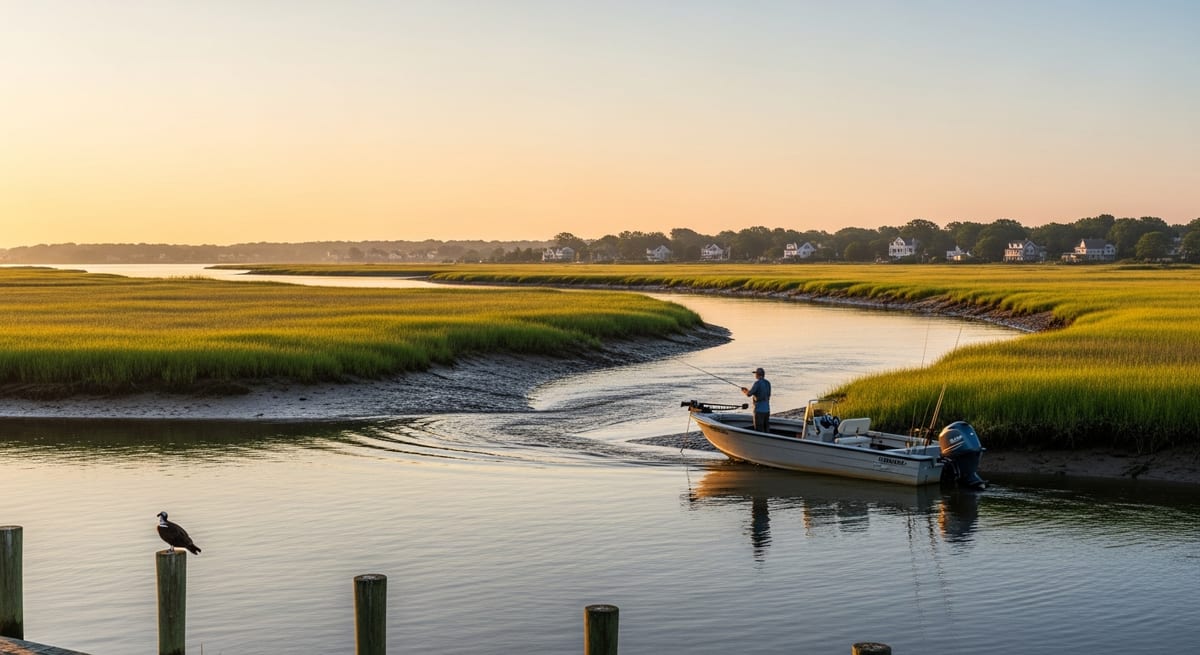
Anglers who fish the Niantic River's tidal section through June consistently report finding stripers two to three weeks earlier in the season than nearby open-Sound locations at the same latitude, and at lighter pressure. That seasonal edge is one reason estuarine regulars across Connecticut treat tidal river fishing as its own discipline, not a fallback for rough open-water days. CT's tidal estuaries (the mixing zones where freshwater rivers push into Long Island Sound) shelter juvenile baitfish, concentrate silversides and menhaden on tidal movements, and hold stripers, blues, fluke, and seasonally variable weakfish populations in accessible, shallower water than open-Sound drifting typically requires.
Why Tidal Rivers Hold Fish When the Open Sound Is Quiet
The consensus among anglers who fish CT tidal rivers regularly is that estuaries deliver a different concentration mechanism than open-Sound structure. The mixing zone where freshwater meets saltwater generates nutrient density that supports bait schools including silversides, menhaden fry, grass shrimp, and sand worms, at concentrations that estuarine regulars describe as more reliable than the open water.
For predators, the channel geometry matters as much as the food supply. Tidal rivers create natural funnel points: bridge pilings, tributary mouths, bend pools, and drainage ditches that compress bait into repeatable ambush zones. Shore anglers on the Niantic and lower Housatonic consistently report finding fish at the same structural features across multiple tide cycles once a system's layout is learned.
For anglers without boats, these systems often offer what the open Sound doesn't: public bank access at multiple points, fish locations tied to predictable tidal movement, and typically lighter pressure than recognized Sound spots.
The Niantic, Housatonic, Connecticut River, and Thames: What Each Estuary Gives Up Differently
Niantic River is the system most CT estuarine regulars point to first. The tidal section from the river mouth upstream past the Route 156 bridge holds stripers from May through late November, with peak reports in June and October. Public bank access at multiple points along the tidal reach makes it accessible without a boat. Anglers who fish it consistently report the incoming tide pushing bait into the upper tidal section is the primary trigger.
Lower Housatonic River (the tidal section below Devon, through Shelton and into Milford) offers deeper channel structure than the Niantic. Estuarine regulars there report mixed-bag action near Stratford Point: stripers, blues, and in productive weakfish years, weaks in the deeper channel cuts. The Housatonic's width makes boat access useful, though bank spots near the lower tidal flats are fishable.
Connecticut River (tidal section from Old Saybrook and Old Lyme upstream) is the largest estuary system in the state. Stripers, bluefish, spring shad, and fluke all move through seasonally. The estuary's size means fish are more spread out; local knowledge of specific coves and flat edges matters more here than in tighter systems.
Thames River (New London to the mouth) is the deepest of the main systems, essentially a major harbor estuary. Regulars report it holds fish all season but rewards anglers who know the channel bends and dock structure where current breaks concentrate stripers and blues. Mystic River estuary and the Pawcatuck River (CT/RI border) are smaller systems that anglers who target them repeatedly describe as consistently productive in spring and fall, with less competition than the better-known estuaries.
How CT Estuarine Regulars Read the Tide Window
The community of anglers who fish CT tidal rivers year-round has developed a consistent read on tidal timing. The incoming tide, particularly the first 90 minutes as water begins pushing, is the window anglers return to most. Fresh bait washes into the system and fish move up from the Sound following it; tributary mouths and secondary drainage channels entering the main river often light up in that window.
The outgoing tide concentrates bait differently. As water drains, bait stacks in deeper channels and sweeps past current breaks: bridge pilings, rocky points on river bends, and dock structures on the outside of curves. Estuarine regulars consistently report the last two hours of the outgoing as the most productive window, precisely because bait compression is at its maximum.
The transition around slack water (roughly 20 to 30 minutes) is typically slow, and experienced anglers use that time to reposition to the next structural feature rather than waiting for current to turn.
Bridge pilings deserve specific attention. Current wraps around them on both sides of the tidal cycle, creating persistent eddies that stripers use as feeding stations across multiple hours of a given tide.
What Tidal River Specialists Carry That Open-Sound Anglers Often Skip
Anglers who have fished CT estuaries across multiple seasons tend to run lighter tackle than open-Sound striper anglers. Shallower water, tighter quarters, and spookier fish (particularly weakfish in clear tidal sections) all push toward a more finesse-oriented setup than typical Sound gear.
The setup most tidal river regulars describe: a 7-foot medium-heavy spinning rod paired with a 4000-class reel, 20 lb braid, and a 20-25 lb fluorocarbon leader. Some regulars fishing the upper tidal sections of the Niantic or Mystic drop to a medium rod with 15 lb braid when fish are visible and lightly feeding.
Soft plastics dominate the reports from CT estuarine anglers. Berkley Gulp! Jerkshad (5-6 inch) on a 3/4 to 1 oz jig head is the lure most frequently mentioned across tidal river reports. Zoom Fluke-style soft baits in white or chartreuse, fished near the surface on lightly weighted hooks, are a consistent warm-weather choice near structure and current seams.
For weakfish specifically, anglers who target them in CT estuaries consistently cite live grass shrimp as the most effective presentation, more so than plastics in years when weaks are present. Sandworms and bloodworms round out the natural bait options, with stripers, weakfish, and fluke all taking them on channel edges.
The Night Tide Advantage CT Estuary Regulars Return To Each July
The pattern tidal river regulars return to in July and August is consistent across multiple seasons of community reports: the same locations that produce modest daytime action fire dramatically after dark. The heat of midsummer pushes bait and fish into the shallows at night in ways that don't replicate during the day.
The trigger anglers report most is artificial light. Dock lights, bridge illumination, and marina lights disrupt baitfish orientation, causing them to concentrate near the light source. Stripers and weakfish position at the shadow line between lit and dark water and intercept bait moving through that boundary.
Shore access to lit bridges over tidal rivers is one of the setups anglers on the Niantic and Housatonic describe most consistently. The technique is straightforward: cast just past the shadow line, retrieve slowly through the lit-dark boundary, with soft plastics working at or just below the surface.
Sound carries over tidal water at night. Anglers who fish these spots regularly note that noise on the bank (doors, cooler lids, heavy footsteps) can clear a lit structure in minutes. Night estuary fishing rewards quiet more than most CT saltwater settings.
Weakfish in CT Estuaries: What the 2025-2026 Population and Regulatory Picture Shows
Weakfish (Cynoscion regalis) are cyclically present in CT estuaries. Some years they concentrate in meaningful numbers in the tidal river channels; other years they are nearly absent from the same locations. ASMFC stock assessments have shown the weakfish population along the East Coast has remained below the strong years of the 1980s and 1990s, and CT anglers fishing tidal rivers over the past two decades have experienced that variability firsthand.
When weakfish are present in CT estuaries, regulars report finding them in deeper channel sections, typically 8 to 20 feet, of the lower Niantic River, the Housatonic estuary near Stratford, and the Thames River. Night, outgoing tide, and channel edges: that is the consistent location pattern described by anglers who target them specifically.
For 2025-2026 DEEP marine regulations, CT anglers should verify current weakfish size and bag limits directly with the CT DEEP Marine Fisheries Division before targeting them. Weakfish regulations have changed multiple times over the past decade as managers have responded to stock status, and the current CT DEEP Marine Recreational Fishing Guide is the authoritative source. Similarly, fluke (summer flounder) in CT tidal rivers are subject to CT DEEP size and bag limits that have shifted in coordination with ASMFC. Confirm current minimums before keeping fish.
Weakfish fight gently. Anglers who target them note the species' soft mouths tear easily under pressure. Light drag, controlled landing without netting the leader, and minimal force are the techniques most described in communities that target them consistently. Fighting them with striper-weight pressure risks losing the fish at boatside.
EVERY SATURDAY MORNING
Weekly fishing intelligence
Nationwide conditions, what's biting, and honest gear deals. One email, no noise.
No spam. Unsubscribe anytime.