
CT Striper, Fluke, and Bluefish Anglers at The Race, Saybrook Point, and Niantic Bay Have Built Their Trips Around Tidal Stage, what NOAA Current Data, LIS Charter Reports, and the Shore-Fishing Community Reveal About Reading Tidal Windows on Long Island Sound
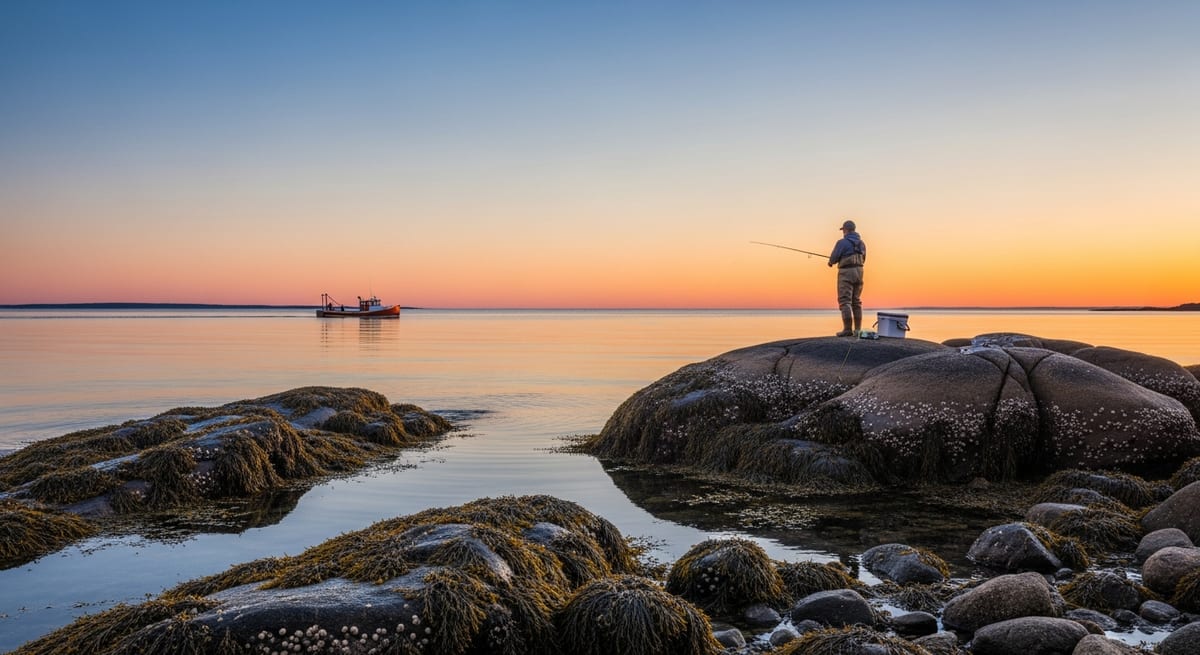
Charter captains working Long Island Sound from Niantic Bay to the New Haven breakwall consistently rank tide stage above moon phase, barometric pressure, and lure selection as the variable that separates productive sessions from slow ones. A rip that holds albies and stripers at maximum current can be empty ninety minutes later when the water goes slack. Anglers who fish The Race regularly describe the transition as abrupt enough to feel like a different body of water. The difference is not skill or gear; it is timing, and it is predictable days in advance from NOAA current tables.
Why Long Island Sound Tidal Current Fishes Differently Than Open Coastal Water
Long Island Sound is a semi-enclosed estuary, and its tidal dynamics differ from open coastal water in ways that matter to how anglers plan their days:
Semi-diurnal pattern with a weekly drift: LIS runs two high and two low tides per day, with timing shifting roughly 50 minutes later each day as the lunar cycle progresses. A dawn high-tide window in early September becomes a mid-morning window by the following week, which is why CT regulars plan tidal windows several days out rather than the morning of.
Modest range, concentrated current: Tidal range at most CT locations is 3-6 feet. The water moving across that range gets funneled through constrictions at The Race (between Fishers Island and Orient Point) and Plum Gut, where tidal current regularly runs 3-5 knots at peak. CT boat anglers report that maximum ebb at The Race can hold bait visually in place in the current column, a concentration that disperses entirely at slack.
Current matters more than height: What CT saltwater anglers track is current movement, not water level. Current is fastest at mid-tide, roughly 2 hours after each high or low, and slowest at slack water. In CT shore-fishing community discussions, the phrase 'dead slack' refers to those 20-45 minutes around the tidal peak when current stops, typically the slowest fishing period of the cycle.
LIS fills and empties from the east: Because the Sound's primary tidal exchange happens through The Race at the eastern end, the eastern portion of the Sound (New London, Niantic) experiences tidal events earlier than the western end (Bridgeport, Greenwich). The difference can reach 1.5-2 hours at the extremes, enough to completely shift a fishing window if you are using the wrong NOAA reference station.
Bridgeport vs. New London: Why Your Tide App Needs the Right NOAA Station
NOAA publishes tide tables from two primary CT reference stations, and the choice between them significantly affects fishing-window accuracy:
New London station (NOAA #8461490) is the correct reference for eastern CT fishing locations: Niantic Bay, the Connecticut River mouth at Old Saybrook, Rocky Neck State Park, and the Thames River mouth. For any location east of the Connecticut River, New London is the appropriate starting point.
Bridgeport station (NOAA #8467150) is the reference for western LIS locations: New Haven Harbor, Milford, the Housatonic River mouth, and the Greenwich shoreline. Using New London tables for a trip to the Housatonic puts the tidal window off by 90 minutes or more, a common error CT shore-fishing community discussions flag for newer anglers.
Applying subordinate station corrections: The NOAA Tides and Currents website (tidesandcurrents.noaa.gov) lists correction factors for specific CT fishing access points. Mystic adds approximately 30 minutes to the New London reference; the CT River mouth at Saybrook runs roughly 20 minutes later. Apps like NOAA Tides and Currents and Tideline apply these corrections automatically when you select a named location rather than the reference station itself.
Current lag: Tidal current peaks roughly 20-60 minutes after the tidal height peak at most LIS locations. Arriving at The Race or Plum Gut at listed high tide expecting maximum current will put you there slightly early. CT boat anglers at The Race commonly target the window beginning 90 minutes before listed high tide through 90 minutes after, capturing the current ramp-up and peak before the slowdown into slack.
The Race and Plum Gut: How the Rip-Fishing Community Times Maximum Current
The Race is the primary tidal rip in eastern CT, and the anglers who fish it consistently have developed a specific approach to timing:
Arrival timing: CT boat anglers who fish The Race regularly report arriving 90-120 minutes before maximum current, not at the listed high or low tide time but at the current peak listed separately in NOAA's current predictions for The Race. This captures the ramp-up period when current is building and fish are actively orienting to the flow.
Back-eddy structure on the flood: On the flood tide, a productive back-eddy forms on the Connecticut-shore side of The Race, distinct from the main rip. Anglers familiar with the location describe this as a holding area where stripers and albies sit facing the current without fighting the full 4-knot flow. The eddy dissolves at slack and reforms as the ebb builds, and it is considered one of the more consistent striper holding spots on the eastern LIS rip-fishing circuit.
Species timing within the current window: False albacore at The Race concentrate during the fastest current, in the 45-60 minutes around maximum ebb or flood. Stripers at The Race are often found on the rip edges at moderate current, during the building and slackening phases, rather than dead-center in the maximum flow. Bluefish tend to appear throughout the moving-water window with less sensitivity to the specific current speed.
Plum Gut: Between Plum Island and Orient Point, Plum Gut is accessible to CT boaters running east and produces similar current-dependent rip fishing. The CT-side fleet typically targets Plum Gut on the west-running ebb, when bait is pushed toward Connecticut-side structure. NOAA lists separate current predictions for Plum Gut at tidesandcurrents.noaa.gov.
The CT River Mouth and Estuary Outflows: Timing the Outgoing Tide Window
River mouths are the most accessible current-fishing locations for CT shore anglers, and the Connecticut River mouth at Old Saybrook is the most productive on the shoreline:
The outgoing tide mechanism: As the tide falls, rivers flush bait out of the estuary and into LIS. Bay anchovies, juvenile menhaden, sand eels, and herring get swept out with the current, and stripers stage at the mouth facing into the outflow to intercept them. CT shore anglers at Saybrook Point and the North Cove jetty report the best striper fishing begins when the outgoing current picks up speed, typically 1-2 hours into the ebb, and continues until 1-2 hours before low tide.
Location specifics at Saybrook: The deepwater channel on the east side of the CT River mouth concentrates bait during the ebb. Shore anglers working Saybrook Point report better action on the east bank of the channel than the west side on outgoing, because the current pushes bait along the eastern shore edge. Positioning on the west side during ebb means fishing behind the main bait column.
Other productive estuary mouths: Niantic River mouth at Niantic Bay, the Hammonasset River outflow at Hammonasset Beach State Park, and the Housatonic River mouth at Milford produce the same outgoing-tide concentration effect on a smaller scale than the CT River. Thames River mouth at New London also produces striper action on outgoing tide, particularly when the river is carrying bait off summer thermal stress in July and August.
The incoming tide shift: On the incoming tide at river mouths, fish often move up into the estuary itself. CT shore anglers familiar with the back portions of the Niantic River report that incoming tide moves stripers well inside the river, requiring a shift in position from the mouth to up-river access points rather than holding at the inlet.
Spring Tides, Moon Phase, and the New Moon Night Window for CT Trophy Stripers
Moon phase modifies the energy of each tidal cycle, and CT anglers track it for two distinct reasons:
Spring tides (new moon and full moon): When the sun and moon align, gravitational pull is strongest and tidal range is at its peak. Current at LIS rip areas is noticeably stronger during spring tides. The Race and Plum Gut during a spring tide can run a knot faster than during neap conditions. CT boat anglers consistently describe spring tide rips as more productive, with bait more concentrated and fish more actively oriented to the current.
Neap tides (quarter moon): Tidal range is smaller and current is weaker. Rip areas lose intensity. Shore fishing that depends on moving current, including point fishing, inlet fishing, and rip-adjacent structure, tends to slow during neap tides. The consensus among CT shore anglers is that neap tides demand more patience at current-dependent spots, though structure-bound species like tautog are less affected by the reduced tidal energy.
New moon and the night striper window: The new moon creates near-total darkness on shallow LIS flats. CT shore anglers at Hammonasset Beach State Park, Harkness Memorial State Park, and the rocky Niantic shoreline report that large stripers move into shallow water on dark new-moon nights with noticeably less caution than under a lit sky. Night tides in September and October around the new moon are considered the premier trophy-class striper window by the CT shore-fishing community. Current CT DEEP striped bass regulations covering minimum size and possession limits apply year-round and are available at portal.ct.gov/DEEP.
Full moon and visible conditions: Some CT shore anglers prefer the full moon for wading and tracking surface disturbance without a headlamp. The general consensus is that fish are warier in brighter conditions, particularly on shallow flats, though full-moon nights can still produce in moving current over deeper rocky structure.
Tidal Windows by Species on Connecticut Saltwater Water
CT anglers targeting specific species have worked out productive tidal windows through accumulated community observation across LIS locations:
Striped bass: Most productive on moving current, particularly the 2-3 hours of outgoing tide at estuary mouths and the mid-incoming tide at rocky structure and beach points. Slack water at high and low tide is often the slowest period. The exception is high tide, which covers rocky structure and grass flats that stripers can only access at high water. CT shore anglers at Race Rock Lighthouse (reachable by boat from the Thames River or Niantic) report stripers holding tight to the lighthouse structure at moderate current on either side of slack, then orienting to the rip as current builds.
Fluke: Move into structure and channels with the incoming tide and disperse somewhat at slack. CT party boats fishing Fishers Island Sound and the nearshore reefs report that fluke drift-fishing is most productive on moving water; dead slack requires slow-speed motoring to maintain bait contact with the bottom. Incoming tide pulls fluke from deeper water toward shallower shell-bottom and sandy flats.
Bluefish: Concentrate in rip areas where tidal current creates surface disturbance and pushes bait. Mid-incoming and mid-outgoing current at The Race and nearshore reefs are the productive windows. Bluefish at LIS rips are less predictable by timing than stripers, but moving water is the consistent organizing variable regardless of location.
Tautog: Less tide-sensitive than pelagic species since they are structure-bound year-round. Moving water increases tautog feeding activity, but CT anglers at Bartlett Reef and the Norwalk Islands report tautog action at all tide stages. Current CT DEEP seasonal regulations on tautog bag limits and minimum size apply and are listed at portal.ct.gov/DEEP.
False albacore: Maximum current at The Race and Plum Gut is the primary location and timing for false albacore in CT. The window around peak ebb is typically best; albies tend to leave the rip area as current slackens toward the bottom of the tide and do not return until the next cycle builds.
EVERY SATURDAY MORNING
Weekly fishing intelligence
Nationwide conditions, what's biting, and honest gear deals. One email, no noise.
No spam. Unsubscribe anytime.