
CT Trout Guides Changed Their Handling Practices Years Ago. Most Weekend Anglers Haven't Caught Up Yet.
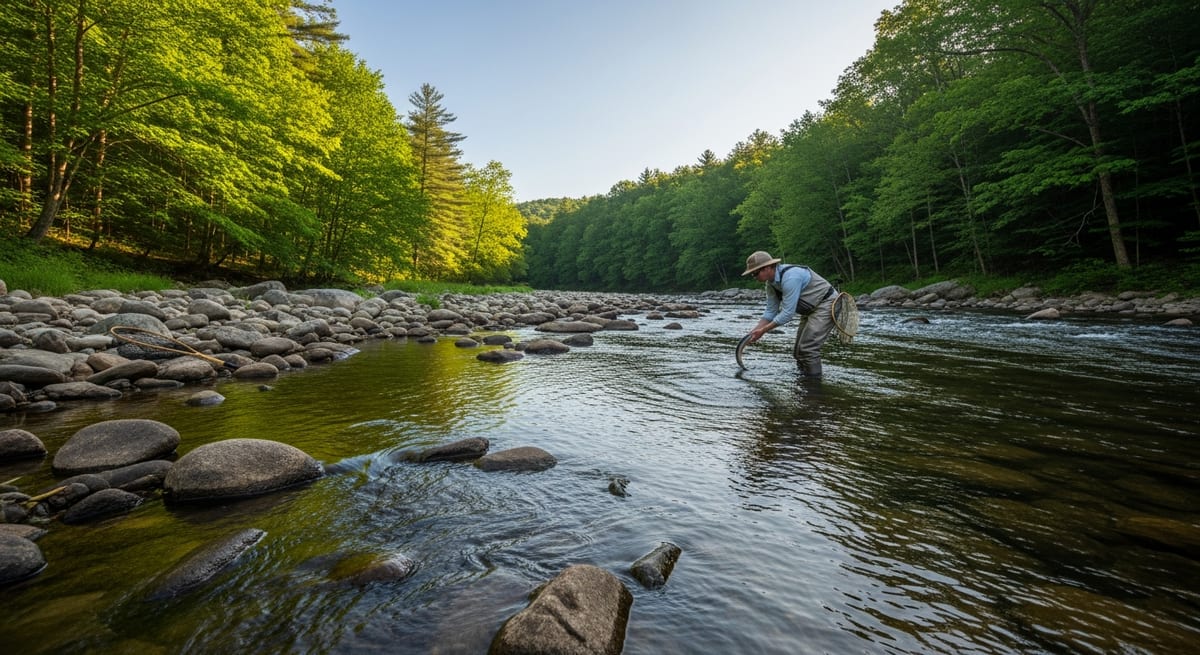
Studies tracking post-release trout survival on managed fisheries have found mortality rates above 20 percent on days when water temperatures pushed past 68°F, even when fish were released quickly and appeared to swim off strong. Trout guides who work the Farmington and Housatonic regularly have quietly shifted their entire handling approach in response to this kind of data, and the shift goes deeper than just "wet your hands." The anglers who consistently release healthy fish aren't necessarily being more careful. They're doing things in a different order, with different tools, and with a clearer sense of where the actual risk lives.
Time Out of Water Is the Variable Most Anglers Underestimate
The single most damaging thing that happens during a typical catch-and-release isn't the hook. It's the two or three minutes the fish spends in the air while the angler sorts out the camera, the forceps, or the best angle for a photo.
Research on trout mortality suggests that air exposure beyond 30 seconds meaningfully increases stress responses and reduces survival odds in coldwater species. The 30-second threshold most guides on the Farmington operate by isn't sentiment; it's a working limit drawn from mortality studies on trout and salmon, including work published through the American Fisheries Society on warmwater and coldwater handling stress.
Anglers who fish the TMA stretch below Route 44 on the Farmington describe a visible shift in how serious C&R practitioners handle this: everything is staged before the fish is lifted, camera app open, forceps already in hand, net already dipped. The fish comes up, the shot happens, the fish goes back. The whole sequence runs under 20 seconds.
A practical discipline that helps enforce this: hold your breath when the fish comes out of the water. When you need to breathe, the fish goes back in. It sounds simple, but it forces an instinctive pause that prevents a 15-second photo from becoming a 90-second ordeal.
Hook Removal: What the TMA Crowd Does Differently
The goal is removing the hook quickly while causing minimal additional tissue damage. A few things experienced CT trout anglers have largely settled on:
Barbless hooks reduce injury and handling time. Pressing the barb down with pliers takes five seconds and makes removal significantly faster. Some TMA stretches in Connecticut, including portions of the Farmington and Salmon River below Leesville Dam, require or recommend barbless rigs, but rules vary by stretch and change from year to year. Check current CT DEEP regulations for the specific water you're fishing before assuming one standard applies across the board.
Forceps, not fingers. Needle-nose forceps or a dedicated hook remover are standard kit on the Farmington. Working a deeply set hook bare-handed wastes time and causes more damage than a clean tool removal.
When the hook is swallowed: If a trout has taken the fly into its throat, cutting the tippet and leaving the hook in place is the approach most CT trout guides and conservation organizations recommend. Hooks in stomach tissue corrode over time, and survival odds with a cut line are substantially better than with an attempted extraction. Digging causes injuries that are rarely survivable.
Treble hooks on lures are often set shallower. Fish hooked on spinners or small plugs can frequently be unhooked while still in the net, keeping the fish wet throughout the process.
When Water Temperature Makes C&R a Gamble
Trout and salmon run hot during a fight. Their oxygen demand spikes, cortisol floods the system, and they accumulate a metabolic debt that has to be repaid after release. When water is already warm, there's less dissolved oxygen available and less physiological margin to recover from that debt.
Research on trout physiology points to 68°F as a meaningful threshold; above that temperature, post-release mortality risk rises substantially even with good handling technique. The Farmington River Anglers Association has issued voluntary no-fishing advisories when Farmington water temps reach that range during summer low-flow periods, as of the 2024 season, those advisories have typically arrived in July and early August. The FRAA website and CT DEEP's river temperature monitoring data are worth checking before heading out on hot days.
Above 72°F, many fisheries biologists and conservation organizations recommend stopping trout catch-and-release for the day entirely. The fish are already working harder just to hold position in warm water; a catch often pushes them past a threshold they can't recover from, even if they swim off initially.
Bass and warmwater species tolerate higher temperatures than trout, but extended summer heat still compresses their recovery window after a fight. Tournament anglers who use livewells and immediate-return protocols have documented meaningfully better survival rates compared to extended boat-side handling. A reflection of the same underlying physiology.
Landing and Handling: What Rubber Nets Actually Do
How the fish is landed matters as much as what happens after.
CT trout guides shifted to rubber mesh landing nets years before they became widely available in chain tackle shops. The reason is straightforward: knotted nylon nets abrade and strip the protective slime coat from trout more aggressively than rubber mesh, and slime coat loss opens infection pathways. The consensus among guides who work the Housatonic and Farmington regularly is that rubber nets aren't optional kit for serious C&R. They're baseline equipment.
Wet your hands before touching. A dry palm removes slime coat on contact. Rinse your hands in the river before handling any fish you intend to release.
Support the body horizontally. Large bass held vertically by the jaw, particularly largemouth over 3 pounds, risk jaw stress and internal organ displacement from unnatural weight distribution. One hand on the jaw, one hand under the body is the correct hold for any fish you're photographing rather than immediately releasing.
Grip pressure matters. Tight squeezing around the body compresses organs. The hold should support, not restrain.
Reading Whether a Fish Is Actually Ready to Go
A fish that swims away immediately after release isn't always fine. A fish that lingers at the surface, rolls slightly, or drifts with the current rather than actively swimming is signaling that it needs more time.
The recovery approach that most CT trout anglers and guides have standardized on: hold the fish gently upright in the water, nose pointed into any available current, until it kicks away under its own power with a strong, deliberate tail stroke. Don't release a fish showing instability. It will likely sink to the substrate and be unable to recover.
In still-water situations, ponds, slack pools, move the fish slowly forward and back to push water across the gills. This helps restore oxygen levels and equilibrium when there's no current to do it passively.
A fish that hasn't stabilized after two to three minutes of supported recovery has likely been handled past a recoverable threshold. At that point, keeping the fish, where regulations allow, is the more ethical outcome than releasing one that won't survive the next hour. If you're fishing catch-and-release-only water on the Salmon River or any DEEP-designated C&R stretch, check the posted regulations for that specific section before making that call. Retention exceptions vary, and the rules are not uniform across waters.
EVERY SATURDAY MORNING
Weekly fishing intelligence
Nationwide conditions, what's biting, and honest gear deals. One email, no noise.
No spam. Unsubscribe anytime.