
The Float Rig Outproduces Live Bait Suspended Without One on the Farmington and Housatonic. What CT River Communities Report About Drift Control, Float Selection, and the Current Seams Most Anglers Walk Past
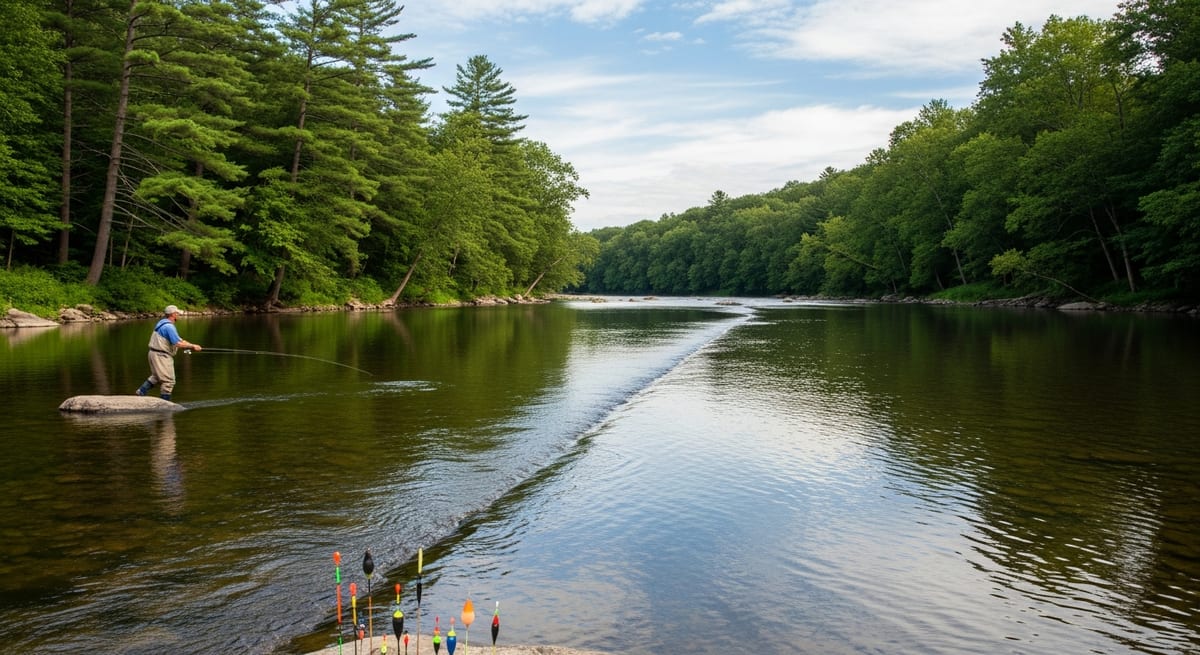
On the Farmington's catch-and-release stretch, anglers report that float-rigged waxworms and small nightcrawler sections outperformed bare-hook presentations across multiple overcast sessions in April and May 2025, based on accounts from the CT Fishing Forum and Collinsville-area tackle shops. Most attribute the difference to drift speed: a float keeps bait traveling at current speed rather than swinging or dragging through the column. Float fishing suspends bait at a set depth beneath a float, letting the current carry it naturally. The float registers subtle takes, holds the bait at the right depth, and eliminates the line tension that causes unnatural movement. On CT rivers where trout and smallmouth see consistent pressure, that difference in presentation speed often separates a productive drift from a refusal.
Why Drift Speed Beats Bait Selection on the Farmington and Housatonic
Nymphs, worms, and small minnows travel with the current, not faster than it. When bait moves at a different speed than the water around it, fish in pressured CT river sections tend to refuse it outright. Farmington tailwater regulars fishing the catch-and-release zone below Hogback Dam describe this as the most common presentation mistake they observe: bait swinging through the column at the speed of the rod hand rather than the speed of the river.
A float corrects this passively. Once the rig is properly weighted and the depth is set, the float rides the surface current and the bait hangs below at the same speed. No reeling adjustment, no rod technique required. The consensus among tailwater communities is that presentation speed accounts for more refusals than bait choice during post-runoff conditions when trout become more selective. This is the same principle that makes nymphing effective under a strike indicator, applied to conventional gear on any CT river section open to bait fishing.
What Float Styles CT River Communities Carry
Slip floats (sliding): Line runs through the float's center and a bobber stop sets the depth. Slip floats let anglers cast rigs set deeper than rod length allows. CT anglers use them in the deeper pools of the lower Housatonic and in the wider, slower runs of the Salmon River in Colchester. Fixed floats: Attached at a fixed point on the line, depth capped at rod length. More sensitive than slip floats and easier to mend on tight runs. Preferred by Farmington wade anglers working shallower pocket water and riffle-edge seams where depth rarely exceeds 4 feet. Waggler-style floats: Cigar-shaped foam floats with a sensitive tip that registers subtle takes. Increasingly common among CT river communities fishing ultralight setups for trout on 4 to 6lb fluorocarbon. Centerpin float fishing: A friction-free reel that pays line at current speed for long, unimpeded drifts. Used by a subset of Salmon River anglers in fall when targeting steelhead-strain browns, though regulations for that fishery require annual verification at the DEEP Inland Fisheries Division (ct.gov/deep) before the season opens.
Float Rig Specifications for CT Trout and Smallmouth
For trout on the Farmington and Housatonic: A size #4 or #5 pencil float, 18 to 24 inches of 4lb fluorocarbon below the float to the first split shot, then 12 to 18 inches to a #6 or #8 hook. Add the minimum split shot needed to cock the float vertical. Start with a single BB shot and add only if the float leans. Bait options: a small nightcrawler section, a waxworm, or a size 14 bead-head nymph such as a hare's ear or pheasant tail. Set depth so the bait drifts 4 to 6 inches off the bottom. A medium-light 6.5 to 7-foot spinning rod with a 2500-series reel spooled with 6lb monofilament gives enough length for mending without overloading a light float.
For smallmouth in Housatonic river pools: A slip float set to 4 to 6 feet of depth, paired with a 1/8 oz jig head tipped with a 3-inch tube or small paddle-tail swimbait in chartreuse or white. Allow the float to drift naturally along eddy lines and current seams adjacent to mid-river boulders. The Housatonic's wide pools between New Milford and Bulls Bridge hold smallmouth that respond consistently to this presentation through June and into early July.
Controlling Drag on CT River Runs
The most consistent float fishing problem anglers report on the Farmington and Housatonic is surface drag: faster surface current catches the line between the rod and the float, pulling it through the drift faster than the water beneath it moves. Fish notice this and refuse the bait. Mending the line: After casting, flip loops of line upstream with the rod tip to keep slack off the surface between rod and float. This lets the float drift at current speed without being accelerated by the faster surface layer. Following the float: Keep the rod pointed at the float throughout the drift, raising the tip as it approaches and lowering as it moves downstream. This maintains connection without pulling. Farmington regulars who crossover from indicator nymphing apply the same mending mechanics to their float rigs, and CT river communities note the muscle memory transfers directly.
Where to Float on the Farmington, Housatonic, and Salmon River
Farmington River (Riverton to Collinsville): The Trout Management Area above Collinsville Dam includes fly-fishing-only and artificial-lures-only restrictions in certain sections. Float rigs with bait are not permitted in those zones. Check the current DEEP Inland Fisheries regulation map at ct.gov/deep before fishing, as section boundaries and rule changes are updated seasonally. The open bait sections below Collinsville respond well to float presentations in tailout runs and mid-pool troughs from late April through May.
Housatonic River (New Milford to Bulls Bridge): Wide pools along Route 7 hold both trout and smallmouth in different seams of the same run. Deeper pools benefit from slip floats set to 5 to 7 feet. The eddy lines along the main channel between New Milford and the Covered Bridge area are where smallmouth float anglers consistently report finding fish.
Salmon River (Colchester): Atlantic salmon restoration efforts continue on this river under CT DEEP management. Atlantic salmon encountered are typically designated catch-and-release only. Confirm current Atlantic salmon regulations at ct.gov/deep before targeting them. The river's wild and stocked brown trout population responds well to float-rigged waxworms and small nymphs from the third Saturday in April through May.
EVERY SATURDAY MORNING
Weekly fishing intelligence
Nationwide conditions, what's biting, and honest gear deals. One email, no noise.
No spam. Unsubscribe anytime.