
Getting Started with Fly Fishing in Connecticut: Gear, Technique, and Best Waters
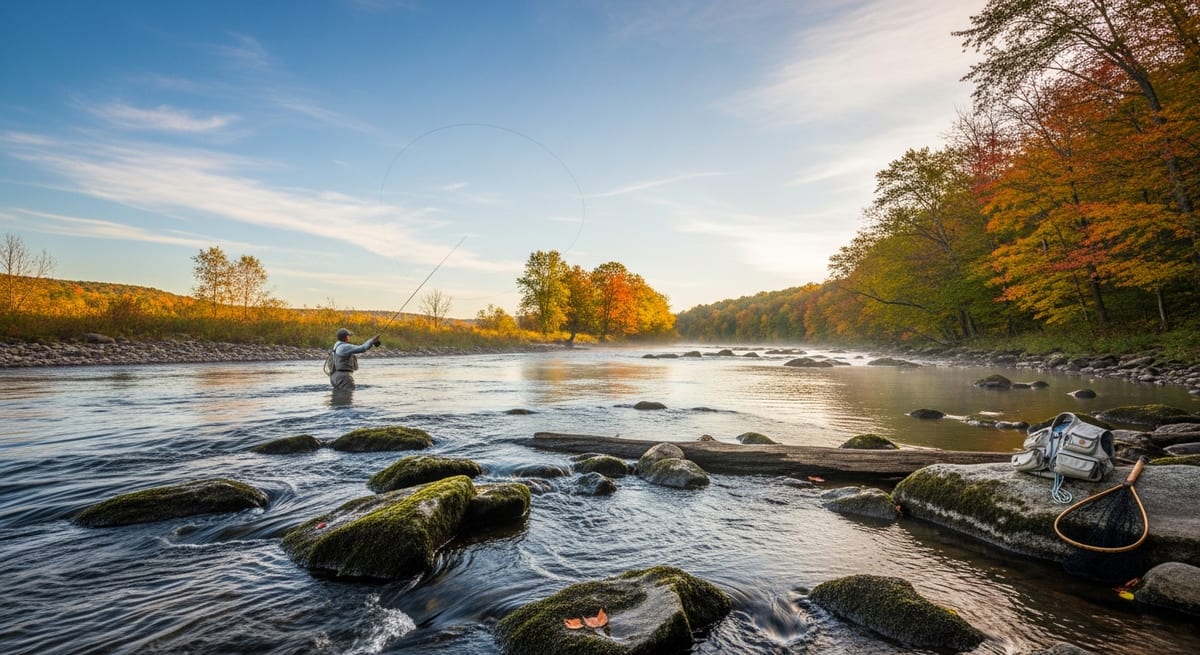
Fly fishing intimidates beginners more than any other fishing discipline. The gear looks complicated, the casting seems impossible, and the culture around it can feel exclusive. None of that is actually true. The basics of fly fishing are learnable in an afternoon, and Connecticut has excellent trout water for beginners. Here's the honest starting point.
Why Fly Fishing Is Different
In conventional fishing, the weight of the lure or sinker carries the line through the air. In fly fishing, the line itself carries the nearly weightless fly. The casting technique is fundamentally different. You're casting the line, not the lure. This is the core thing to understand: fly fishing requires learning a different casting motion, but once you have the basic cast, everything else follows.
The other difference: fly fishing is about presenting an artificial fly (tied to look like an insect, baitfish, or other food source) in a way that looks natural to the fish. The fishing itself is slower, more observational, and more technical than spinning. That's what attracts people to it.
Beginner Gear: What You Actually Need
The fly rod: A 9-foot 5-weight rod is the universal beginner recommendation for freshwater trout fishing. It handles dry flies, nymphs, and small streamers effectively. Most trout in CT streams and ponds are caught on 5-weight rigs. Don't overthink it, go with 9', 5-weight.
Starter rods that are genuinely good: Redington Vice (about $80), Echo Base Kit (about $80), Orvis Clearwater. Temple Fork Outfitters (TFO) rods offer exceptional quality for the price. Avoid the ultra-cheap rod/reel combos under $50. They'll frustrate your learning.
The reel: At beginner level, the reel is primarily a line holder. Any properly matched reel holds adequate backing and fly line and has a functional drag. A reel matched to your rod ($40-$80) is fine for all CT trout fishing.
Fly line: The fly line carries the weight that makes casting work. For a 5-weight rod, use a weight-forward floating line, labeled WF-5-F. Most starter kits include a line. Replace it when it cracks or loses its coating (usually after 3-4 seasons of regular use).
Leader and tippet: A 9-foot tapered monofilament leader connects the fly line to the fly. Tippet is additional thin monofilament added at the end of the leader when it gets short. For CT stream trout, 4X or 5X tippet (diameter rating) is appropriate for most conditions.
Flies: Start with: a Woolly Bugger (#8-10, in black or brown), a bead-head Hare's Ear nymph (#12-14), a Elk Hair Caddis dry fly (#14-16), and an Adams dry fly (#14). These four patterns cover most CT trout fishing situations. Cost: $12-15 total.
Everything else: Polarized sunglasses (essential for seeing fish and eye protection), forceps (for removing hooks), a simple vest or sling pack, nippers for cutting tippet, and a net if you plan to practice catch-and-release (which is recommended on wild trout water).
Learning to Cast
The basic fly cast. The overhead cast, has three elements: the backcast, the pause, and the forward cast. The motion is often described as "10 o'clock to 2 o'clock", your rod tip travels between those positions on a clock face.
Self-teaching: YouTube is genuinely useful here. Tim Rajeff's "Introduction to Fly Casting" and the Orvis free fly fishing guide are both excellent free resources. Practice in a park or yard with a piece of yarn tied to the leader instead of a fly, safer and you can see the loop you're forming.
A lesson: A single 2-hour lesson from a fly fishing guide or shop is the fastest investment you can make. A good instructor will identify and fix bad habits before they become ingrained. Local CT fly shops (Housatonic River Outfitters in Cornwall Bridge, Orvis in Glastonbury) offer lessons. Cost: $75-$150 for a group introduction.
What good casting looks like: A tight, narrow loop unrolling smoothly in front of you. What bad casting looks like: a pile of tangled line. You'll do more of the second at first, then gradually more of the first. That's the learning curve.
Best CT Beginner Fly Fishing Waters
Farmington River (Farmington, Burlington, New Hartford): The best beginner fly fishing river in Connecticut. Excellent wading access, high trout populations (stocked plus wild), and a dedicated fly-fishing-only catch-and-release section in New Hartford that protects wild browns and rainbows. The Farmington has a large fly fishing community. You'll often see experienced anglers who are generally helpful to beginners.
Housatonic River (Cornwall Bridge to Falls Village. The trophy section): Some of the best wild trout water in the Northeast. The catch-and-release section between Cornwall Bridge and Falls Village holds wild brown and rainbow trout up to 20+ inches. It's a more technical fishery than the Farmington. Fish are spooky and selective, but the quality is exceptional. Best fished in fall when browns are active.
Salmon River (Colchester): Smaller, more intimate than the Farmington. Good stocked trout population, beautiful scenery, and manageable wading for beginners. Less crowded than the Farmington. Good spring and fall fishing.
Bantam River (Litchfield/Morris area): A smaller stream with decent wild brook trout in upper sections and stocked rainbows in accessible lower sections. Good for solo beginners who want less pressure.
What to Fish With (and When)
Spring (April-June): This is the most active season for CT trout on the fly. Water temperatures are ideal, fish are feeding aggressively after winter, and CT DEEP is actively stocking. Nymphs (dead-drifted below an indicator) produce consistently. Watch for hatches, if you see insects in the air and fish rising, switch to a dry fly that matches what you see.
Summer (July-August): Heat pushes fish into deeper, cooler water and makes them lethargic in mid-day. Fish early (before 9 AM) or evening (after 5 PM). Streamers (large, swimming flies) fished on a swing through deep pools produce summer fish when dry flies don't. Some CT streams run too warm for comfortable trout by August.
Fall (September-November): Excellent streamer fishing. Brown trout enter fall spawning mode and become aggressive. Large Woolly Buggers and articulated streamers stripped through pools and runs produce some of the biggest fish of the year. Fall is many serious fly anglers' favorite CT season.
EVERY SATURDAY MORNING
Weekly fishing intelligence
Nationwide conditions, what's biting, and honest gear deals. One email, no noise.
No spam. Unsubscribe anytime.