
Fly Fishing in Connecticut: Where to Go, What to Use, and How to Get Started
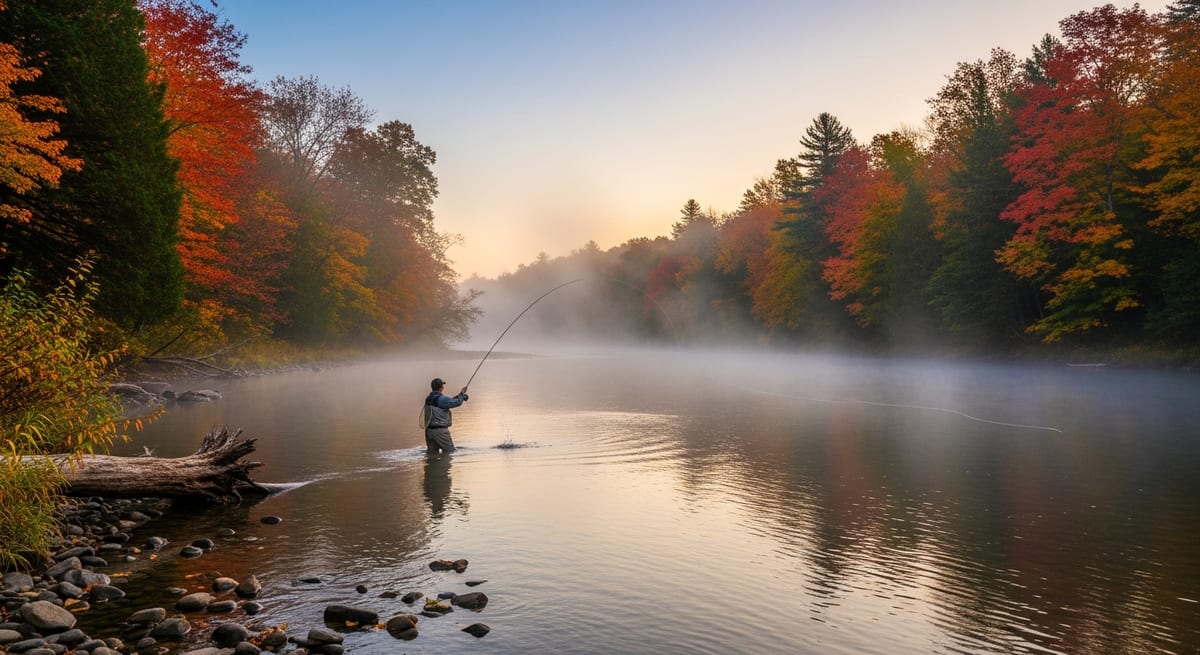
The Farmington River in Barkhamsted produces wild brown trout on a 2-mile tailwater you can fish year-round. Most Connecticut anglers still drive past it on the way to Vermont. The state also has native brook trout streams in the eastern hills that see almost no pressure, and a coastal striper fishery on the fly that gets going in May. Neither requires expensive gear or years of experience. Pick up a 5-weight, learn to read moving water, and Connecticut will keep you busy.
Why Connecticut Is an Underrated Fly Fishing State
Connecticut doesn't have the name recognition of Vermont or Maine, but it holds up against both in specific categories.
The Farmington River below Hogback Dam is one of the finest wild trout tailwaters in the Northeast. It's a year-round fishery with a permanent catch-and-release trophy section (the TMA. Trout Management Area), brown trout that reproduce naturally in the river, and a hatch calendar that rivals Pennsylvania limestone creeks.
Beyond the Farmington, the state has:
- Native brook trout in dozens of small headwater streams in the eastern hills and Litchfield County
- Stocked rivers that fish well with a nymph rig from March through May
- A productive coastal striper fly fishery from mid-May through June and again in the fall
- Bonito and false albacore (albie) runs in late September and into October, timing shifts year to year, but when they show up along the eastern shore, fly fishers come from across the region
The western hills, Salmon Creek, the Natchaug River, and the Willimantic River all hold trout and offer classic New England fly fishing scenery.
The Farmington River: Connecticut's Premier Fly Fishing Destination
The Farmington River Trout Management Area (TMA) runs for roughly 2 miles in Barkhamsted and is the most consistent wild trout water in the state. It's catch-and-release only, fly and artificial lures only, and produces brown trout through natural reproduction in the river rather than hatchery stocking.
What you'll find:
- Wild brown trout from 12 inches up. Fish in the mid-to-high teens show up regularly in the TMA, and larger fish are occasionally reported, though they're not the norm
- Stocked trout in the catch-and-release and general sections downstream
- A predictable hatch calendar (see below)
- Clear, cold, wadeable water with classic riffles and pools
- An active local fly fishing community (Farmington River Anglers Association)
The TMA hatch calendar:
- Early April: Blue-winged olive (BWO) hatches, size 16-18, most active on overcast days
- Late April-May: Hendricksons, one of the most important mayfly hatches on the Farmington, typically early afternoon
- May-June: March Browns, Grey Foxes, Cahills, Sulphurs
- July: Trico spinners at dawn, terrestrials (ants, hoppers) during the day
- September-October: Blue-winged olives return, little blue-winged olives, caddis
Access: Multiple public access points run along Route 44 in Barkhamsted. The TMA begins below Rainbow Dam and is clearly marked with DEEP signage. The Beaver Meadow Road pulloffs are the most popular starting points, brown DEP signs mark the lot on the south side of Route 44. A second access at the Sandy Beach Road area gets you into the upper TMA section with noticeably less foot traffic on weekdays.
Best times to fish: April through June for hatches. September-October for fall runs and active hatches before winter.
Small Stream Brook Trout: Wild Connecticut
Away from the Farmington, some of the most rewarding fly fishing in the state is on small headwater streams where wild brook trout live in pools barely deep enough to hide a 10-inch fish.
Many of these streams don't appear in guides. You find them by studying CT DEEP watershed maps, looking for cold-water Class 1 and 2 streams in Tolland, Windham, and Litchfield counties, and walking in from the nearest road crossing. Two worth knowing:
Salmon Creek (Litchfield County): Flows through Salisbury and North Canaan. Public access along the stream corridor near the Canaan area via Route 44 road crossings, park along the shoulder where the shoulder widens and walk the bank upstream. Small brookies with occasional wild browns. A 3-weight shines here.
Natchaug River (Windham County): Flows through Natchaug State Forest in Eastford and Chaplin. DEEP maintains gravel parking areas off Phoenixville Road in Eastford, look for the green state forest signs. Several miles of public access through forest land with minimal pressure mid-week. Best in April and again in September when water temps cool back into the 50s.
Tactics for small streams:
- 7-8 ft rod in a 3-weight or 4-weight, shorter, more maneuverable under tight canopy
- Dry flies: elk hair caddis (size 14), parachute Adams (size 14), small black or cinnamon ants (size 16-18)
- Nymphs: pheasant tail (size 16) dead-drifted on a tight line through deeper pockets, no indicator needed
- High-stick nymphing in slower pools; let it swing at the tail of the run
- Move quietly and cast low, brook trout spook easily in clear shallow water
- Upstream approach keeps you behind the fish's line of sight
What to look for: Water temps in the 50s-low 60s°F, shaded channels, areas below springs, beaver flowages with deeper pools.
Fly Fishing for Striped Bass in Connecticut
The Connecticut coastline offers productive fly fishing for striped bass from late May through October. It's a different game than freshwater, bigger flies, heavier gear, reading tidal water, but the fundamentals are the same: put the fly in front of a feeding fish.
When stripers are catchable on the fly:
- May-June: Schoolie stripers pushing baitfish into shallow coves and tidal rivers
- July-August: Early morning and late evening feeding windows; occasional blitzes on bunker schools along the beach
- September-October: Fall run migration. Many anglers consider this the best fly fishing of the year on the CT coast
Gear for striper fly fishing:
- 9-10 weight rod (9-weight handles most shore and tidal river situations)
- Weight-forward saltwater floating line or intermediate sink-tip for subsurface presentations
- Large arbor reel with at least 200 yards of 30lb backing
- 9 ft leader tapered to 16-20lb fluorocarbon tippet
- Flies: Clouser Minnows in chartreuse/white (size 1/0-3/0), Lefty's Deceivers, EP Fiber Baitfish patterns in white or olive, crab patterns for flats work
Access points for CT striper fly fishing:
- Niantic River mouth, wade access off Rope Ferry Road in East Lyme; schoolies stack here in May on a moving tide
- Connecticut River estuary (Old Saybrook area), big tidal swings push bait; launch from Pilgrim Landing for wade access along the east bank
- Hammonasset Beach State Park (Madison), long sand beach accessible from the main lot; fish the surf line at dawn, state park entrance fee applies in season
- Old Lyme/Black Hall flats, kayak fly fishing for sight-casting to cruising stripers on a falling tide
- Eastern CT shore (Stonington, Mystic area), rocky points and ripping tidal current; the fall run pushes through here hard in October
Tide is everything: Fish 2 hours before and after a moving tide. Slack water slows the bite significantly. Falling tides that trap bait in drains, guts, and creek mouths create the most concentrated feeding windows.
Gear Recommendations for Beginners
A reasonable starter setup runs $150-$250 and will handle 90% of what Connecticut offers. You don't need to spend $900 on a fly rod to catch fish here.
Freshwater starter (trout):
- Rod: 9 ft 5-weight. The Redington Crosswater ($80) is the most forgiving intro rod at that price; the Orvis Clearwater ($179) is a noticeable step up in feel and comes with a strong warranty
- Reel: Most combo kits include a matched reel pre-spooled with WF5F floating line. That's the right line for CT trout fishing and a fine place to start
- Leader: 9 ft tapered 4x for most Farmington conditions; drop to 5x fluorocarbon tippet in low, clear water
- Tippet: Keep spools of 4x and 5x fluorocarbon in your vest
CT trout fly box essentials:
- Dry flies: Elk hair caddis (sizes 14, 16), parachute Adams (14, 16), Sulphur parachute (16, 18) for late May on the Farmington, Hendrickson dry and emerger (14) for late April
- Nymphs: Copper John (14), pheasant tail (14, 16), hare's ear (14, 16). These three cover most CT subsurface situations
- Streamers: Woolly bugger in black and olive (size 6), effective year-round on the Farmington, especially in early spring and during high water
Saltwater starter (stripers):
- Rod: 9 ft 9-weight. The Temple Fork Outfitters BVK ($160) is the best rod-for-dollar at this weight class; the Sage Foundation ($295) is worth the step up if you plan to fish saltwater regularly
- Reel: Saltwater-rated and corrosion-resistant. The Redington Behemoth ($120) holds backing well and survives the abuse of a sandy beach
- Line: Rio Outbound Short or SA Amplitude Saltwater Taper for floating; an intermediate sink-tip when fish are deeper than 4 feet
- Flies: Chartreuse/white Clouser Minnow (1/0), olive/white Clouser (2/0), 4-inch EP Fiber Baitfish in white or sand eel colors
Casting instruction: The Farmington River Anglers Association (FRAA) hosts casting clinics in the spring. UpCountry Sportfishing in New Hartford and All About Fish in Middletown both offer beginner lessons. One half-day with a patient instructor will cut months off your learning curve.
Connecticut Fly Fishing Regulations
Key rules before you go:
- A valid CT fishing license is required for all inland fly fishing, check the CT DEEP licensing page for current fees and online purchase
- The Farmington River TMA (Barkhamsted) is fly fishing and artificial lures only, catch-and-release only, year-round. This designation was current as of 2026, but always confirm TMA boundaries and rules with the CT DEEP regulations booklet before your first trip
- The Salmon Creek TMA and Natchaug River TMA carry similar restrictions. The DEEP booklet has the exact boundary markers
- Trout season on most CT waters runs mid-April to Labor Day, with year-round catch-and-release allowed on designated streams
- Saltwater fishing in CT requires a free Recreational Fishing License, separate from the freshwater license, available through CT DEEP online
- Striped bass minimum size: 28 inches, one fish per day under current 2026 rules, striped bass regulations have shifted in recent years, so verify the current season slot before heading to the coast
Regulations change. The TMA designations and striper slot rules are the two most important things to verify before you wade in.
EVERY SATURDAY MORNING
Weekly fishing intelligence
Nationwide conditions, what's biting, and honest gear deals. One email, no noise.
No spam. Unsubscribe anytime.