
Generic Northeastern Hatch Charts Run 7-14 Days Off on the Farmington and Housatonic TMA. What CTFA Bench Sessions, FRAA Hatch Reports, and USGS Temperature Data Show About Timing CT's Major Emergences From the Quill Gordon Through the October Caddis
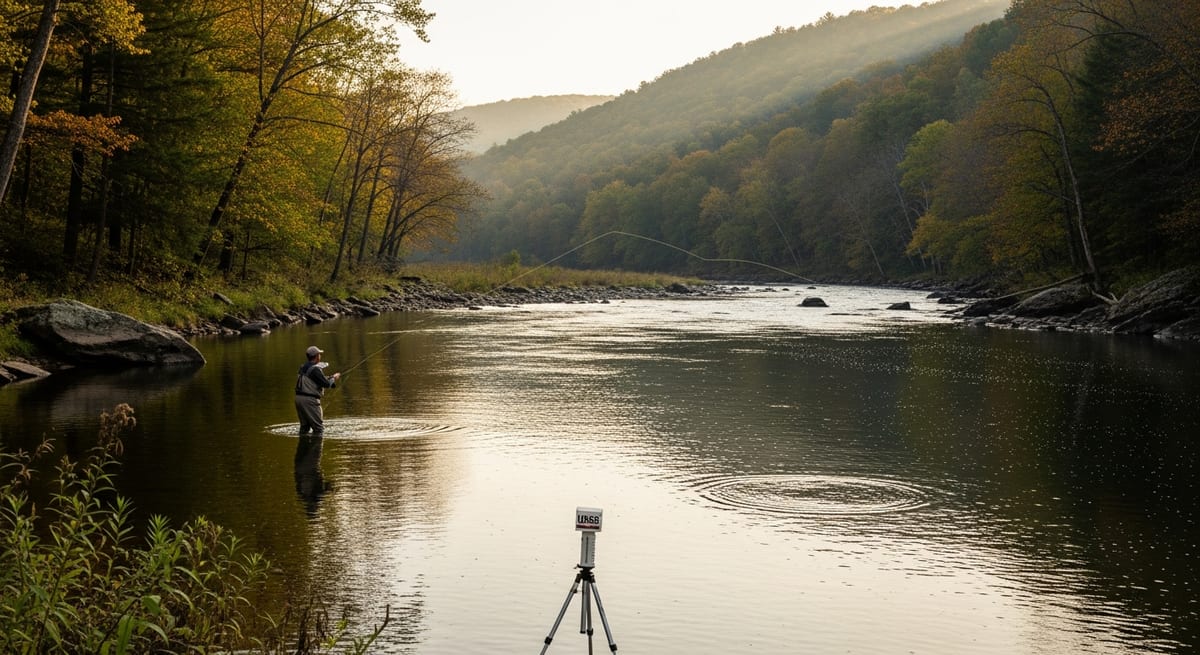
Fly anglers who have tracked the Housatonic TMA Hendrickson hatch across multiple seasons report the peak emergence rarely lands where the generic northeastern charts predict. Water temperature at the USGS gauge matters more than the calendar date, and spring runoff volume on the upper Farmington can shift the Quill Gordon window by a full week in either direction. Connecticut Fly Fishers Association (CTFA) bench sessions and Farmington River Anglers Association (FRAA) hatch reports surface this pattern every year: CT-specific timing diverges from the regional averages in most nationally printed hatch guides, sometimes by 10 days or more. What follows aggregates community-reported observations from the Farmington and Housatonic TMA, cross-referenced against public CTDEEP flow and temperature records, covering the major emergences from late March through November.
What CT River Regulars Actually Track: Water Temperature Over Calendar Date
Aquatic insects spend most of their life cycle as nymphs underwater. The emergence event, when nymphs rise to the surface and split their shuck, is when trout feed selectively on a single species and size. During a heavy hatch on the Farmington below Riverton or the Housatonic TMA through the Cornwall stretch, trout will often refuse anything that does not closely approximate the emerging insect in size, color, and stage.
CTFA members who post regular observations in the Farmington River corridor note that the water temperature trigger matters more than any specific date. The USGS Farmington River gauge at Tariffville and the Housatonic gauge at Falls Village both publish real-time temperature readings. Experienced CT regulars use these to anticipate emergence windows, particularly in early spring when air temperature and water temperature can diverge sharply.
The three stages that matter are the nymph (underwater, pre-emergence), the emerger (transitional, in the surface film), and the adult dry fly (fully hatched on the surface). CTFA bench sessions consistently emphasize emerger patterns as the most productive during the hatch window itself, often outperforming both deep nymphs and adult dry flies when fish are keying on the transitional stage.
Late March Through April on the Farmington and Housatonic: Quill Gordon and Hendrickson
Quill Gordon (Epeorus pleuralis): Typically the first significant hatch of the CT season, with emergence often beginning in the last week of March on the Farmington and mid-April on the cooler Housatonic TMA. Water temperature trigger is roughly 45 to 50 degrees Fahrenheit. Size 12 to 14, dark brown body, gray wings. Riffle sections below Riverton on the Farmington and the Church Pool stretch of the Housatonic TMA are areas FRAA members have noted as consistent Quill Gordon water.
Emergence tends to occur mid-afternoon on cold, sunny days. A Quill Gordon dry fly in size 14 or a soft-hackle wet fly swung just below the surface during the emergence window are the patterns CT regulars rely on. In high-water runoff years, anglers who fish both rivers report the hatch window can compress or delay by 7 to 10 days.
Hendrickson / Red Quill (Ephemerella subvaria): The Housatonic TMA Hendrickson hatch is a recurring topic in FRAA and CTFA discussions every April, consistently described as one of the most reliable dry fly events in southern New England. Peak emergence on the Housatonic typically falls in mid-to-late April when water temperature reaches 50 to 55 degrees, most often on mild, partly cloudy afternoons.
Dry fly options CT anglers reach for: Hendrickson pattern (size 12 to 14), Parachute Adams as a general approximation, CDC Emerging Dun during the hatch window, and Red Quill Spinner after the adults have mated and returned to the water. The spinner fall often occurs separately from the emergence, sometimes a day or two later in the same pool.
May Through June: March Brown and Sulphur, With Notes From CT River Communities
March Brown / Grey Fox (Maccaffertium vicarium): These overlapping hatches run from late April through June on both the Farmington and Housatonic TMA. Size 10 to 12, brown to olive body. CTFA members note the March Brown hatches throughout the day under overcast conditions rather than in a single concentrated window. A Grey Fox soft-hackle swung through transitional water is the technique most CT regulars describe for this hatch, particularly in the deeper runs below pocket water on the Farmington.
Sulphur (Ephemerella dorothea): May through June, with late May typically the peak on the Farmington. Size 14 to 18, pale yellow to sulphur body. The Sulphur hatch on the Farmington is an evening event, most concentrated in the final 90 minutes before dark. FRAA members who post hatch reports in late May consistently describe feeding activity that intensifies after 7pm on warm evenings and can continue past legal light.
Patterns CT anglers rely on: CDC Sulphur Dun (size 16), Parachute Sulphur for visibility in low light, Sulphur Poly Spinner for the spinner fall after dark. The Light Cahill hatches on similar timing with a cream or tan body in size 14. On evenings in early June when Sulphurs and Light Cahills overlap, having both available tends to matter on flat, slow pools where fish have time to inspect.
June Through July: Caddis Volume and the Trico Difficulty Gap on the Farmington
Caddisflies (Hydropsychidae and related families): By volume, caddis are the most abundant insect in CT rivers through late spring and summer. Evening hatches from late May through July on the Farmington can produce surface feeding across wide stretches of water. Size 14 to 18, tan, olive, or gray. The Elk Hair Caddis in tan or olive is the near-universal first choice among CT fly anglers for the evening caddis rise.
The spent-wing caddis pattern, a CDC Caddis spent-wing or similar flush-floating tie, fished in the surface film at dusk represents the spent adult stage and often outperforms upright dry flies when fish are taking naturals in the film rather than intercepting them at the surface. CTFA members note this distinction is among the most commonly missed by anglers who see caddis rises but fish conventionally.
Trico (Tricorythodes species): July through September, early morning spinner falls. Size 18 to 24, the smallest consistent dry fly fishing on CT rivers. The male spinner's white wings and the spent female on the surface are the visual trigger. FRAA hatch discussions consistently flag the Trico fall as the point where presentation precision replaces pattern selection as the primary variable. 7X tippet is standard among CT regulars, and drag-free drift on flat water is not optional.
Anglers new to the Farmington Trico window often report needing multiple seasons before they can read the fall reliably. The insects are difficult to see, the rising fish subtle, and the productive window is typically 6am to 9am before heat ends the activity.
August Through September: BWO, Isonychia, and the White Fly Window
Blue-Winged Olive (Baetis species): Present year-round in smaller sizes but particularly significant from August through September and again in October through November. Size 16 to 22, olive body, gray wings. The BWO is the classic overcast-day hatch on CT rivers. CTFA members and Farmington regulars consistently note that BWO emergence intensifies on cold, cloudy, drizzly afternoons when many anglers have already left the water. A Parachute BWO in size 18 or a CDC BWO Emerger are the standard CT patterns for this hatch.
Isonychia (Mahogany Dun): Late summer and early fall, size 12 to 14, dark burgundy to brown. Isonychia hatch in riffles and transitional water, often in the late afternoon. An Isonychia Dun dry fly is the standard match. Some CT anglers also fish the nymph as a swing through riffle edges during the hatch period, particularly on the Farmington's faster pocket water below the New Hartford section.
White Fly (Ephoron leukon): Late August through September, evening hatch on some CT river sections. When present, the white mayfly hatches in significant numbers at dusk and drives aggressive surface feeding. CTFA members who have encountered the White Fly on the Housatonic describe it as one of the most intense surface-feeding events of the season. A white dry pattern in size 14 to 16 fished at last light is the approach CT regulars use when the hatch is active.
October Through November: October Caddis, Fall BWO, and TMA Regulation Notes
October Caddis (Pycnopsyche species): Large orange or amber caddis, size 8 to 12. Late September through October on the Farmington and Housatonic TMA. The October Caddis is large enough to elicit aggressive feeding from fall trout that have been selective all summer. FRAA members note it as one of the few fall hatches that consistently draws big fish to the surface during daylight hours. An orange Elk Hair Caddis or orange Stimulator in size 10 covers the adult stage. An October Caddis soft-hackle or wet fly fished during the emergence itself also draws strikes on the Housatonic TMA's deeper runs.
Blue-Winged Olives: Return in force during overcast October and November days, using the same patterns as the summer run. Fall trout on both the Farmington and Housatonic TMA tend to feed more aggressively. Late-season BWO hatches on cold, cloudy afternoons can produce exceptional surface activity in the 45 to 55 degree water temperature range.
Stoneflies: Several stonefly species are present in CT rivers year-round. Large stonefly nymph patterns, black stones in size 6 to 8, fished deep are productive in fall when adults are on the water. CTFA members report consistent stonefly activity on faster sections of the Farmington, particularly below the Still River confluence, as a reliable fall nymphing option when surface hatches are absent.
Regulations: Both the Housatonic TMA (West Cornwall through Housatonic village) and the Farmington River TMA (below Goodwin Dam through Burlington) carry special fly-fishing-only or artificial-lure restrictions with size and creel limits that differ from general trout regulations and have been updated in recent seasons. Anglers should verify current rules in the CTDEEP 2025-2026 Inland Fishing Guide before fishing either TMA.
EVERY SATURDAY MORNING
Weekly fishing intelligence
Nationwide conditions, what's biting, and honest gear deals. One email, no noise.
No spam. Unsubscribe anytime.