
The Farmington Peaks in October. The Housatonic Peaks in May. Most CT Fly Fishers Never Figure Out Both.
Three Tiers of CT Trout Fishing, and Why Most Fly Fishers Only Ever Work the First
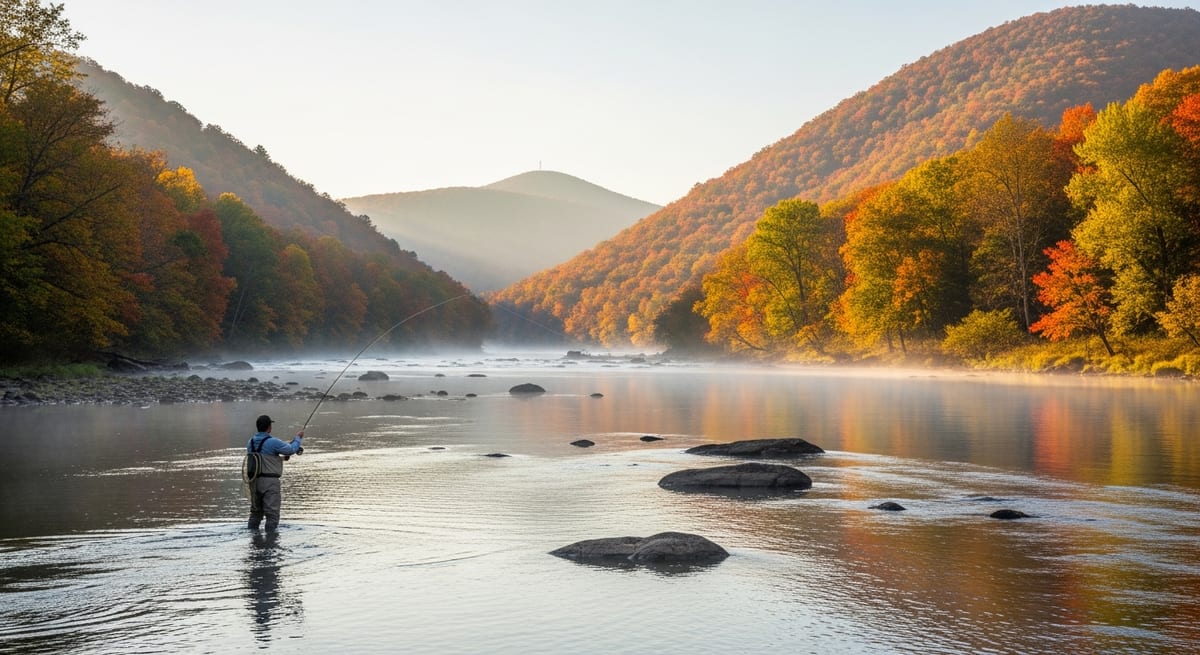
Farmington River TMA regulars who fish through October consistently report that the October Caddis, big, clumsy orange bugs in sizes 8-10, produces some of the best dry-fly action of the year, on water that holds a fraction of the May crowd. That seasonal blind spot repeats across Connecticut's trout fisheries: popular water fished at the wrong time by anglers who know only one rhythm tells you almost nothing about what's actually possible here.
CT's fly fishing divides into three distinct tiers. The catch-and-release TMAs on the Housatonic and Farmington are the crown jewel, wild and holdover brown trout, serious hatches, year-round cold flows. Below that sit the CT DEEP-stocked freestone rivers, which fish well in a defined window from late March through early June (per the CT DEEP annual trout stocking calendar, published each season at ct.gov/deep) before summer heat moves fish into the deepest pools. And in the northwest corner of the state, Litchfield County holds small wild brook trout streams, native fish in headwater hollows that most CT fly fishers never locate.
Each tier asks for something different. The two TMAs in particular reward completely different approaches at different points in the season, understanding both is what separates CT fly fishers who fish year-round from those who pack it in by September.
The Housatonic TMA: World-Class Spring Fishing, Crowded on the Best Days
The upper Housatonic TMA, cornwall Bridge downstream to the covered bridge in West Cornwall, is the stretch that gets written up in national fly fishing magazines, and the write-ups reflect a legitimately strong fishery. It is frequently cited in regional fly-shop circles and CT DEEP trout literature as among the finest stretches of publicly accessible trout water in the Northeast. Wild and holdover brown trout dominate, the Hendrickson hatch in late April pulls anglers from all over New England, and by May, Sulfur evenings on this stretch are legitimately world-class.
What those profiles tend to skip: the Housatonic TMA is crowded during peak hatches in ways that change how fish behave. Browns in this stretch have seen thousands of flies. On a busy May evening, presentation matters more than pattern, and anglers who wade a quarter mile upstream from the main pull-off consistently report outfishing the crowd at the parking area.
The lower TMA section below Bulls Bridge dam, from Merwinsville downstream toward the CT-NY state line near Wingdale in Dutchess County, NY, gets a fraction of the pressure the upper section does and holds fish well into fall. Anglers should note that water crossing into New York is governed by NYSDEC regulations, not Connecticut's; confirm current rules for both states before fishing below the border. For anyone who finds the upper section too crowded from August onward, the lower water is worth the scouting trip.
The Farmington TMA: The River That Rewards Patience and Technical Fishing
The Farmington River TMA, riverton downstream through Pleasant Valley below Colebrook Reservoir, is the one most often recommended for first-time CT fly fishers before moving to the Housatonic. The reservoir release keeps water temperatures stable year-round. Trout survive and grow; the Farmington River Anglers Association (FRAA) has documented brown trout over 20 inches in this stretch through recent catch surveys, though the river doesn't give them up easily on a first visit.
The Farmington is also more technically demanding than the Housatonic. Trico spinner falls in July and August, tiny #22-26 flies on flat, clear water, are where anglers either solve the puzzle or spook every fish in the run. The consensus among Farmington regulars, reflected across FRAA member reports and guided-trip feedback, is that the fly pattern matters less than achieving a drag-free drift on clear, low-gradient water before the sun hits the pool. Guides working this stretch regularly note that visiting anglers over-change flies and under-work their presentation.
Late September and October on the Farmington is widely regarded, among anglers who fish both TMAs year-round, as the best fly fishing Connecticut offers. October Caddis bring up big fish, crowds thin considerably, and the river is at the peak of its holdover season. Most CT fly fishers concentrate on the Housatonic in spring and stop fishing by September. That late-season window on the Farmington is the gap worth building a calendar around.
Willimantic River TMA in Windham County rounds out the options as an undervisited third alternative, quality catch-and-release fly fishing in an eastern corner of the state that most Housatonic-focused anglers never consider.
Stocked Rivers: The Eight-Week Window Most Anglers Compress to One Day
Per the CT DEEP annual trout stocking calendar, the main stocking window runs from late March through early May on most rivers, with supplemental stocking extending into June on select stretches (check ct.gov/deep for the current season's schedule before planning a trip). A pattern common among newer stocked-river anglers: showing up once in the first week of April, fishing the obvious access point where the stocking truck last stopped, and measuring all of CT's put-and-take fishing by that single crowded experience.
Anglers who return after the initial pressure wave typically find better conditions. Holdover fish settle into structure and stop stacking in the most obvious pools. These are the rivers worth your time outside the TMAs:
Salmon River (Colchester): The section below the Salmon River State Forest parking area is among the most accessible public fly fishing destinations CT offers. Consistent stocking, readable pools, enough flow to fish a nymph rig through early June. Anglers who fish this stretch in late April regularly report strong surface action in the riffle above the main pull-off, not on opening day, but after the initial pressure subsides.
Natchaug River (Chaplin/Hampton): Eastern CT freestone with solid stocking and meaningful wild carry-over in the colder, shaded sections upstream. Anglers making the trip to fish the Willimantic TMA often add an afternoon on the Natchaug on the same trip east.
Eightmile River (Salem/East Haddam): A Connecticut River tributary that gets overlooked because it lacks the name recognition of the major TMAs. Early-season action can be strong, and low weekday pressure is frequently reported by anglers who fish it in April while the Farmington draws the regional crowd.
Most stocked rivers lose their best fly fishing by late June as water temperatures climb. The TMAs are the destination once summer sets in.
Wild Brook Trout in the Northwest Corner (Most CT Anglers Never Find These)
The northwest corner of Connecticut. The Berkshire-Taconic foothills of Litchfield County, holds remnant wild brook trout populations in small headwater streams. These aren't stocked fish. They're native brookies in their historic range, living in streams so small that most anglers drive past without a second look.
Finding them takes real legwork. The working filter used by CT wild brookie hunters: streams in state forests with dense hemlock canopy, minimal agricultural disturbance, and water cold enough to numb a hand in August. That last condition eliminates most candidates. The highlands around Cornwall, Goshen, and Sharon are where concentrated searches tend to pay off, according to accounts across CT fishing forums and CT DEEP's publicly available wild trout stream classifications, which designate verified wild brook trout habitat by watershed.
Gear for small-stream brookies: A 2-3 weight rod, 7-9 feet, longer becomes unworkable in tight streamside cover. Small Elk Hair Caddis, Adams, and Parachute patterns in sizes 14-18 cover most situations. Wild brook trout in these streams aren't selective, but they're spooky. The approach anglers who fish them consistently describe: staying low, coming from downstream, keeping shadows off the water. Fish are rarely large: 6-10 inches is a good brookie in these streams, but they're native fish in historic habitat, and the experience is unlike anything else CT trout fishing offers.
CT Trout Hatch Calendar, and What the Charts Don't Tell You
Spring (April-May):
The season opens with Blue-Winged Olives. Most reliable on overcast, cool days. The Farmington fishes this hatch particularly well because the Colebrook Reservoir release buffers water temperature against the air-temp swings that shut off surface activity on freestone rivers. Hendricksons arrive in late April as the signature hatch on both TMAs; Farmington regulars and guides consistently report that the best Hendrickson activity happens at around 50°F and spitting rain. The precise conditions that move casual anglers off the water and leave the pools to those who stay. Quill Gordons appear on freestone rivers early in the season: timing is inconsistent, but when they align with the right afternoon temperature window they can produce excellent dry-fly fishing.
May through August:
Sulfur evening hatches run from mid-May through June on both TMAs. The hatch looks simple on paper, but experienced Farmington and Housatonic anglers note that fish key in on the dun, the spinner, or the emerger at different points in the evening, matching the stage matters more than the exact pattern. Elk Hair Caddis (tan and green) are useful from May through September on any CT trout water.
Trico spinner falls in July and August, #22-26 morning falls on the Farmington, are a consistent technical barrier for anglers fishing the TMA for the first time. FRAA member reports and guided-trip feedback that circulates in CT fly fishing communities point to the same diagnosis: fish can be rising across the entire pool and refuse every fly until the angler achieves a truly drag-free drift on flat, clear water before the sun hits the run. The fly is rarely the variable.
Foam-body ants in size 18-20 on the Housatonic are a summer terrestrial option that receives less attention than it deserves relative to the consistent action anglers report on them.
Fall (September-October):
Blue-Winged Olives return as the most reliable fall hatch on both TMAs. October Caddis, large (#8-10) orange caddis on the Housatonic and Farmington, are the hatch that keeps experienced CT fly fishers wading well into November when most of the state has packed away gear for the year. Brown trout moving into pre-spawn mode respond well to streamers (Woolly Bugger, Muddler Minnow) alongside the dry-fly options.
Always carry: BWO 16-20, Parachute Adams 14-18, Elk Hair Caddis 14-18, Hare's Ear and Pheasant Tail nymphs 14-18, and a handful of size 8-10 October Caddis dry flies from mid-September on.
EVERY SATURDAY MORNING
Weekly fishing intelligence
Nationwide conditions, what's biting, and honest gear deals. One email, no noise.
No spam. Unsubscribe anytime.