
CT Kayak Anglers Fish the Coves and Dock Lines That Powerboats Blow Past. What Community Reports From Candlewood, Lake Lillinonah, and Bantam Lake Reveal About Quiet-Approach Bass Fishing in Connecticut
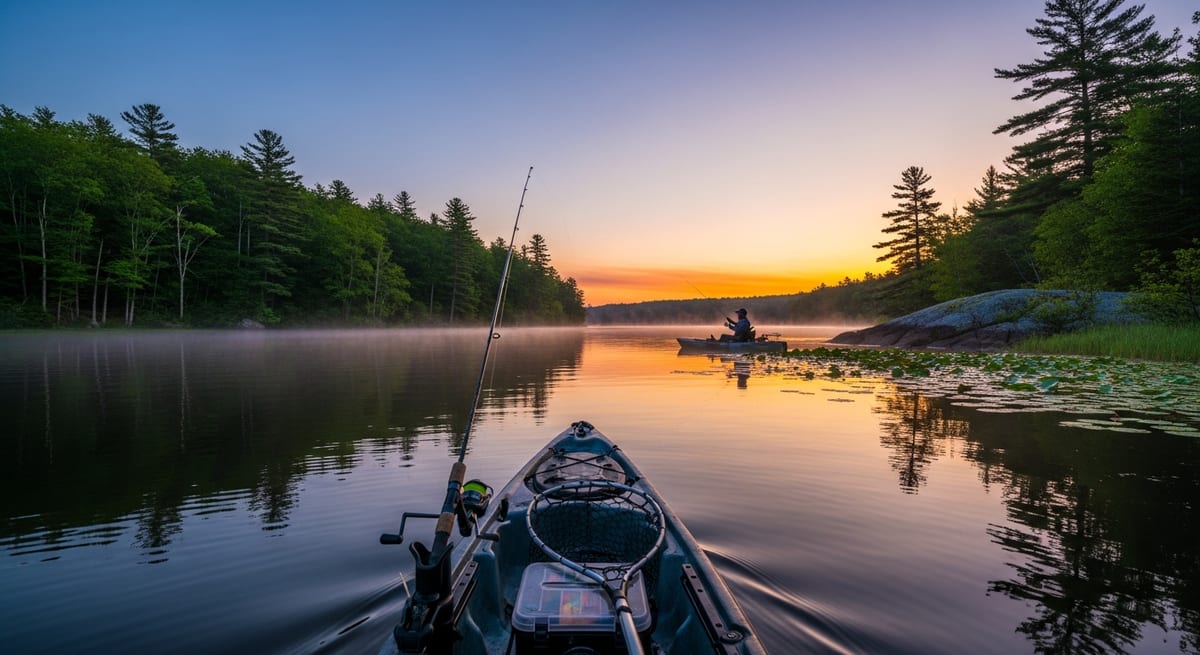
Anglers who paddle the protected coves on Lake Lillinonah's northern basin report consistent largemouth from mid-May through early June, fish holding tight to submerged timber in 2-4 feet that powerboat anglers tend to push off the moment they idle in. That same dynamic plays out across Connecticut's best kayak bass water: Candlewood's pressured dock sections, Bantam Lake's shallow weed flats, and the quieter backwaters on Tyler Lake all hold fish that react differently to a silent approach than to everything else on the lake. Community reports from CT kayak bass anglers through spring 2026 consistently point to the same pattern: slow-water structure on low-traffic days produces fish across the season in ways that power-fishing schedules rarely replicate.
The Quiet Approach: How CT Kayak Anglers Access Structure That Pressured Bass Avoid
On Candlewood Lake and similar high-traffic CT impoundments, bass in clear water respond to boat noise. Anglers who fish the dock lines on Candlewood's western shore describe observing the same pilings go cold within minutes of a gas-motor pass, then reset after the disturbance clears. A paddle kayak approaching from the far end of a dock, low-profile and without motor wash, arrives at a bass that has not been pushed down.
The pattern comes up repeatedly in CT kayak bass community discussions: dock lines and rocky points that appear unproductive mid-morning after powerboat traffic often produce fish for kayak anglers willing to approach slowly from deep water rather than motoring up from the launch ramp.
Pace also plays a role. CT kayak anglers who work Bantam Lake's weed edges describe making eight to ten casts per dock or point before moving, a thoroughness that boat-fishing schedules rarely allow. The consensus among experienced CT kayak bass anglers is that methodical coverage, combined with the silent approach, accounts for the difference on pressured water.
Launch Access and Water Character: CT Lakes Where Kayak Anglers Report Consistent Bass
Candlewood Lake (Fairfield and Litchfield Counties): 5,420 acres with the highest dock density of any CT lake. Kayak anglers launch from Squantz Pond State Park on the northern end; a CT boat launch sticker covers the ramp fee in season. The northern basin near Sherman and New Fairfield draws kayak anglers specifically because powerboat traffic is lighter than in the southern sections. Pre-spawn largemouth in protected coves from late April through May; smallmouth on the rocky points off Pootatuck State Forest shoreline in June and September.
Lake Lillinonah (Housatonic River chain, Brookfield/Newtown/Monroe): State boat access on Route 133 in Brookfield; a second access point on River Road in Monroe provides better reach to the upper basin. Extensive shallow coves with submerged timber and emergent vegetation make this high-density largemouth habitat throughout Fairfield County. Anglers who fish the upper basin's creek inlets and timber-rich backwaters report bass concentrations in 2-6 feet over submerged structure from May through July.
Bantam Lake (Litchfield): Connecticut's largest natural lake at 947 acres. Town launch off Route 209. Clear, shallow water means kayak anglers describe positioning the kayak 30-40 yards from dock lines to avoid pushing fish before the first cast. The western flat's weed edge produces largemouth from June through August; the drop-off on the eastern shore holds smallmouth in 8-14 feet.
Tyler Lake (Goshen) and Lake Pocotopaug (East Hampton): Both are smaller, high-clarity impoundments with limited powerboat pressure relative to Fairfield County lakes. Tyler Lake has a hand-carry launch off Route 4. Lake Pocotopaug has a town ramp on Main Street in East Hampton; anglers who work the northern coves through early summer report consistent largemouth on weed structure.
Moodus Reservoir (Colchester/East Haddam): State boat ramp on Moodus Reservoir Road. Irregular shoreline with multiple rocky points, creek arms, and vegetation pockets that kayak anglers can work methodically. Lower pressure than most Fairfield County destinations.
Farmington River (Burlington to Windsor sections): An atypical application: inflatable or hard-shell kayaks floated through Class I-II sections while targeting smallmouth on current-seam structure. The section below Collinsville Dam through Burlington produces smallmouth on rocky ledges. The Farmington River TMA sections carry distinct rules under CT DEEP 2025-2026 freshwater regulations; anglers should verify boundaries before the float.
Working the Structure: How CT Kayak Anglers Fish Dock Lines, Cove Edges, and Rocky Points
Dock lines on pressured lakes: CT kayak bass anglers on Candlewood describe approaching from the far end of a dock rather than the side, keeping the cast parallel to the dock face and covering more pilings per position. A Texas-rigged Senko or finesse worm pitched to each piling, followed by a drop shot along the deeper pilings in 6-10 feet, is the most commonly reported dock-line sequence. Working the same dock on the return pass often produces a second fish after the first has settled.
Cove vegetation: Shallow CT coves with lily pads or emergent grass are typically approached from the open-water side, casting inward rather than paddling into the mat. Community reports from CT kayak anglers cite hollow-body frogs for surface coverage over matted vegetation and beaver-tail jigs or Texas rigs along the outer weed edge. Water temperatures above 65 degrees Fahrenheit in late spring correlate with the most consistent frog bites in CT kayak reports from the Lillinonah basin.
Rocky points for smallmouth: Lake Lillinonah's rocky main-lake points and Bantam Lake's eastern drop-off produce smallmouth reliably from June through early September. Anglers who target these areas approach from deep water, positioning the kayak at the base of the point and working progressively shallower. A drop shot with a 3-inch finesse worm or a shakey head jig in 6-12 feet produces fish when surface temperatures push bass off the flats.
What Experienced CT Kayak Bass Anglers Carry on Larger Lakes Like Candlewood and Lillinonah
Rod setup: CT kayak bass anglers on dock-heavy lakes typically fish two to three rods rigged and ready: a medium-heavy baitcaster for Texas and flipping applications (7 feet to 7'3" is the length that comes up most often in CT kayak bass discussions, giving extra casting reach without the rod-management issues of longer sticks in a cockpit), a medium spinning rod for drop shot and finesse presentations, and an optional spinning rod for topwater.
Anchoring and position control: A 3-5 lb folding grapnel anchor with 20-25 feet of rope handles most CT lake conditions. Anglers who fish Bantam Lake's exposed main basin describe a kayak anchor trolley, a cord running bow-to-stern that adjusts where the anchor rope attaches, as providing significantly better position control when afternoon wind shifts mid-session. Bow attachment for facing into current; stern attachment for facing downwind.
Electronics: A Garmin Striker 4 or Humminbird HELIX 5 on a RAM arm provides structure and depth information that changes how anglers read unfamiliar water on larger lakes. Particularly useful on Candlewood's varied bottom composition and Lake Lillinonah's submerged timber fields, where visual reading of structure is limited.
Dry storage: A waterproof case or dry bag for phone, keys, and electronics is standard equipment on open-water CT lakes where afternoon wind chop can develop quickly from the southwest.
CT Regulations, Lake Conditions, and What Changes How Kayak Anglers Plan a Day on the Water
Bass regulations for 2025-2026: Under CT DEEP 2025-2026 freshwater regulations, Connecticut maintains a 12-inch minimum size limit and a 5-fish daily creel limit for largemouth and smallmouth bass combined during the regular season. A small number of CT impoundments carry modified limits; anglers should verify any special-regulation waters directly in the CT DEEP 2025-2026 Freshwater Fishing Guide before fishing unfamiliar lakes.
PFD requirements: Connecticut law requires a Coast Guard-approved life jacket on board for each occupant of a kayak. Wearing it rather than just carrying it is strongly encouraged on CT's larger open lakes. Candlewood Lake and Lake Lillinonah can generate significant wave action in afternoon southwest winds; capsizing in open water on either lake is a real scenario, not a theoretical one.
Weather windows: CT lake weather changes rapidly in spring and summer. Afternoon thunderstorms can develop in under 30 minutes. The standard guidance among CT kayak anglers is to leave open water when thunder is audible, without waiting for lightning to become visible. Morning sessions on large lakes are typically calmer; southwest winds often build after noon on Candlewood and Bantam Lake.
Float plan: Sharing your destination, launch location, and expected return time with someone before launching is standard practice among experienced CT kayak anglers on water where cell coverage can be intermittent.
EVERY SATURDAY MORNING
Weekly fishing intelligence
Nationwide conditions, what's biting, and honest gear deals. One email, no noise.
No spam. Unsubscribe anytime.