
Bantam Lake and Wangumbaug Frog Anglers Report Most Missed Strikes Happen in the First Heartbeat After the Explosion, Not the Cast. What CT Lily Pad Lakes, DEEP Freshwater Bass Regulations, and Summer Topwater Communities Reveal About Getting a Hollow-Body Frog to Convert
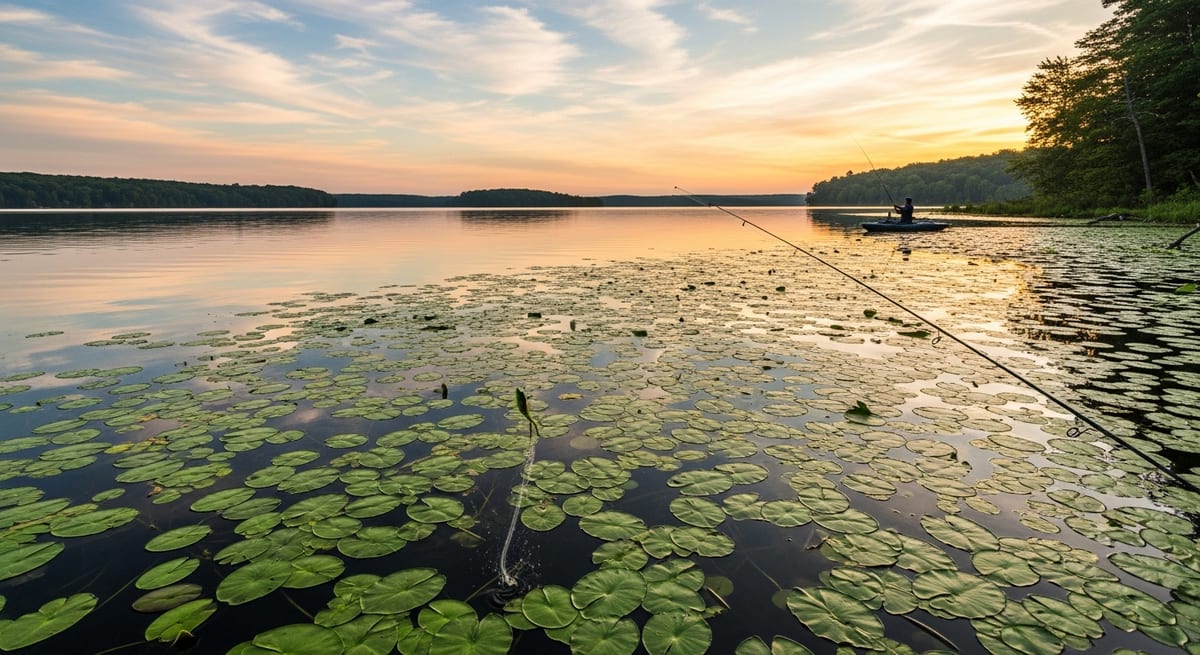
CT bass anglers who fish lily pad fields on Bantam Lake and Lake Pocotopaug consistently report two things about frog fishing: the strike is always more violent than expected, and the hookset window is tighter than it looks. A hollow-body frog is one of the few presentations that works through vegetation thick enough to stop any other bait. Matted hydrilla, wall-to-wall lily pads, emergent cattail edges. Bass hold under that cover in July and August and won't move to open water to eat. The challenge anglers on Wangumbaug and Gardner Lake describe isn't finding the fish or placing the cast. It's resisting the instinct to set the hook the moment the water explodes.
The Vegetation Trigger: When CT Frog Conditions Come Together
Frog fishing on CT lakes is tied to two conditions: water temperature and surface vegetation density. The consistent threshold reported by bass regulars on Bantam, Pocotopaug, and Mashapaug is 65°F surface temperature. Below that, bass under pad fields tend to be sluggish and short-striking. USGS gauge data from CT rivers typically shows surface temps clearing that threshold in mid-to-late May, though conditions vary by year and water body.
The peak frog window on most CT lakes runs June through September. August tends to produce the most consistent topwater activity, particularly in the early morning hours when bass have moved tight to pad edges overnight before pulling to deeper structure in the midday heat. Overcast mornings extend the topwater window significantly. Anglers on Wangumbaug report fish hitting frogs past 9 AM on heavy overcast days, versus a roughly 7:30 AM cutoff in full summer sun.
What the cover looks like matters as much as timing. Dense lily pad fields, matted milfoil or hydrilla, emergent cattails, and mixed surface vegetation all hold fish. The pockets within the mat, patches of dark water visible through the vegetation, are where strikes concentrate. Bass sit beneath the mat looking up, and those openings are the windows they're watching.
Rod, Reel, and Braid: No Shortcuts on Frog Gear
CT frog anglers who have worked through multiple setups consistently land on the same configuration: 7 to 7.5-foot heavy or extra-heavy baitcasting rod with a fast to extra-fast tip. The heavy power is about turning a fish's head before it can wrap around pad stems. A medium-heavy rod does not generate enough lift through thick cover to keep a fish moving.
A high-speed baitcaster at 7.1:1 ratio or faster is standard. After the hookset you need to pick up slack and keep the fish moving toward you before it can burrow deeper into the mat.
50 to 65 lb braid only. Monofilament or fluorocarbon stretches enough to absorb hookset force through the compressed body of a hollow frog. The hooks won't penetrate consistently. Braid has zero stretch, so the full force of the rod translates directly to the hook points. This difference is not marginal on a frog strike.
Frogs that come up consistently in CT topwater discussions: SPRO Bronzeye, Booyah Pad Crasher, and Livetarget Hollow Body Frog. Standard sizes for CT waters are 3/8 to 1/2 oz. Rig the frog so the hook points sit slightly upward rather than flat against the body. Anglers who track their hookup rates report a consistent improvement with the upward-angled hook position.
Under DEEP 2025-2026 freshwater regulations, largemouth bass carry a 12-inch minimum and a 6-fish daily limit on most CT inland waters. Verify the current DEEP Freshwater Fishing Guide before fishing any specific impoundment. Trophy-lake designations and slot limits apply to select waters and change from year to year.
Walking a Frog Across CT Pad Fields
The standard frog retrieve is the walk: rod tip angled downward rather than parallel to the water surface, short downward pulls that make the frog walk left-right while you reel in slack. The back legs kick on each directional change. Over open water adjacent to vegetation, a continuous moderate walk produces strikes. Over pad fields, the retrieve changes.
Over heavy vegetation, the productive pattern anglers describe is cast-and-pause. Land the frog on a pad, let it sit, twitch it toward the edge, and pause it directly over any opening or pocket in the vegetation. A 3 to 5-second pause directly over a dark-water pocket is often where the strike comes. Long pauses are more productive than continuous movement on most CT frog water.
The dragging technique produces fish on thick pad stems and matted surfaces: drag the frog slowly across stems every 2 to 3 feet, pausing at each edge. This mimics a frog moving across a pad surface toward open water. Bass often follow under the mat and commit when the bait stops moving.
Casting accuracy matters more than distance. The target is a specific pocket, typically 12 to 24 inches across, not a general zone. Bass orient upward under the mat, and a frog landing directly over a pocket versus 18 inches off produces different results, particularly on pressured lakes where fish have seen the same presentations through the whole summer.
The Wait After the Explosion: Why Hookset Timing Takes a Full Season to Learn
The most consistent finding reported across Bantam, Candlewood, and Gardner frog anglers is that hookset timing is the last thing most anglers develop, not the first. When a bass hits a frog from underneath dense vegetation, the strike is a water explosion. The visual and audio cue triggers an immediate set-the-hook reflex. That reflex is wrong.
At the moment of the explosion, the bass has launched at the bait but hasn't yet turned with the frog secured in its mouth. Setting the hook at the visual strike compresses the hollow body and the frog shoots out. Hookup rates on premature sets are very low.
The correct sequence: when the water explodes, reel down to eliminate slack and wait. Wait until you feel the weight of the fish pulling. Then drive the rod hard to the side, not straight up, with maximum force. The wait is typically 1 to 2 seconds. Under adrenaline it feels much longer.
Anglers who fish frogs regularly on Wangumbaug and Mashapaug describe counting aloud after the explosion, "one, two," until the delayed set becomes automatic. Overriding the set-at-the-splash instinct is the actual learning curve in frog fishing. Most anglers who commit to a summer of dedicated frog fishing report the delay doesn't become reliable until late in the season.
When the Bass Misses: Reading the Follow-Up
Short strikes and missed explosions happen in frog fishing. The response to a missed strike is not to move the bait away immediately. Let the frog sit in the strike zone for 5 to 10 seconds. Bass regularly circle back within seconds of missing, and a stationary frog in the pocket draws a second look.
If the fish doesn't return, walk the frog slowly away from the strike zone and off the pad field. Wait 30 to 60 seconds, then cast back to the same pocket. Bass under cover don't leave after a missed strike.
When fish are hitting short or blowing up without committing repeatedly, a few adjustments help. Re-rigging with the hooks positioned slightly closer to the tail improves conversion for many anglers. Slowing the retrieve and increasing pause time to 4 to 6 seconds instead of 2 to 3 changes the presentation enough to trigger a cleaner commitment.
A smaller frog, 3/8 oz instead of 1/2 oz, is a common mid-August adjustment reported on high-pressure CT lakes by anglers seeing fish blow up short on the standard size. Late-season fish on heavily fished water have seen the 1/2 oz bait repeatedly, and the size shift can be enough to produce a clean strike.
CT Lakes With Enough Pad Coverage to Make Frog Fishing Work
Not every CT lake has sufficient surface vegetation for frog fishing. The technique requires dense lily pad fields, matted hydrilla or milfoil, or heavy emergent cover. Scattered pads don't produce the same holding structure. Lakes that come up consistently in CT bass communities:
Bantam Lake (Morris): The northern bays hold extensive lily pad fields through August. Bantam is one of the most frequently cited CT frog lakes, with pad coverage dense enough to hold fish through the heat of summer. It also receives high fishing pressure. Early morning is the more productive window. Public boat launch off Bantam Road.
Wangumbaug Lake (Coventry): Solid vegetation structure in the shallower bays. Receives less pressure than Bantam and has produced consistent summer topwater reports in CT bass communities. State boat launch off Lake Street.
Gardner Lake (Bozrah): Good summer lily pad development, particularly along the eastern shoreline. Public boat launch at Gardner Lake State Park.
Mashapaug Lake (Union): Pad fields with documented bass density in the northeastern corner of CT. A less-pressured option for anglers willing to make the drive. Public access via Bigelow Hollow State Park.
Lake Pocotopaug (East Hampton): Vegetated areas produce topwater strikes through summer. Pad coverage is more patchy than Bantam's northern bays but the lake holds largemouth in good numbers. State boat launch on Route 66.
Smaller town ponds throughout CT often hold better vegetation and significantly less pressure than the major lakes. A small pond with wall-to-wall pads and no public launch frequently produces more willing fish than a large impoundment with a boat ramp and weekend pressure. DEEP's CT Lakes and Ponds listing notes public access points by town.
EVERY SATURDAY MORNING
Weekly fishing intelligence
Nationwide conditions, what's biting, and honest gear deals. One email, no noise.
No spam. Unsubscribe anytime.