
Bantam Lake Bass Are on Beds When Candlewood's Are Still in Pre-Spawn. What CT Anglers Who Track the Spawn Window Report About Lake-to-Lake Sequencing, Sight-Fishing the Beds, and the Finesse Slump That Follows
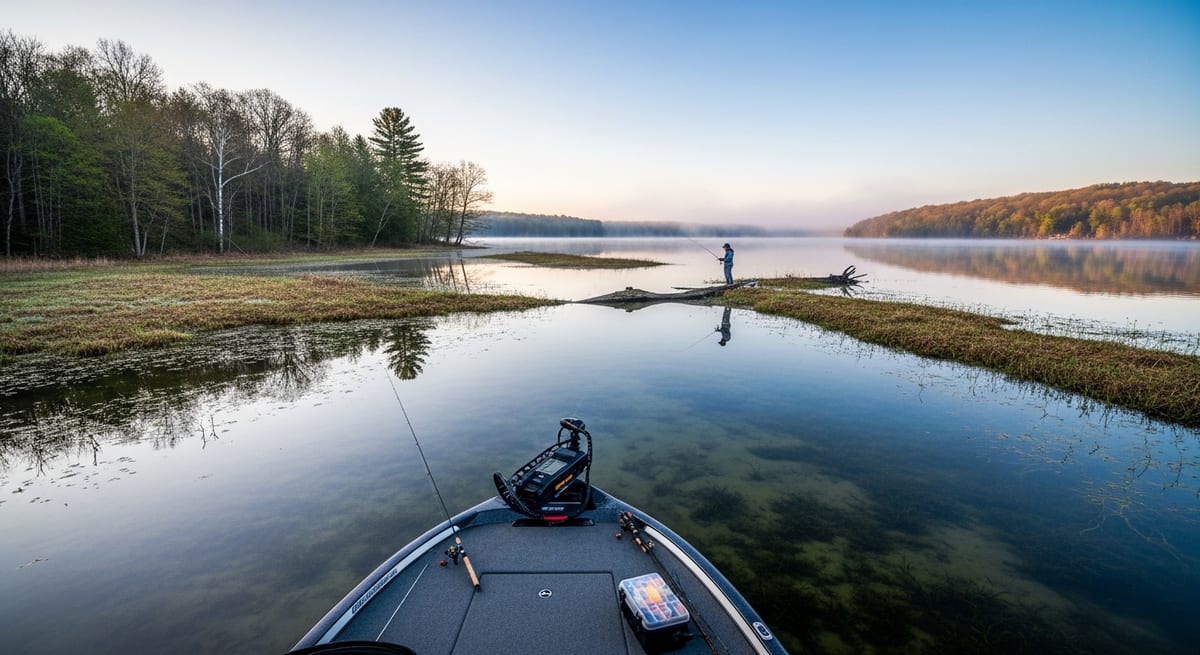
Bass spawning beds on Bantam Lake show up as pale sand circles against the darker bottom, fanned clean by guarding males, and anglers fishing from kayaks with polarized glasses report spotting them in as little as 18 inches of water by the second week of May in a typical spring. The same beds appear on Moodus Reservoir and Gardner Lake roughly one to two weeks later, and on Candlewood and Lake Lillinonah later still, where greater average depth keeps surface temperatures below spawn range longer. CT anglers who track the transition consistently report this shallow-to-deep lake sequence holds most years, which means the fishing window is not a single statewide event, but a rolling two-to-three-week stretch when one CT lake or another is in full spawn mode.
The Spawn Sequence Across CT Lakes
Bass spawn when water temperatures reach roughly 60-65°F for largemouth and 55-62°F for smallmouth, though these thresholds come from regional fisheries literature rather than published DEEP survey data specific to Connecticut. Anglers who monitor surface temps with a handheld gauge report that smaller, shallower lakes like Bantam (Litchfield County) and Moodus Reservoir (New London County) typically hit those thresholds 10-14 days ahead of larger impoundments.
In most years, Bantam and Moodus beds go active in the first two weeks of May. Candlewood and Lake Lillinonah. Both deeper and larger, typically follow in the second half of May through early June. Year-to-year variation is real: a cold, wet April can push everything back two weeks; an early warmup in late March can pull the window forward.
Male bass fan out circular nests on firm substrate, sand, gravel, hard clay, or flat rock, in 1-4 feet of water in protected coves and bays. Males guard the eggs and larvae while females stage nearby on adjacent deeper structure. Anglers targeting females during the spawn report finding them in 6-10 feet just off the spawning flat, often suspended near a point or creek-channel edge while males tend the beds.
Consult the DEEP 2025-2026 Connecticut Freshwater Fishing Guide directly for bass season dates and size limits before fishing, regulations vary by specific water body and should not be assumed uniform across the lakes mentioned here.
Reading Beds on CT's Clear-Water Lakes
On clear-water lakes like Bantam and the upper arms of Lake Lillinonah, spawning beds appear as pale circles, sometimes 18-24 inches across, against darker soft bottom. Anglers kayak-fishing the shallows with amber or copper polarized glass lenses report spotting beds from 15-25 yards in good morning light. The difference between quality glass lenses (Costa, Maui Jim) and polycarbonate clip-ons is noticeable on these lakes; lower-angle morning light cuts better through glass.
Structure patterns CT anglers reliably find beds near: protected coves on the north and east sides of lakes, sheltered from the prevailing southwest wind; gradual slopes from 4-6 feet down to 1-2 feet over hard bottom; wood, boulders, or dock pilings that give males a structural reference point and shade cover.
On Moodus Reservoir, the coves off the eastern arm of the main basin hold consistent spring beds, according to anglers who fish it every May. On Bantam, the shallower northern and western arms warm fastest and are the first to show activity. On Lillinonah, the back ends of coves above the Lovers Leap section hold structure-associated beds through mid-May in most years.
Carry a handheld surface thermometer. When you find 60-65°F in a protected shallow cove with firm bottom, beds are either active or arriving within days.
The Pre-Spawn Window, what CT Anglers Consistently Target Instead
The consensus among CT bass anglers who fish the full spring sequence is that the two-to-three weeks before the beds appear produce the most consistent results of the year. Pre-spawn fish have emerged from winter, are feeding aggressively to build reserves, and concentrate in predictable transition areas, points and channel edges adjacent to spawning flats, typically in 6-12 feet of water.
Lipless crankbaits worked along hard-bottom and grass-edge transitions draw reaction strikes from fish actively covering water. CT bass anglers commonly cite the Strike King Red Eye Shad and Yo-Zuri Rattl'n Vibe in shad or crawfish colors as pre-spawn staples when water temperatures are in the 52-58°F range. A medium-heavy rod in the 7-7'3" range with 15-17 lb fluorocarbon gives enough throw-weight for the bait while absorbing the treble-hook hookset.
As temperatures climb toward spawn range, many CT anglers shift to swimbaits and 3/8 oz spinnerbaits along main-lake points. Once fish are clearly in transition mode, drop shot and Ned rig presentations on 6-8 lb fluorocarbon consistently pick up fish that will not commit to moving baits.
Anglers who fish Bantam's shoreline points in late April and early May report the pre-spawn window ends abruptly. Fish that were active along structure seem to disappear into the shallows within a few days once bed activity starts. Watching the coves for the first pale circles is often the signal that the transition is complete.
Fishing Bedded Bass: What Anglers Report and What DEEP C&R Guidance Suggests
Sight-fishing to bedding bass, presenting a lure directly to a visible nesting male until it strikes, is practiced on Connecticut's clear-water lakes during the spawn. Whether specific waters carry restrictions on taking fish from spawning areas should be confirmed in the DEEP 2025-2026 freshwater regulations before fishing; anglers should not assume a blanket rule applies across all CT waters.
Anglers who regularly target beds on Bantam and Moodus report the male is catchable but requires persistence. A Yamamoto Senko in natural green pumpkin or a white tube on a 1/16 oz jig head, dropped directly onto the bed and left in place, draws strikes when the male perceives a genuine threat to the eggs. Repeated casts past the fish without contact often cause the male to flush; waiting and returning is often more effective than high-frequency casting.
Responsible handling is standard practice regardless of regulations. Minimizing air exposure and returning the fish directly to the bed allows a healthy male to resume nest guarding within minutes, cT anglers report this is consistently observed when releases are made quickly. Prolonged fights or repeated targeting of the same fish noticeably reduce the male's responsiveness and increase the risk of nest abandonment, per regional fisheries literature; CT-specific DEEP nest disturbance data for Connecticut lakes is not publicly available.
Many CT bass anglers who fish the spawn period skip the beds entirely and focus on pre-spawn staging and post-spawn finesse, reporting that aggregate catch quality over a full spring is equivalent or better with less uncertainty about fish condition.
The June Slump and the Finesse Window That Opens After
Post-spawn female bass are visibly thinner, hollow-bellied, slow-moving, and males that have spent weeks guarding nests are equally depleted. Anglers fishing Candlewood and Lillinonah in the weeks immediately after the spawn consistently report a drop in quality: fish that were aggressive during pre-spawn become reluctant to commit to reaction baits.
A drop shot with a 4-inch Roboworm in morning dawn or green pumpkin, fished slowly on 8 lb fluorocarbon in 8-14 feet along the first break below spawning flats, is the most commonly cited technique among CT finesse anglers for this window. Wacky-rigged 5-inch Senkos worked on a slow drift over deeper gravel structure also produce post-spawn fish that will not move far.
The post-spawn finesse period on Connecticut lakes typically runs from late May through the third week of June, varying by lake and year. Anglers fishing smaller lakes like Gardner and Moodus report fish transition back to active summer patterns faster than on Candlewood and Lillinonah, where the population is more dispersed across a larger water body during recovery.
By early to mid-July on most CT lakes, bass have recovered: midday deep structure bite, morning and evening feeding activity on main-lake points and rocky shoreline banks.
EVERY SATURDAY MORNING
Weekly fishing intelligence
Nationwide conditions, what's biting, and honest gear deals. One email, no noise.
No spam. Unsubscribe anytime.