
CT Bass Hit the Wacky Rig When Post-Spawn Pressure Stalls Everything Else. What Candlewood, Bantam Lake, and Lake Lillinonah Anglers Report About Finesse Fishing Connecticut's Clear-Water Bass Lakes
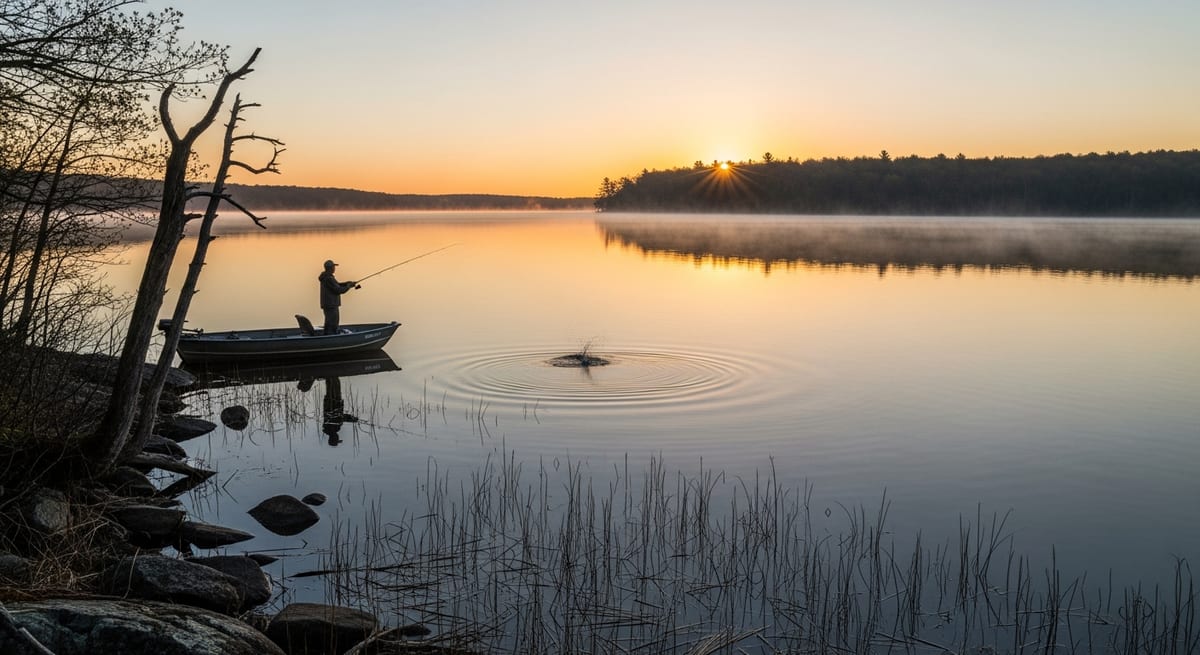
Post-spawn bass on Bantam Lake and Candlewood routinely ignore spinnerbaits and swimbaits for weeks at a stretch. CT finesse anglers who fish these clear-water lakes through June and July consistently report the wacky-rigged Senko generates strikes when most other presentations stall, particularly on calm, high-pressure days when fish are visibly following and refusing. The setup is straightforward: a soft plastic worm hooked through the middle, cast to structure, and allowed to fall on a completely slack line. Both ends flutter and shimmy on the way down in an action that pressured bass in clear water often respond to when they've already seen reaction baits all season. What keeps this bait on every serious CT finesse angler's deck is that it produces across the full warm-water calendar, from the post-spawn dock bite in late May through August, when most fish have pushed to deeper structure on Candlewood and Lake Lillinonah.
Why CT Clear-Water Pressured Bass Respond to the Wacky Rig
Bantam Lake, Candlewood, and East Twin Lake are among the clearest bass fisheries in Connecticut, and clear water is where the wacky rig earns its reputation. Anglers who fish pressured CT lakes report that bass in high-visibility conditions often reject reaction baits but respond to the slow, erratic fall of a wacky-rigged stick bait, especially in the weeks after the spawn when fish are lethargic and staged near shallow structure.
The physics are straightforward. When a Senko-style worm is hooked through the center and allowed to fall on a slack line, both ends move independently, producing a shimmying action that mimics a dying shad or injured invertebrate without any input from the angler. CT anglers fishing Candlewood coves and Bantam weed lines note that most strikes come during that unassisted fall, before the bait reaches the bottom.
Fishing pressure accelerates this pattern. On heavily-fished public water, bass see spinnerbaits and swimbaits repeatedly through the season. The consensus among CT smallmouth anglers fishing the Housatonic impoundments is that the wacky rig's slow, subtle presentation often reads differently enough to generate strikes on calm, clear days when fish are visibly spooky and other presentations produce few follows.
Wacky Rig Setup: What CT Dock Anglers Standardize On
Standard wacky hook: A size 1/0 or 2/0 wide-gap weedless hook inserted through the center of the worm. The weedless version carries a small wire guard that prevents snagging around dock pilings, submerged vegetation, and the laydowns that accumulate along Candlewood's developed shorelines.
O-ring method: Most CT anglers who fish this rig heavily use a silicone o-ring placed around the middle of the worm rather than hooking directly through the bait. The direct-hook method tears the worm after two or three fish. The o-ring preserves the bait through five to ten bass, which is a meaningful cost difference when fishing 5-inch Senkos at roughly a dollar apiece.
Weighted version (Neko rig): Pressing a small nail weight (1/64 to 1/8 oz) into the nose of the worm changes the fall angle. The head sinks faster than the tail, producing a head-down glide that anglers on deeper Candlewood structure report outperforming the standard wacky fall in 15 to 25 feet of water during midsummer.
Baits That Perform in CT's Clear and Stained Bass Lakes
Yamamoto Senko (5-inch): The bait CT finesse anglers most consistently reach for on clear-water fisheries. The Senko's salt-impregnated body falls slowly and produces a tight shimmy that cheaper stick baits generally don't replicate as well. The cost is high for a soft plastic, roughly a dollar per bait, but the o-ring method extends bait life substantially. Green pumpkin, watermelon red, and black/blue remain the most-reported colors on CT water.
Zoom Trick Worm (6.75-inch): A budget-friendly alternative with a slightly more open fall action. Anglers fishing stained water on Gardner Lake and Moodus Reservoir report that the larger profile improves visibility in off-color conditions where the Senko's subtlety works against it.
Color selection: In clear water (Bantam, East Twin, Candlewood), natural colors work best: green pumpkin, watermelon. In stained water (Moodus, Gardner, parts of the Housatonic impoundments), darker and more visible profiles: black/blue, junebug, dark green pumpkin with red flake. Overcast and low-light conditions favor darker colors across CT water types.
The Fall Is the Bait: How CT Finesse Anglers Present the Wacky Rig
The most consistent mistake CT anglers new to this presentation make is retrieving on a tight line, which kills the worm's action entirely. The bait generates most of its strike-drawing movement on a completely slack line during the fall. Cast to the target, engage the bail, and watch the line. The majority of strikes arrive as the line goes slightly slack, jumps sideways, or stops moving before the bait should have reached the bottom.
Set the hook with a sideways sweeping motion rather than a straight upward snap. The hook placement through the middle of the worm makes an upward set significantly less effective at turning the hook point into the fish.
After the bait reaches the bottom, CT dock anglers report that a slow lift-and-fall sequence generates more secondary strikes than a dead retrieve. Lift the rod tip six to twelve inches, pause, and let the bait fall again on a slack line. Most secondary strikes come in the first two or three feet of that re-fall.
Dock skipping: Wacky rigs can be skipped flat across the water surface to slide under dock overhangs. This is a presentation Candlewood and Lake Zoar dock-bass specialists use when fish push up under low overhead structure that conventional pitching cannot reach, and it is worth practicing on open water before fishing a new dock stretch.
Connecticut Bass Lakes Where This Presentation Outperforms
Candlewood Lake: CT's largest lake, with extensive dock structure throughout the Danbury and New Milford sections. Anglers fishing Candlewood in the post-spawn window (late May through June) report that wacky-rigged Senkos worked parallel to dock faces outperform most other presentations on fish that have locked into shaded structure.
Bantam Lake (Litchfield County): One of the cleaner bass lakes in the state. Bantam regulars note that on high-pressure days when power fishing generates few follows, dropping to a wacky rig along the weed line edge produces consistent smallmouth and largemouth through the summer.
Lake Zoar and Lake Lillinonah (Housatonic River impoundments): Large reservoir systems with substantial laydown and fallen-timber structure in the back coves. Spring and early summer wacky rigging around these laydowns, before the coves warm past 75°F and bass push to main-lake structure, is a pattern Housatonic impoundment regulars return to every year.
East Twin Lake (Salisbury): Clean, clear northwest CT water with a mixed largemouth and smallmouth population. The lighter pressure relative to southern-tier lakes makes it worth the drive for anglers targeting finesse bass on a less-crowded fishery.
Gear Setup and What Experienced CT Finesse Anglers Do Differently
Rod: 6'8" to 7' medium-light spinning rod with a fast tip. Enough sensitivity to detect the subtle tick of a strike on the fall, but with enough give that a hookset does not pull the hook through the middle of the worm.
Reel: Size 2500 to 3000 spinning reel with a smooth drag. CT bass anglers fishing this presentation on light line set drag light enough to absorb the initial surge of a solid largemouth before the hook is fully seated.
Line: 8-10 lb fluorocarbon direct to the hook is the standard CT setup. Fluorocarbon sinks, stays nearly invisible in clear water, and has enough stiffness that the bait falls naturally rather than ballooning on the surface. Braid with a 10-12 lb fluorocarbon leader is a common alternative for anglers fishing deeper Candlewood structure where feel is a priority.
What experienced CT anglers do differently: Bantam Lake and Candlewood regulars consistently report downsizing to a 4-inch Senko or Yamamoto Slim Senko when bass are visibly following but not committing. A smaller profile in calm, clear water often converts lookers to biters in the community's experience. The same anglers note that the wacky rig's effectiveness on CT lakes tends to peak in the 62°F to 72°F water temperature window. Below that range, bass typically respond better to a slower dead-sticking approach. Above 78°F on shallow water, topwater and drop-shot presentations frequently outperform the wacky rig as fish push to deeper, cooler structure.
EVERY SATURDAY MORNING
Weekly fishing intelligence
Nationwide conditions, what's biting, and honest gear deals. One email, no noise.
No spam. Unsubscribe anytime.