
CT River Smallmouth Hold in the Same Current Pockets Year After Year. What Housatonic, Farmington, and Salmon River Wade Communities Report About Reading Structure, Summer Timing, and the Presentations That Trigger Strikes
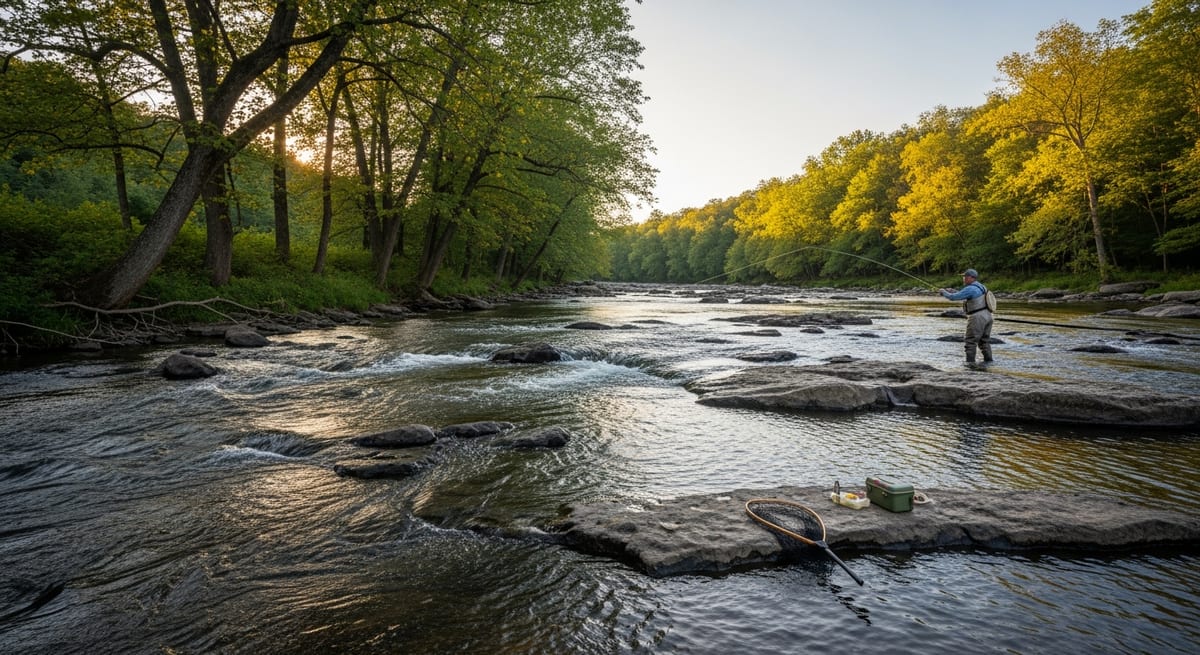
Anglers who wade the Housatonic below Bull's Bridge in Kent in mid-June report pulling smallmouth from the same boulder pockets year after year, fish that hold in numbers most CT anglers associate with reservoir fishing rather than river water. Wade anglers on the Farmington and Salmon River describe a similar pattern: wherever current breaks against a rock, gravel bar, or depth change, fish are likely holding nearby. The consensus among CT river smallmouth anglers, reflected in fishing forum reports and DEEP creel survey data from recent seasons, is that current is the organizing force. Smallmouth in moving water tend to position where fast water delivers food to a slower seam where they can hold with minimal effort, and that behavior is consistent whether you're fishing the Housatonic's rocky midsection or a smaller northeastern stream. CT anglers who fish both reservoir largemouth and river smallmouth often note that river fish are generally more aggressive toward moving lures and, by most accounts from the water, more likely to take a topwater presentation in summer when water temperatures peak.
How Current Creates Smallmouth Holding Water
Current is what river anglers consistently describe as the defining variable in finding smallmouth. Every position, every presentation angle, every cast is a response to where the water is moving fast and where it is slowing down. Anglers who fish CT rivers regularly describe the same concept: the seam. A seam is the boundary between fast water and slow, the downstream shadow of a boulder, the inside bend of a run, the edge of an eddy. Fast water on one side delivers insects and baitfish; slower water on the other lets a fish hold with minimal effort. Farmington wade communities describe smallmouth sitting right on the edge of that boundary, often facing upstream, waiting for current to sweep food past them. Learn to read where seams form and you have identified where smallmouth will be across any CT river.
The CT River Pockets That Hold Smallmouth All Summer
Behind large boulders: The downstream pocket of a rock is the most predictable holding spot in any river. Anglers who fish the Housatonic's rocky midsection describe casting upstream of a visible rock and letting the lure drift through the slower water behind it as a reliable method for finding fish. Gravel points and bars: Where a gravel bar extends into the current, it creates an edge between fast and slow water. Smallmouth often cruise this edge for feeding, a behavior CT river communities describe as most consistent during morning hours in summer. Eddy lines: The circular current behind a bend or obstruction creates an eddy, calm water that traps insects and baitfish. The outside edge of the eddy, where it meets main current, is where many experienced anglers focus first. Deep pools below riffles: The turbulent water at the tail of a riffle oxygenates well and funnels food into the pool below. The upper third of any pool below a riffle is widely reported as holding fish through the warmest summer days. Rocky runs: Three to five feet of moving water over rocky substrate is described by CT river anglers as ideal smallmouth habitat throughout summer. Work every significant rock in a run methodically before moving on.
What CT River Anglers Reach for First: Proven Lures in Moving Water
Ned rig: A small mushroom-head jig (3") with a finesse plastic tail is described by most Farmington and Housatonic wade anglers as their first choice in clear water. The stand-up head presents the tail off the bottom; current makes the soft plastic undulate without any retrieve. Dead-drift it through boulder pockets or drag it slowly across rocky substrate. Inline spinners: A Mepps or Panther Martin in #2 or #3 has been a CT river standard for decades. Cast across and downstream, let it swing through the current seam. The blade vibration is widely reported to draw strikes from fish that have not yet committed to a slower presentation. Crayfish imitations: Anglers fishing rocky-bottom CT rivers report that crayfish imitations, tube baits in brown or olive or craw-style plastics on a 1/8 oz ball head, consistently outperform other options when fish are not actively chasing. CT DEEP population studies note that smallmouth in rocky river environments consume crayfish as a significant portion of their diet. Surface lures at first light: Wade anglers describe calm eddy pools at first light in summer as prime conditions for topwater presentations. A small popper or walking bait often draws aggressive surface strikes in water that is still cool from the night, a pattern Housatonic and Farmington regulars consistently describe as the most productive window of the day.
Connecticut Rivers With Consistent Smallmouth Populations
Housatonic River: The stretch from Bull's Bridge (Kent) downstream through Gaylordsville is CT's most-reported smallmouth fishery. Rocky bottom, consistent current variety, and strong populations through summer. CT DEEP regulates black bass including smallmouth at a 12-inch minimum size with a 5-fish daily creel on the Housatonic; verify current regulations at the DEEP Inland Fisheries page before each season, as local rules can vary by reach. Farmington River: The upper Farmington above New Hartford holds a significant smallmouth population alongside its well-known trout fishery. Pull-offs along Route 44 near Barkhamsted provide access to productive rocky runs. Salmon River (East Hampton/Colchester): The lower reaches of the Salmon River hold smallmouth in its rocky sections near Comstock Bridge. Anglers on CT river forums describe this as an underutilized fishery relative to its proximity to Hartford. Eight Mile River (Hamburg/Lyme): A federally designated Wild and Scenic River with healthy smallmouth populations in its lower reaches; access via the Hamburg Cove area off Route 156. Moosup River (northeastern CT): A smaller stream with consistent rock structure and a reported smallmouth fishery, with notably less pressure than the Housatonic and Farmington systems.
Wading Upstream: The Approach CT River Smallmouth Anglers Describe
Wade anglers on the Farmington and Housatonic consistently describe the upstream approach as the most effective method for getting close to river smallmouth. Wading against the current, you approach fish from behind and stay largely out of their sight line, since smallmouth typically face upstream to intercept current-delivered food. Move slowly between positions. Loose rocks shift underfoot and create noise that can push fish off holding water. Most CT river waders describe making casts upstream and across, then retrieving downstream with the current rather than against it. Keep rod shadow off the water you are about to fish. For anglers newer to wading CT rivers, the Salmon River access near Comstock Bridge offers more forgiving terrain than sections of the Housatonic, which can have deep, fast pockets adjacent to the productive shallows. The Farmington above New Hartford is also described by the wade community as more consistent footing than the rougher Housatonic midsection.
The River Smallmouth Spinning Setup CT Wade Anglers Run
The setup described most often by CT river smallmouth communities is a medium-light to medium spinning rod in 6'6"-7' paired with a 2500 series reel. Braid in the 10 lb range with a 6-8 lb fluorocarbon leader is widely reported as the standard configuration for clear CT rivers. Braid's sensitivity matters when feeling lures drag over rocky bottom; fluorocarbon is less visible in gin-clear conditions where river smallmouth are often line-cautious. On the Housatonic and Farmington, where summer clarity can be notably high, some wade anglers describe dropping to 6 lb fluorocarbon leader as a noticeable improvement. For wading specifically, rod length of 7' or under is commonly recommended. Longer rods catch on streamside vegetation and make upstream presentations awkward in the tight corridors common on the Salmon River and Moosup River.
EVERY SATURDAY MORNING
Weekly fishing intelligence
Nationwide conditions, what's biting, and honest gear deals. One email, no noise.
No spam. Unsubscribe anytime.