
Striper Season Prep: Connecticut Coast Guide
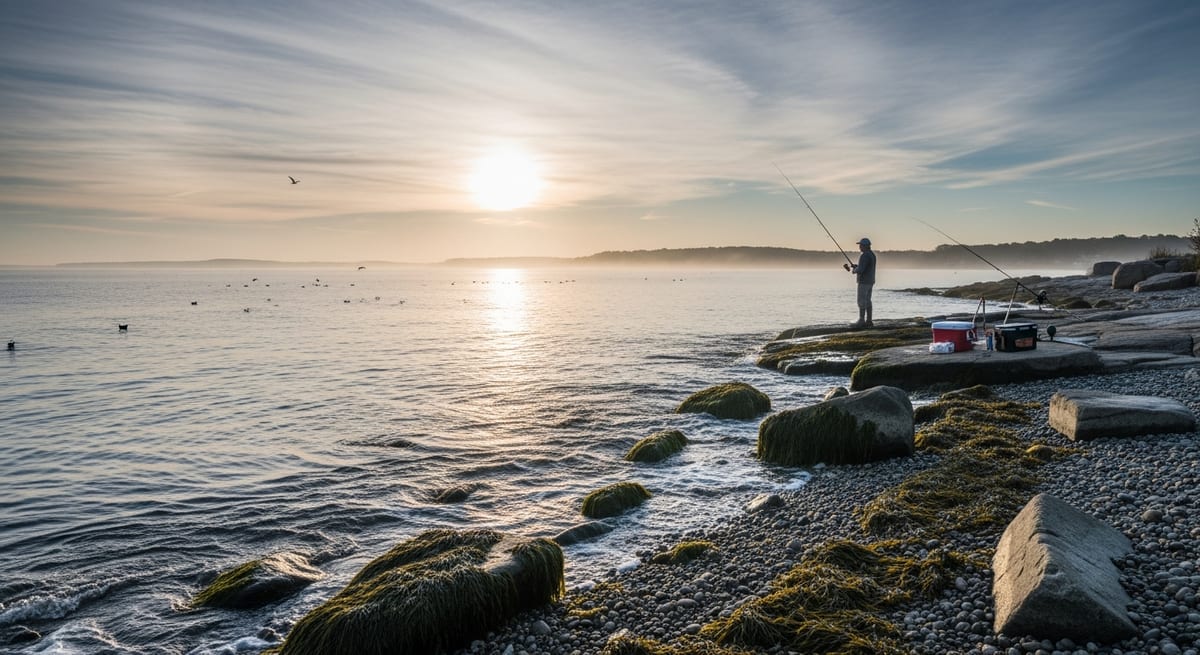
Connecticut's Rocky Neck east point starts producing schoolies on incoming tides around the same week the Execution Rocks NOAA buoy breaks 52°F, based on our tracking over recent seasons, that window has hit anywhere from the third week of April to the first week of May. Striped bass in Long Island Sound move on water temperature, not the calendar, and when that threshold falls into place, many anglers find first action along the Sound or near major river mouths within the same week. Timing shifts year to year, so treat any calendar window as a rough frame and watch NOAA buoy data instead. This guide covers the timing, spots, rigs, and gear worth bringing.
When Do Stripers Arrive in CT?
In most years, early fish show in the lower Long Island Sound and near major river outflows sometime in late April, but water temperature drives the timing more than the date. Based on our tracking of NOAA Execution Rocks buoy data over recent seasons, stripers often turn on when surface temps reach the low to mid 50s°F, with the 52-54°F range being a reasonable watch point. Spring temps have been variable enough that anywhere from mid-April through mid-May stays on the table in a given year.
Watch CT DEEP spring trawl survey reports; when those surveys start picking up fish moving through, the bite often heats up within a week or so. The CT DEEP publishes these periodically through spring, worth bookmarking before you commit to a trip.
Peak action at most CT coastal spots typically runs from early May through late June in a normal year. By July, fish scatter as water temps climb and better action shifts to early morning tidal rips or deeper offshore structure.
Best Spots on the CT Coast
Five spots that have held fish consistently across seasons:
Rocky Neck State Park (East Lyme): A classic surf spot. The rocky points and sandbars at the east end of the beach hold fish early season. Work the jetty on the western end at low tide moving out. Bass often stage along the drop-off waiting for bait to wash through.
Harkness Memorial State Park (Waterford): The rocks and points along the shoreline funnel baitfish, and stripers follow. The rip that forms off the main point on an outgoing tide has produced fish in many seasons. Time it right on a weekday and you'll have the place nearly to yourself.
Connecticut River (Essex to Saybrook): The lower CT River draws stripers in spring when conditions cooperate, check CT DEEP reports before committing to a trip, since run timing and fish density vary year to year. Work the channel edges and current seams from Saybrook Point upriver toward Essex. The river mouth flats near Lynde Point, accessible by boat or kayak, can be productive on an incoming tide when fish are present.
Niantic River Mouth: The stretch between McCook Point and Crescent Beach where the Niantic empties into the Sound. Stripers often stack here in May when bunker push into the area. The channel edge on the south side of the mouth is the spot to work.
Hammonasset (Madison): The long beach and tidal flats draw fish along the surf line at first and last light. Less rocky structure than other spots, but the sandbars off the east end of the beach hold fish when there's enough current moving bait through.
We're not publishing exact coordinates or naming lesser-known spots that don't need the traffic. The five above are well-known enough that we're not blowing anyone up.
Tides, Currents, and Timing
Stripers in CT are tide-dependent fish. Fish the two hours before and after a tide change, especially on a moving tide. That window produces more consistently than any other.
For surf fishing, an incoming tide pushing bait into structure is often your best window. Outgoing can be excellent at river mouths and estuary entrances as bait gets flushed out. That Niantic mouth situation typically runs best on the outgoing.
Early morning (45 minutes before sunrise through 2 hours after) and the last two hours before sunset reliably outproduce midday. Night fishing, especially around a full or new moon, is when many anglers find the biggest fish of the season. Darkness pulls them into the shallows in a way that daylight rarely does.
Rigs and Presentations
From the surf:
- Bucktails (1-3 oz, white or chartreuse) with a soft plastic trailer are the most versatile option for CT surf. Match the jig weight to the current, heavier when the tide is moving hard.
- Swim shads (4-6 inch, white or peanut bunker colors) on a 1 oz jighead. Work them slow near bottom during slack, medium retrieve in current.
- Popping plugs in low light. A surface walker worked across a flat at dawn will get your blood going. Classic CT surf choices include the Bomber Long A and the Gibbs Canal Special. Both have produced fish here for decades.
From a boat:
- Trolling with umbrella rigs or parachute jigs covers water efficiently when fish are actively moving through.
- Live lining bunker is among the more consistent approaches when menhaden schools are present in the Sound, find the bunker and the bass typically aren't far.
- Chunk bait (bunker chunks) on a circle hook fished on bottom is a reliable producer, especially in the CT River channel.
Fly fishing: Tidal flats and river mouths give you room to work. Surf candies, Clousers, and bunker patterns in 2/0-4/0 are solid choices when fish are showing in skinny water.
Gear Recommendations
Rod and reel for surf: A 9-10 foot medium-heavy spinning rod rated for 1-3 oz handles most of what you'll need. The Penn Battle III 4000 or 5000 is a solid, affordable reel that holds up in saltwater with reasonable maintenance. Spool with 20-30 lb braid (Power Pro or Sufix 832 are proven options) and a 20-30 lb fluorocarbon leader, 18-24 inches.
Boat rod: A 7-7.5 foot medium-heavy paired with a conventional reel (Penn Squall 30 or similar) handles trolling and live bait work. Heavy spinning gear in the same length range works fine too. 40-50 lb braid for trolling.
What you actually need vs. what's nice to have: You can catch fish all spring on a basic spinning combo and a handful of bucktails. The more expensive setups help in specific situations, heavy current, long casts at night, wire trolling, but they don't change the fundamentals. Don't let gear be the reason you're not on the water.
CT Regulations (2026)
Always verify current regulations directly with CT DEEP before you go out, rules can change mid-season and this guide may not reflect the latest updates.
As of the 2025/2026 season:
- Minimum size: 28 inches (one fish per angler per day, check CT DEEP for any active slot limits or zone-specific rules before heading out)
- Possession limit: 1 per person per day
- If you're fishing federal waters or near the RI line, different size and bag limits may apply, confirm before you target those areas
Use circle hooks when bait fishing. It reduces gut-hooking significantly and improves survival odds on released fish. The striper population has been under real pressure in recent years and it shows in the numbers, handling matters.
Measure fish in the water if you're releasing. Wet your hands. Keep the fish horizontal. Don't let a photo cost a fish its life: 10 seconds out of the water is the ceiling.
EVERY SATURDAY MORNING
Weekly fishing intelligence
Nationwide conditions, what's biting, and honest gear deals. One email, no noise.
No spam. Unsubscribe anytime.