
CT Bass Go Vertical When Lakes Hit 80°F. What Bantam Lake, Moodus Reservoir, and Lake Lillinonah Anglers Report About Finding Summer Largemouth and Smallmouth
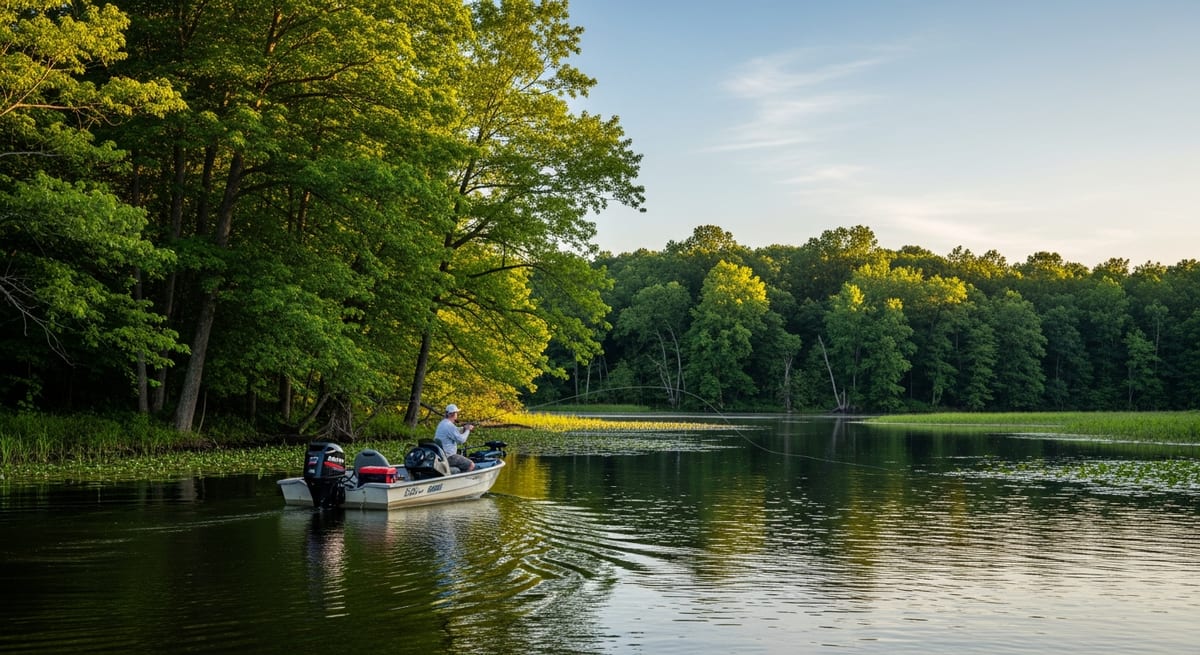
Sonar readings shared by CT bass anglers tracking Bantam Lake and Lake Lillinonah through July typically show fish stacked at 15 to 20 feet on the same structural features where those fish were working in 4 feet of water six weeks earlier. Community reports from Connecticut's warmwater bass community point consistently to the same pattern: summer bass relocate vertically, not laterally, and anglers who don't account for this spend July and August fishing water that's been empty since early June. The thermal stratification that develops in most CT lakes by early July creates a temperature and oxygen gradient that concentrates bass, forage, and activity near a specific depth band. Anglers who understand this shift and adjust their presentations accordingly report steady summer catch rates. Those who stay on spring shoreline structure generally don't.
How CT Lake Stratification Pushes Bass Off the Flats
Connecticut lakes stratify thermally each summer, and the process is more pronounced in deeper impoundments like Lake Lillinonah, Candlewood Lake, and Moodus Reservoir than in the shallow ponds scattered across the state.
The thermocline layer: Surface water warms to the 75 to 85°F range by mid-July. Cold, lower-oxygen water occupies the deeper basin. Between them, a transition layer called the thermocline typically forms between 12 and 25 feet in most CT lakes, depending on depth, basin shape, and wind exposure. Bass tend to avoid both the warmest surface water and the oxygen-depleted cold layer below, and community reports from anglers depth-fishing Bantam and Lillinonah place fish most consistently in this intermediate zone.
Light and pressure: Long summer days drive bass away from open, sun-exposed shallows during peak hours. Anglers at Lake Lillinonah and Bantam Lake frequently note that shaded north-facing shorelines, covered dock structures, and deeper transitions hold fish that are gone from open flats by mid-morning.
Shallow exceptions: Not all CT bass go deep in summer. In smaller, heavily vegetated ponds across Tolland, Windham, and Middlesex counties, bass often stay shallow under mat cover where vegetation canopy compensates for surface heat. The vertical migration described here applies most directly to mid-depth impoundments and larger lakes with defined depth transitions.
Where CT Anglers at Bantam, Moodus, Lillinonah, and Candlewood Report Finding July and August Bass
Named CT waters appear repeatedly in summer bass community discussions, and the patterns across them are worth comparing.
Lake Bantam (Litchfield County): Anglers fishing Bantam's eastern shoreline timber and the deeper drop-off sections near the dam report summer largemouth staging on submerged wood at 12 to 18 feet. Jigs and drop shots along these depth transitions tend to outperform shallow presentations after mid-morning. Public boat access is available at the Bantam River inlet area.
Lake Lillinonah (Newtown/Bridgewater): This Housatonic River impoundment has defined channel structure, and the old river channel edges at 18 to 25 feet are a frequently cited summer holding area in CT bass discussions. Rocky points where the channel bends often hold smallmouth through July and August. Boat ramp access at Stevenson and Lake Lillinonah ramps.
Moodus Reservoir (East Haddam): Anglers familiar with Moodus note that deep brush piles and rocky mid-reservoir humps produce both largemouth and smallmouth through summer months when the shallows go quiet. The reservoir's varied bottom structure rewards depth-mapping before fishing.
Candlewood Lake: Connecticut's largest lake has significant depth variation and shad forage that most other CT bass lakes lack. Summer bass on Candlewood often suspend at the thermocline following shad schools, and suspending jerkbaits are more relevant here than on smaller lakes where bluegill and crayfish dominate.
Matted-vegetation ponds: Smaller CT ponds with heavy lily pad and hydrilla coverage across the state's interior see bass holding under surface mats through the summer months. These fish typically don't relocate to depth, using vegetation as thermal cover instead of water column depth.
The Active Windows CT Bass Anglers Target in July and August
Across community reports from CT warmwater lakes, summer bass fishing shows a pattern of compressed active windows rather than consistent all-day activity.
Early morning: Reports from Bantam, Lillinonah, and smaller CT ponds consistently note that shallow-water activity, including topwater, is most productive from first light through roughly 8 to 9 AM. This window is generally shorter in July and August than in spring, before heat and direct sun push bass off exposed flats.
Evening: Bass often become more active again in the two hours before dark as sun angle drops and surface temperatures begin falling from their afternoon peak. Dock edges, weed lines, and shallow rocky points typically see more movement in the evening than during midday.
Midday depth fishing: Rather than leaving the water, anglers targeting summer bass at midday often shift to slower, deeper presentations and work thermocline-adjacent structure in 15 to 22 feet with drop shots and football jigs. Many CT anglers report that these midday deep-water sessions produce steady catches while the shallows sit empty.
A note on timing data: CT DEEP creel surveys for bass do not currently publish catch-per-hour breakdowns that would let us quantify these windows precisely. The morning-and-evening pattern reflects what the CT bass community broadly reports across multiple named lakes, not a rigorously measured catch-rate figure.
Summer Bass Presentations CT Anglers Use from Dawn Through Midday
Technique follows location and timing in summer. The same angler working topwater on Bantam at dawn may be dragging a football jig in 20 feet of water by 10 AM on the same trip.
Deep structure presentations: A 3/4 oz football jig dragged slowly along rocky breaks, timber edges, and channel structure in 15 to 22 feet is the primary midday technique reported by CT anglers on deeper impoundments. A heavier drop shot rig (1/2 to 3/4 oz weight) keeps a soft plastic vertical and is often effective for bass suspended near the thermocline rather than holding tight to bottom.
Topwater at first light: Walk-the-dog surface lures worked along shallow weed flats and dock edges in the first hour of light produce strikes during the brief early morning window. Covering water matters more than precision targeting at this hour.
Mat punching for shallow ponds: In CT ponds with heavy lily pad and surface mat coverage, a punch rig (1 to 2 oz tungsten, Texas-rigged craw or creature bait) dropped vertically through mat openings reaches bass holding under surface cover. This approach is most relevant for smaller, shallow ponds where fish never relocate to depth.
Night fishing: A portion of the CT bass community considers summer night fishing the most consistent option, particularly on heavily pressured lakes with significant daytime boat traffic. Dark-profile topwater worked slowly on calm nights around docks and weed edges is the standard approach. Moodus Reservoir and Bantam Lake both have a following among CT anglers for summer night sessions.
CT DEEP Regulations for Summer Bass: What to Verify Before You Go
Anglers fishing Connecticut bass waters in summer should check the CT DEEP 2025-2026 Freshwater Fishing Regulations booklet before heading out. Minimums, slot limits, and special conditions apply on certain designated waters and are subject to change between seasons.
Statewide general minimum: Connecticut's general statewide minimum for largemouth and smallmouth bass is 12 inches, with a daily creel limit. However, DEEP designates certain waters as trophy bass management areas or slot-limit waters with different requirements. Anglers should not assume the statewide minimum applies to every named CT lake.
Verify rules for the water you're fishing: Anglers targeting Bantam Lake, Lake Lillinonah, Moodus Reservoir, Candlewood Lake, or other named CT bass waters should confirm whether special conditions apply to those specific bodies of water. Rules that applied in prior seasons may have been updated in the current regulation booklet.
Summer catch-and-release practices: Bass handling under heat stress is a topic the CT bass community takes seriously, and community norms on CT fishing forums reflect a consistent approach: minimize air exposure, wet hands before handling, and avoid prolonged photography during midday sessions. This is community practice rather than regulatory requirement on most CT waters.
License requirement: A Connecticut fishing license is required for all anglers 16 and older. Annual and combination licenses are available through the CT DEEP online portal.
EVERY SATURDAY MORNING
Weekly fishing intelligence
Nationwide conditions, what's biting, and honest gear deals. One email, no noise.
No spam. Unsubscribe anytime.