
CT Surf Anglers Who Learn to Read the Trough Before the First Cast Consistently Outfish Those Who Don't. What Bluff Point, Hammonasset, and Harkness Regulars Report About Shore Structure, the Current DEEP Slot Limit, and Getting Distance With the Right Setup
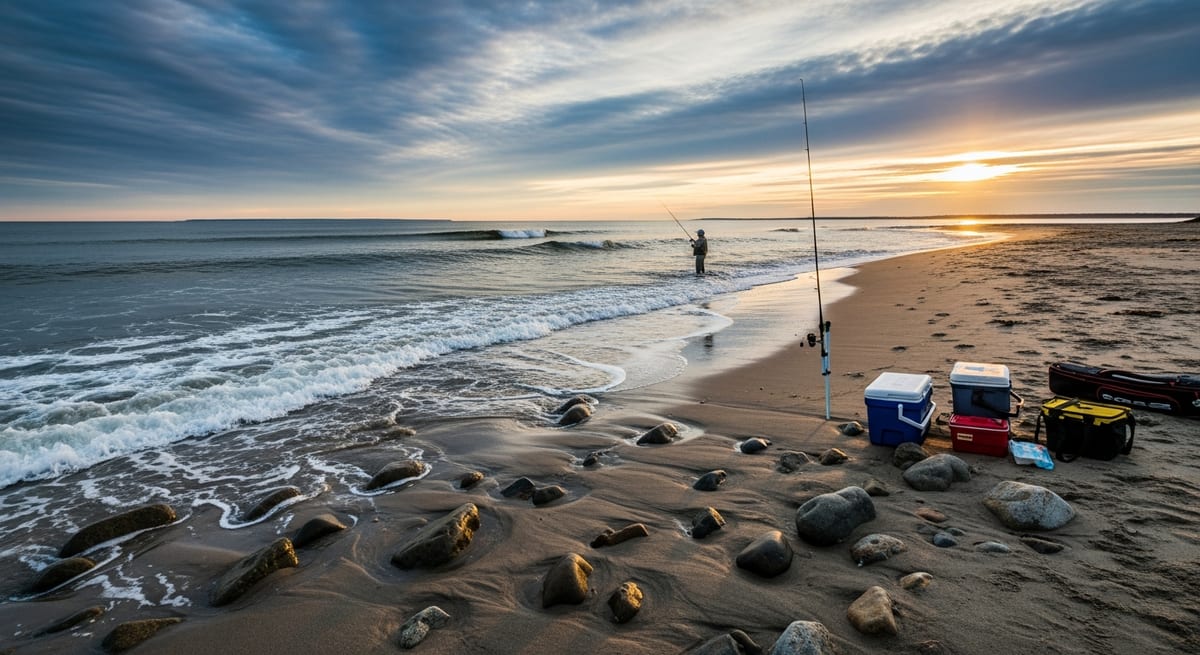
Regulars fishing Bluff Point's outer bar and the rocky backside of Harkness Point consistently report the same observation about new CT surf anglers: most set up on the closest dry sand and cast straight ahead, while the troughs and current seams that actually hold stripers are often 20 to 40 feet off to the side or running parallel to shore. CT surf communities on local forums and in bait shop conversation around the Old Saybrook and Niantic corridors describe this as the pattern that separates productive first sessions from frustrating ones, not casting distance, not gear, but time spent reading the beach before the first cast. This guide aggregates what those Sound regulars report about structure, timing, setup, and what the DEEP Saltwater Fishing Guide says about keeping fish legally.
CT Sound Surf Spots: What Shore Anglers Report About Bluff Point, Hammonasset, and Harkness
Connecticut's Long Island Sound coast has more structural variety than most first-timers expect. Bluff Point State Park (Groton): The rocky southern tip and the sandy spit extending toward Fishers Island Sound create rip edges at the point on both tidal phases, among the most consistently productive surf striper locations in CT, according to shore-fishing communities. No vehicle access; the mile-plus walk filters crowds and keeps pressure manageable. Hammonasset Beach State Park (Madison): The longest publicly accessible shoreline in CT. Meigs Point at the park's eastern end concentrates current and bait around a rocky finger, regulars report it fishes differently than the main beach and typically produces stripers when the flat sand sections have gone quiet. Harkness Memorial State Park (Waterford): A rocky limestone shelf drops off into deeper water just off the point. Anglers who fish it regularly describe working the rocky edges at night during October as the most reliable late-season surface option on the eastern Sound coast. Rocky Neck State Park (East Lyme) and Seaside Park (Bridgeport) round out the accessible options, rocky Neck's sheltered cove configuration provides more forgiving casting conditions for anglers still building range.
Reading the CT Beach: How Sound Regulars Find the Fish Before They Cast
Troughs: The deeper channels running parallel to the beach between sandbars are the primary travel lanes stripers and bluefish use in CT surf environments. Slightly darker water between two white water zones marks a trough. CT surf communities consistently describe casting across the trough, not into it, as the more productive approach, letting a lure or bait swing through the feeding lane on the retrieve. Cuts and rips: When wave backwash finds a low spot in a sandbar, it forms a cut. A concentrated flow that baitfish get pushed through and predators stage below. Rips around jetties and points like the Bluff Point tip concentrate this effect and are widely reported as the highest-percentage spots on the CT shore. River mouths: The Connecticut River mouth at Old Saybrook, the Thames at New London-Groton, and the Housatonic at Stratford all produce on outgoing tides as bait flushes seaward. Shore anglers who fish these transitions during the fall run report they often outproduce open-beach casting during the same session. Night vs. day: CT shore-fishing communities broadly report better striper action after dark. Fish that hold offshore in daylight tend to move trough-depth at night, particularly at rocky spots like Harkness and Bluff Point.
The Shore Setup CT Sound Regulars Use (and What They've Walked Away From)
Rod: A 10'-11' surf rod is the community-standard minimum for reaching the trough zone on CT Sound beaches. Most regulars report that undersized freshwater rods are the most common beginner mistake, not because of strength, but because a shorter blank can't load properly on 2-3 oz casts. Penn Prevail II and Ugly Stik Bigwater appear in CT surf community setup threads as cited entry-level options in roughly the $60-$90 range. Reel: A 5000-6000 series spinning reel with a sealed drag is the typical CT shore recommendation. Line capacity matters: 200 yards minimum on the spool before backing fills the rest. Penn Battle III and Shimano Stradic FL are frequently cited in community threads as value-tier picks that hold up to regular saltwater exposure. Line: 20 lb braid as the main line with a 2-4 ft leader of 30-50 lb fluorocarbon or monofilament is the widely reported CT surf standard. Braid's low diameter improves casting distance; the leader handles rock abrasion and fish teeth. Caveat from community threads: gear specs discussed by anglers vary meaningfully by conditions and personal preference, treat these as a calibrated starting point, not a prescriptive spec list.
Bait Rigs CT Surf Anglers Run in the Trough
Chunk bunker (menhaden), sand eels, and squid are the most frequently cited natural baits for CT Sound surf fishing. Bunker availability from local tackle shops, primarily in the Old Saybrook, Niantic, and Groton corridors, is seasonal, with fall run timing aligning with the period when bulk supplies are most accessible. A 3-4 oz pyramid sinker on a fish-finder rig is the dominant bottom setup reported by CT surf regulars, with the sliding sinker allowing the bait to drift naturally in current while the weight holds position. Technique: cast to the outer trough edge, stake the rod, open the bail, and hold the line lightly. A tap-tap-pull pattern typically means the fish is mouthing the bait, regulars consistently report waiting for the sustained pull before closing the bail and setting the hook. Regulations note: CT DEEP regulations include a striped bass slot limit governing legal harvest from CT waters. Shore anglers who plan to keep fish should consult the current DEEP Saltwater Fishing Guide for the active slot dimensions and daily bag limit before fishing. The slot framework has changed in recent seasons, and CT surf communities report that citations most often follow anglers who retained fish without verifying the current year's regs.
Lures CT Surf Communities Carry in Fall vs. Summer
The CT surf lure mix shifts by season and target. Fall run (October through early November): Pencil poppers in the 3-4 oz range are the community-consensus surface presentation during the bunker push. The walk-the-dog retrieve over breaking bass is the scenario CT fall-run shore anglers most often describe in post-session reports. SP Minnow-style suspending swimmers running 1-3 feet deep are widely reported as the secondary fall option when fish aren't breaking. Summer bluefish and mixed bag: Kastmaster spoons (1-2 oz) dominate summer recommendations for their cast distance and durability against bluefish tooth damage relative to treble-hook plugs. Year-round: A 1-2 oz bucktail jig with a soft-plastic trailer is the most consistently cited versatile choice in CT shore-fishing communities, works at any depth, casts far, and imitates both sand eels and small bunker effectively. Rock loss at Bluff Point and Harkness: Regulars at both spots specifically flag that lure loss to snags runs high until the bottom structure is familiar, community advice is to carry a few inexpensive options until a spot is dialed in.
Tides, Windows, and the DEEP Slot: What Sound Regulars and Public Data Confirm
Tidal windows: CT Sound anglers who track results consistently report the two hours before and after peak tide. Both incoming and outgoing, as the most productive surf window. Slack water typically produces less action unless bunker is visibly present. The NOAA Bridgeport tide station (Station 8467150) is the reference point most commonly cited in CT surf communities for Long Island Sound timing; it anchors the tidal windows regulars describe in forum post-session reports. Tide direction by spot type: For inlet and jetty fishing, bluff Point tip, the Connecticut River mouth, the Thames mouth, outgoing tide often outperforms incoming, flushing bait out of the estuary into waiting fish. For open beach fishing at Hammonasset and Rocky Neck, incoming tide correlates more often with better action as stripers push shallow with rising water. Seasonal window: CT stripers run May through November; the community-reported peak for shore-accessible larger fish is October, when pre-migration fish stage in shallow Sound water before heading south. DEEP slot limit: Under current CT regulations, striped bass in Connecticut are regulated under a slot limit consistent with ASMFC coastwide management. The specific dimensions and daily bag limit are documented in the DEEP Saltwater Fishing Guide, consult the current edition or the CT DEEP website before retaining any fish, as the slot has been revised in recent seasons.
EVERY SATURDAY MORNING
Weekly fishing intelligence
Nationwide conditions, what's biting, and honest gear deals. One email, no noise.
No spam. Unsubscribe anytime.