
An American Eel in the Lower Farmington or Housatonic May Have Been There for 20 Years. Almost Nobody in CT Is Fishing for Them.
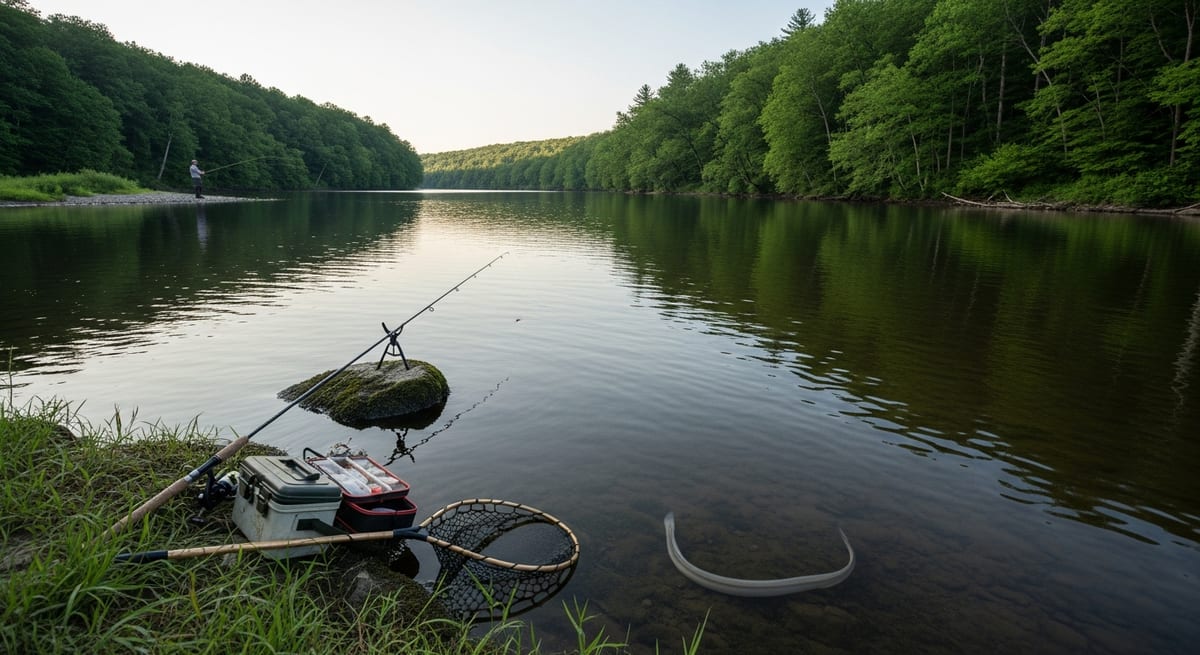
American eels in CT's tidal-connected rivers can live in the same stretch of water for 15 to 20 years or more, born in the Sargasso Sea, they migrate upstream as juveniles and settle into root tangles and rocky bottom structure that most anglers pass daily without knowing it's occupied. CT DEEP river monitoring data consistently documents eels in every major river system with tidal access in the state, yet they appear in almost no CT catch reports and are rarely a deliberate target. Anglers who night-fish the Connecticut River corridor, the lower Farmington, and the Housatonic near Shelton and Derby describe consistently finding eels, and almost never encountering another angler doing the same. Eels are active when most species slow down, they hold in shore-accessible structure, and prepared correctly, they're considered excellent table fare across a dozen world cuisines. CT anglers already fishing after dark for catfish or bass regularly report that adding a second rod rigged for eels is the easiest way to add consistent takes without changing location or start time.
A 20-Year River Resident Almost Nobody Targets
American eels are catadromous, born in the Sargasso Sea far out in the Atlantic, they migrate to freshwater rivers as juveniles and spend anywhere from 10 to 30 years living as river residents before making a single, terminal trip back to the ocean to spawn and die. That lifecycle means eels colonize virtually every CT river system with a connection to tidal water, and they've had decades to settle into structure most anglers walk right past.
The path into eel fishing for many CT night anglers follows a recognizable arc: an accidental catch on a bass or catfish rod after dark, an encounter with someone who regularly night-fishes the lower Housatonic, and the realization that the fish is worth targeting deliberately. Anglers who fish the Housatonic near Shelton and Derby describe eels as a consistent bonus species that became a primary target once they tried them on the table.
Eels concentrate around structure: under flat rocks in current seams, in root tangles along undercut banks, around bridge pilings and rip-rap, and in the soft substrate at the edges of deep pools. CT night anglers consistently report that the productive window runs from about an hour after sunset through midnight, daytime eel fishing in CT rivers is generally unproductive, and most accounts from anglers who've dedicated daytime trips to eels describe the effort as rarely worth it.
CT Waters That Produce Eels Consistently
Any river or stream accessible from tidal water holds eels. Rivers and stretches that CT eel anglers report consistently:
Connecticut River main stem: Below the Enfield Dam, historically impassable to eels, with ongoing CT DEEP discussions about passage restoration that may affect population distribution in coming seasons, bridge abutments near Hartford and Middletown, and the deep scour pools where tributaries enter. Rocky structure around the Glastonbury and Portland stretches appears frequently in local night-fishing accounts during summer.
Salmon River (Colchester area): The Salmon River below its confluence with the Connecticut holds eels through the lower rocky stretch. Anglers who fish this section on warm summer nights report good numbers, particularly in current seams with moderate flow and broken-rock bottom.
Housatonic River near Shelton and Derby: Deep pools in the lower Housatonic produce large eels. The rocky stretches below the Derby-Shelton Dam are worth a few hours after dark, access via the Shelton River Walk or the Derby riverfront parks.
Farmington River (lower section): Eels are present throughout the lower Farmington from the Connecticut River confluence upstream. Rocky bottom sections below the Unionville area draw CT eel anglers who fish the stretch regularly and report consistent after-dark action on warm nights.
Tidal river mouths: Any CT tidal drainage. The Niantic, Thames, Mystic, Quinnipiac, holds eels in high density where rocky and muddy bottom types meet near the mouth. These spots are frequently overlooked by the wider fishing community and don't require a long walk from most parking areas.
The Setup: A Simple Bottom Rig After Sunset
Eels don't require specialized gear. A medium-action 7-foot spinning rod with 10-20lb monofilament or braid handles them easily. The rig: egg sinker above a barrel swivel, 18-inch fluorocarbon leader to a size 4 or 2 bait hook. Nightcrawlers are the standard bait among CT eel anglers. Most who've experimented with alternatives report that nightcrawlers remain the consistent top producer across conditions. Cut them in half so the hook point isn't buried.
Cast to structure, rocks, pilings, any transition between hard and soft bottom, and wait. The bite feels different than a bass strike: a slow, sideways pull on the line rather than a sharp tap. A consistent observation among experienced CT eel anglers is that newcomers set the hook too early. Eels mouth bait and move before fully committing. The right trigger is a sustained, definite pull, not the first twitch.
Experienced CT eel anglers who cover multiple spots in a night typically fish from a rod holder rather than hand-holding, eels rarely commit immediately after the cast, and a sensitive rod tip in a holder covers structure more patiently than standing over a rod for extended periods.
Once hooked: Eels fight by spinning and twisting around the line. Lift the rod high immediately and get the eel off the bottom fast. The longer it contacts the substrate, the more tangled the line gets. Once it's off the bottom, the spinning becomes manageable. Keep it away from the bank.
Eel traps (fyke nets): Also legal in CT with a freshwater fishing license, though fyke net regulations include additional permit tiers depending on trap count, verify the full requirements in the current CT DEEP freshwater regulations before setting one. A cylindrical wire trap baited with fish scraps, set overnight in a calm pool, often out-produces rod-and-reel by volume.
Grip, Bucket, and Hook: Handling Eels in the Field
Eels produce significant mucus, and a large one is among the most difficult fish to hold bare-handed, cT anglers who target them regularly describe bare-handed control as nearly impossible on fish over 18 inches. A few approaches that work:
- Rubber or nitrile gloves are the single most useful addition to the kit. They grip through slime rather than sliding. Experienced CT eel anglers consistently recommend keeping a pair in the tackle bag on any after-dark trip to eel water.
- A lidded bucket is non-negotiable. Eels climb out of open containers readily and quickly. A five-gallon bucket with a tight lid keeps them contained.
- Removing the hook: Keep the leader taut and work the hook out with long-nosed pliers or a disgorger. If the hook is deep, cut the line. It will rust out.
- Keeping them alive: Eels are hardy. A bucket with a few inches of river water and a tight lid keeps them in good shape for hours. Keep the bucket shaded; heat is the primary cause of loss on warm nights.
Table Quality: Why CT Eel Anglers Keep Coming Back for the Grill
American eel is rich, fatty, and mildly flavored, fattier than catfish or trout, which is exactly what makes it perform well smoked or grilled. That fat content explains why eel is a celebrated ingredient in Japanese cuisine (unagi), across northern European traditions, and in traditional Italian cooking. Most CT anglers who haven't tried it haven't considered that local river eels are the same species sold at a premium in specialty seafood markets.
Skinning: Make a circular cut through the skin just behind the head, grip the edge with pliers, and peel toward the tail. It comes off in one piece on a fresh eel. Gut, rinse, and cut into 3-4 inch sections or fillet along the backbone.
Simple preparations: Pan-fried sections dredged in seasoned cornmeal are the most accessible route, medium-high heat, a few minutes per side. Grilled over high heat with olive oil and salt works well. Smoked eel, brined for several hours, then smoked at low temperature until firm, is considered the premium preparation among CT anglers who keep them regularly.
CT DEEP regulations have historically allowed freshwater license holders to keep up to 25 eels per day, but possession limits for eels have changed over time, verify the current limit directly on the CT DEEP website before fishing. Many experienced CT eel anglers keep mid-size fish and release the very largest; smaller eels tend to be mostly bone. Check the current CT DEEP regs for any applicable size minimums before keeping fish.
EVERY SATURDAY MORNING
Weekly fishing intelligence
Nationwide conditions, what's biting, and honest gear deals. One email, no noise.
No spam. Unsubscribe anytime.