
CT River Shad Are on a Reaction Bite, Not a Feeding One, why That Changes Everything From Essex to Enfield Dam
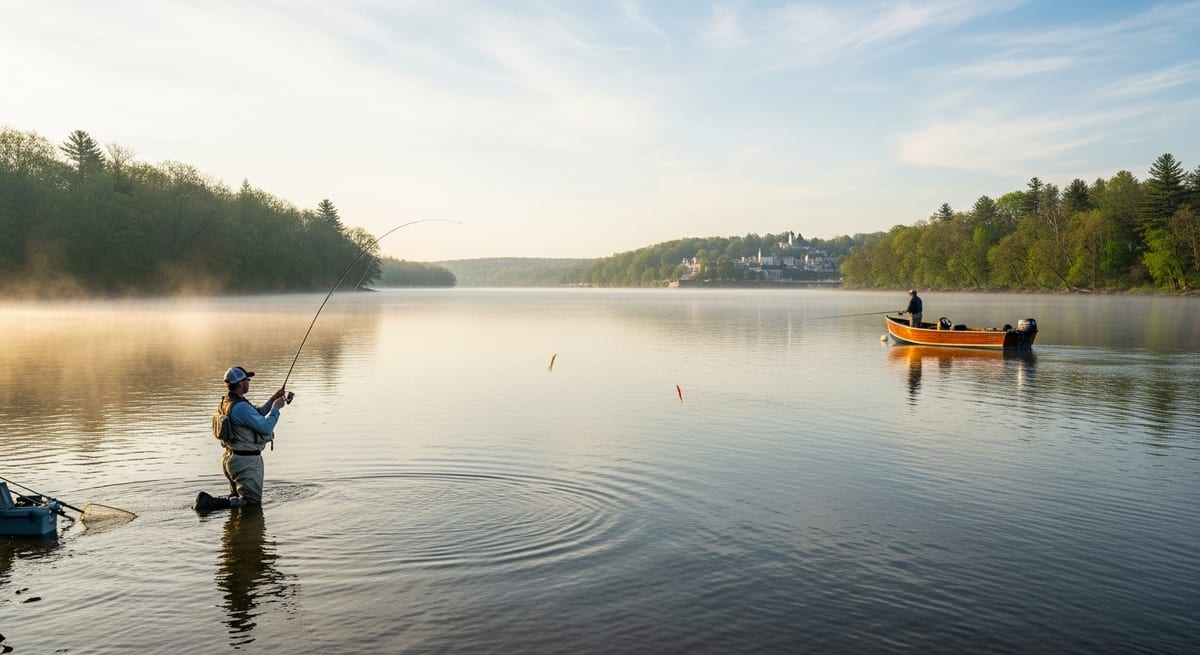
The Reaction Bite: What Enfield Regulars Figure Out After Their First Season
American shad enter the Connecticut River without feeding, not a single calorie consumed from the time they cross Long Island Sound until they spawn and return to sea. Anglers who spend multiple seasons at Enfield consistently describe the same learning curve: an early phase of fishing shad the way you'd approach trout or bass, then a fundamental shift once the biology actually registers.
What shad do is react. The consensus among CT shad regulars, reflected across CT fishing forum threads and CT DEEP in-season fishing reports, is that swinging a 1/8 oz pink dart through the right current seam at the right angle produces aggressive strikes from fish that have zero feeding motivation. The working theory among anglers who fish the run regularly is that it reads like territorial aggression or irritation, something about the lure's arc through a specific water column position that triggers a response entirely unrelated to food.
American shad are anadromous, maturing at sea and returning to spawn in natal rivers. CT DEEP and the Atlantic States Marine Fisheries Commission have tracked the Connecticut River run for decades; Holyoke Dam fish passage counts, published annually by the Massachusetts Division of Marine Fisheries, provide one of the most consistent public benchmarks for run health. Recent seasons show the run remains viable, with year-to-year variation driven primarily by spring water temperature and Atlantic population cycles.
Typical bucks run 3-5 lbs. Roe shad average larger, and CT anglers broadly describe them as stronger fighters relative to size than the buck numbers would suggest. Shad roe is a traditional New England preparation that the Connecticut River fishing community takes seriously; early-season lower-river trips out of Essex often target roe shad as much for the table as for the sport.
How the Run Moves North: Essex, Middletown, and the Enfield Window
The run tracks water temperature north. Access points near Essex and Old Saybrook at the lower CT River see the first fish arrive from Long Island Sound when river temperatures approach 60°F, typically late April in a normal spring. From there the run progresses upstream through Middletown, Portland, and Cromwell before fish begin staging below Enfield Dam through May and into June.
By section:
- Enfield area (upper accessible reach): Fish stage below the dam because passage isn't available. They hold in current because they have nowhere else to go. Regulars who fish this stretch report peak action running mid-May through mid-June in most seasons, though CT DEEP in-season fishing reports document variation of two weeks or more in either direction during cold or warm spring cycles. This is the most concentrated fishing on the river.
- Middletown/Portland area: Fish are moving through, not staging. Late April through May is the realistic window. CT anglers who fish this section describe less consistent action than Enfield but report productive days when water conditions stack fish against current breaks along the Portland bank.
- Lower river and Essex: First fish push in from the Sound in late April. Best for early-season action before fish concentrate upstream; the river is wider here, fish are more distributed, and session-to-session variability is higher.
Timing varies significantly year to year. CT DEEP publishes in-season fishing reports during the shad run, searchable at ct.gov/deep, and Connecticut fishing forums carry real-time access conditions and current seam reports throughout the season. Anglers who fish the run regularly treat both as more reliable than any printed calendar estimate when planning a specific trip date.
Why the Enfield Dam Pool Produces, and How to Read the Seams
Enfield Dam is where CT shad anglers concentrate effort for a straightforward reason: fish moving upriver hit the dam and stop. The concentration that results below the dam means anglers aren't searching for fish. The variable is water level and which current seams are holding on a given day, not fish location.
Bank access runs along the right bank below the dam. Wading is workable at normal-to-low flows, but water level determines whether the productive seams are reachable at all. Regulars recommend checking USGS gauge 01184000 (Connecticut River at Thompsonville) at waterdata.usgs.gov before making the drive, high water pushes fish into unreachable current and makes wading unsafe. Anglers who fish the dam pool multiple times per season report that a quick call to tackle shops in the Enfield area before the first trip of the season is worth the two minutes for current bank and launch status.
Reading the current seam is the core skill. Shad hold where fast water transitions to slower flow, in that boundary zone, not in the hard current and not in the slack behind structure. The standard approach among Enfield regulars is a cast upstream at roughly 45 degrees, allowing the dart to swing naturally through the seam on a tight line. Strikes most often come somewhere in the arc of the swing, frequently just as the dart begins to straighten below the angler's position.
Access conditions at Enfield can shift with seasonal flow. Anglers who fish the pool across multiple seasons consistently recommend verifying bank access at the start of each spring rather than assuming conditions match a prior year.
What CT River Shad Anglers Actually Rig
The shad dart dominates CT River shad fishing, and the reason most anglers on the water give comes back to the reaction bite: the slim profile and swinging action in current reliably trigger strikes where bulkier presentations don't replicate the same movement in moving water. Dart fishing on the CT is explicitly not about mimicking food.
Spinning tackle: The setup CT shad anglers converge on across forum discussions and DEEP report commentary is a 7-8 foot light-action spinning rod, soft enough to telegraph the take through the swing, with backbone enough to control a roe shad in current. A 2500-series spinning reel spooled with 8-10 lb mono, or light braid with a mono leader, covers both approaches. Mono stretches and absorbs short takes; experienced anglers on the CT report the choice rarely affects catch rates, and both are well-represented on the Enfield bank.
Dart rigging: 1/8 to 1/4 oz darts in hot pink, chartreuse, or classic red-and-white account for the bulk of reported catches. A common setup among Enfield regulars adds a second, lighter dart as a dropper 18-20 inches above the primary, double hookups are frequently reported during active periods. A 1/4 oz hammered silver spoon through the same current seams is worth having rigged as a secondary option when dart action slows.
For fly anglers: An 8-weight with a short sink-tip section is the consistent recommendation in CT shad fly-fishing discussions. Weighted shad flies in pink, white, or chartreuse, clouser-style or Estaz-bodied in sizes 4-8, cover the standard presentation. Cast upstream, dead-drift into the seam, short strips through the swing. CT anglers who pursue shad on the fly regularly describe the strike as among the more distinctive takes in freshwater spring fishing.
Tackle shops in the Enfield area carry darts and can advise on which colors have been producing during the current part of the run. A more useful benchmark than any pre-season color recommendation.
Middletown, Cromwell, the Lower River, and CT Regulations for Roe Shad
Middletown and Portland: The river broadens here and fish are moving through rather than staging, which makes location harder without the ability to cover water. Current seams along the Portland bank have a decent reputation among CT shad anglers for producing fish during the late April through May window, but regulars who fish both sections consistently describe results as less predictable than Enfield. Treat it as exploratory access rather than a reliable target destination unless CT DEEP in-season reports indicate fish are backing up in the section.
Cromwell area: Several bank access points off the Route 9 corridor are worth checking during the run. Shad do move through, and anglers who work current breaks report occasional productive sessions with less competition than the Enfield pool draws. Useful as a secondary option when the dam pool is at peak pressure.
Fishing from a boat on the lower CT: Anglers with small boats or kayaks report a consistent positional advantage on the lower river. The ability to position directly over current seams that bank anglers can't reach changes the equation on fish contact. A slow drift while swinging darts through depth changes and current transitions is the approach lower-river regulars describe. Fish are less concentrated than at Enfield, so covering water matters considerably more.
CT regulations for roe shad: The CT DEEP Freshwater Fishing Guide lists a daily bag limit for American shad on inland waters. Anglers should verify the current limit and any species-specific conditions at ct.gov/deep before the season, as regulations are subject to annual revision. Beyond the bag limit, CT shad anglers broadly recommend handling roe shad carefully: keeping fish in the water while removing the dart, skipping extended photography for visibly tired fish, and allowing a brief revival before release on warm late-May afternoons when water temperatures rise. Bucks recover quickly; roe shad in late-season warm water take longer, and the difference is worth accounting for before opening your hand.
EVERY SATURDAY MORNING
Weekly fishing intelligence
Nationwide conditions, what's biting, and honest gear deals. One email, no noise.
No spam. Unsubscribe anytime.