
Enfield Dam Stacks Shad Every May. What CT DEEP's Anadromous Fish Program, Connecticut River Regulars, and Salmon River Confluence Reports Reveal About Timing Connecticut's Spring Shad Run
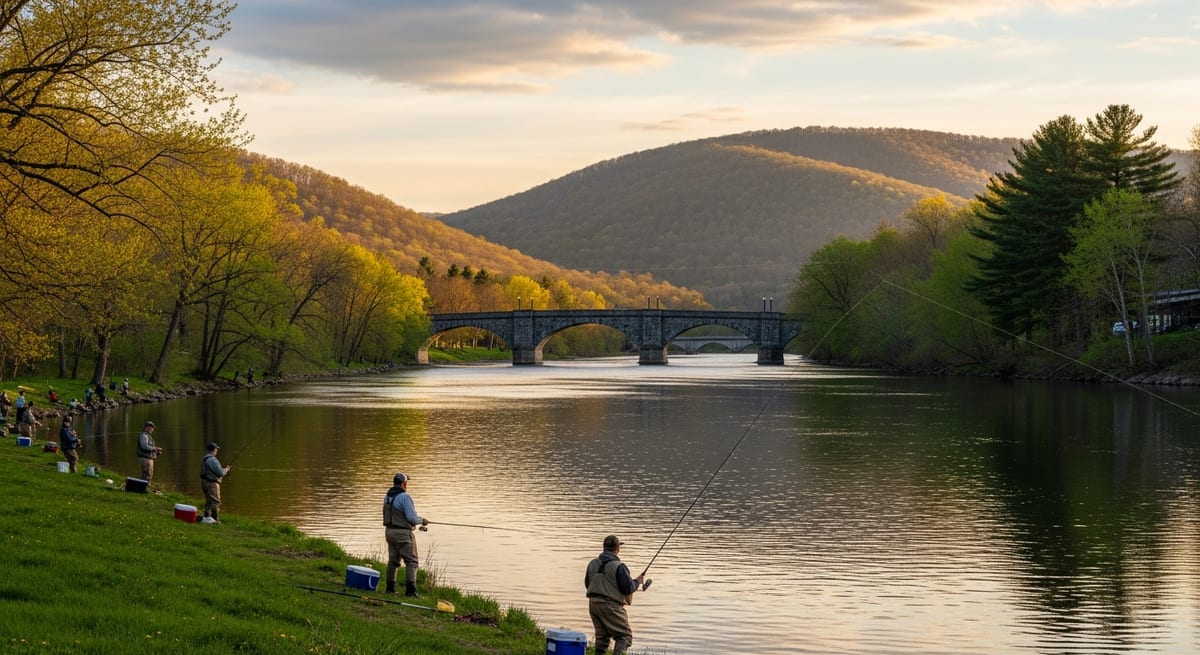
Anglers who work the Enfield Dam pool during the third and fourth weeks of May describe shad stacked in the current seams below the dam, responding to nearly every cast through the holding water. American shad are the largest member of the herring family. A 4-pound fish on 8-pound test will jump, run, and cartwheel across the current in ways that surprise anyone used to chasing largemouth or stocked trout. CT DEEP's anadromous fish program has documented shad returning to the Connecticut River system annually, and the migration extends into the Salmon River, the lower Housatonic, and smaller coastal drainages, all with public boat launches and, in many stretches, wading access.
Water Temperature, Not the Calendar: What CT DEEP Migration Monitoring Shows About Run Timing
Shad enter Connecticut rivers when water temperatures climb into the low 50s F and push further upriver as temperatures rise through the mid-to-upper 50s. CT DEEP's anadromous fish program tracks spring shad passage annually, and regulars who follow the program's public data report that a cold late spring can push peak activity from mid-May into early June, while a warm March can compress the schedule by two weeks or more. In most recent seasons, Connecticut River regulars describe the heaviest action at Enfield Dam occurring somewhere in the window from early May through the first week of June. CT DEEP's fisheries website posts anadromous fish updates each spring. Checking the site before a long drive is standard practice among experienced shad anglers, and the year-to-year timing variance makes calendar-based planning less reliable than following the actual temperature data.
Enfield Dam to Haddam: The Connecticut River Corridor and Access Points That See the Most Traffic
The Enfield Dam creates a natural stacking point where shad concentrate in the holding water before attempting passage. Anglers who fish this area during the peak window consistently report dense fish concentrations, with action measurably better than open stretches further downstream. Public boat launches are available from Haddam north through the corridor; the Haddam ramp is a common starting point for drift fishing along the main channel. The area around the Salmon River confluence near Colchester draws significant pressure during overlap weeks when shad and resident stripers are both active in the same water. Current seams where the main channel edge meets slower water are the primary holding zones, as shad do not distribute evenly across a wide river. Shore access exists at several points along the Connecticut, though bank anglers report limited casting angles at some sites compared to a kayak or small boat.
Salmon River Confluence, Lower Housatonic, and What Smaller CT Drainages Offer
The Salmon River gets a documented annual shad run through its lower section, with the state boat launch on Route 16 in East Haddam providing the primary access point. Anglers who fish both the main Connecticut and the Salmon regularly note that the Salmon draws less pressure during peak-run weekends, a meaningful difference when the mainstem is crowded. The lower Housatonic through Derby and Shelton receives a shad run with smaller fish concentrations than the Connecticut, but regulars report consistent action during the May window when conditions align. The Farmington River near Windsor gets a lighter run with good wading access throughout; anglers who prefer wading to boat fishing describe it as a quieter alternative when the bigger rivers are busy. Hickory shad appear alongside American shad across these systems and are noted by CT ultralight anglers as excellent sport on their own terms.
The Shad Dart Rig CT River Regulars Actually Fish, Including the Two-Dart Dropper Setup
Shad darts, small lead-headed jigs with bucktail or synthetic tails, are the standard lure across every Connecticut shad fishery. Enfield Dam regulars describe a consistent preference for pink, red/white, and chartreuse in the 1/8 to 1/4 oz range, with yellow and orange producing well in off-color water. The two-dart dropper rig is widely used among Connecticut River shad anglers: a heavier dart (1/4 oz) at the bottom and a lighter one (1/8 oz) on a dropper 12 to 18 inches above, which doubles coverage and helps work through different depths on the same cast. Light to medium-light spinning gear handles shad well: a 6- to 7-foot rod rated for 4-10 lb line with a 2500-3000 series reel, fished with 6-10 lb monofilament or braid with a short mono leader. Regulars consistently note that lighter line draws more strikes from these line-shy fish. Flutter spoons in silver are an effective alternative to darts in faster current.
Reading the Current Seams Where Shad Actually Hold
Cast across-current at roughly a 45-degree angle and let the dart swing downstream. Shad frequently hit on the swing as the lure turns into slower water. From a boat anchored above a known holding area, a vertical presentation works well: drop straight down, lift the rod tip slightly, and let the dart flutter on the fall. Depth matters more than anglers new to shad fishing typically expect. CT River regulars describe fish holding 3 to 8 feet down, rarely within a few feet of the surface, and diagnose productive depth by ticking bottom occasionally. If you're fishing without any bottom contact across several casts, work progressively deeper before moving. Current seams where fast water meets slow, and the edges of the main channel, are described consistently by experienced shad anglers as more productive than open midchannel water.
CT DEEP 2025-2026 Shad Regulations: What to Verify Before Launching
American shad in Connecticut are managed under regulations that include possession limits, size rules, and seasonal closures tied to the spawning run. These rules change periodically between seasons, and CT DEEP's Freshwater Fishing Guide (2025-2026 edition) is the binding source; verify current rules at ct.gov/deep before fishing, as season dates and bag limits have shifted in prior years. Hickory shad carry different regulations from American shad despite often appearing in the same water. Fishing both species in the same session requires knowing the current rules for each. Catch-and-release during the densest part of the run is encouraged within the shad-fishing community; regulars who fish the Connecticut River annually note that these fish complete a substantial ocean migration to reach CT rivers, and many practice selective harvest as a result.
EVERY SATURDAY MORNING
Weekly fishing intelligence
Nationwide conditions, what's biting, and honest gear deals. One email, no noise.
No spam. Unsubscribe anytime.