
CT Shad Regulars Below Enfield Dam Report the Run Peaks in Days, Not Weeks. What the Connecticut River Shad Community, DEEP Passage Counts, and ASMFC Data Reveal About the May Window, Dart Selection, and Current Harvest Regulations.
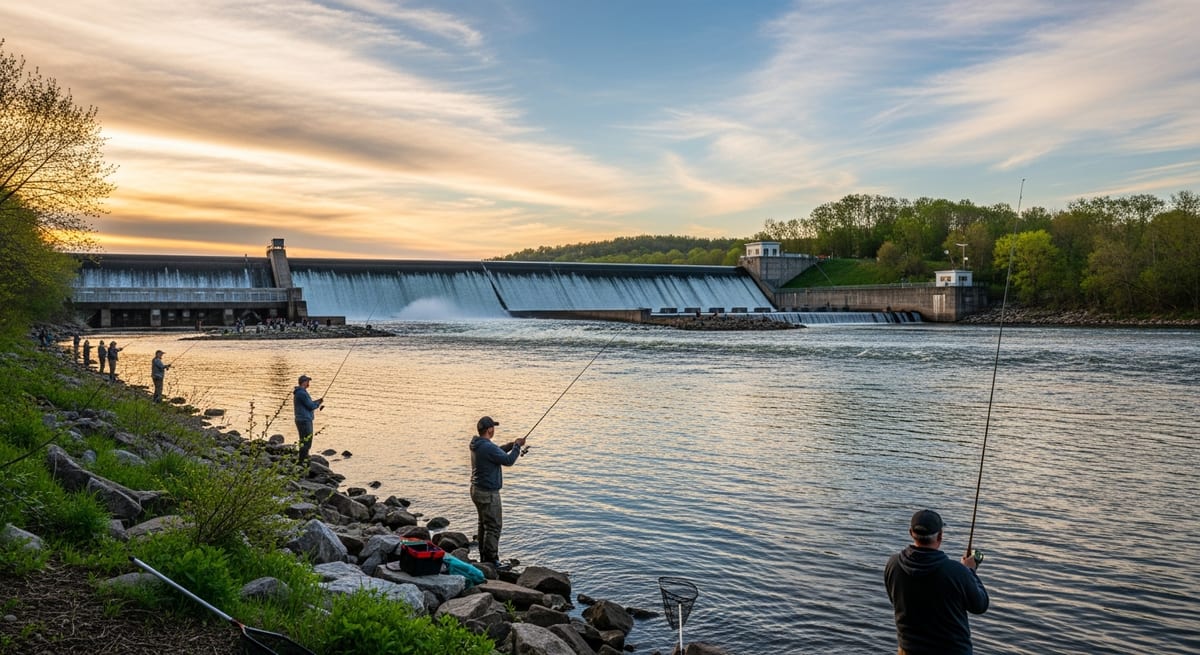
The pool below Enfield Dam concentrates shad so densely during peak run years that anglers fishing the Windsor Locks bank report visible fish rolling on the surface and strikes on near-consecutive casts through the productive midday hours. What makes the bite extraordinary, and brief: CT shad regulars who track DEEP's Holyoke Dam fish-lift passage counts say the prime Enfield window often compresses into 10 to 14 days in mid-to-late May, triggered less by the calendar than by water temperatures at Connecticut River USGS gauges climbing into the upper 50s°F. The Connecticut River shad run is among the largest surviving anadromous runs on the East Coast, dEEP and Connecticut River Atlantic Salmon Commission passage records document hundreds of thousands of American shad moving through the Holyoke Dam ladder in strong seasons. The fish average 3 to 5 lbs and, in the consistent experience of CT anglers who fish them annually, produce runs on light tackle that routinely surprise anyone expecting a more modest fight.
Biology, Timing, and the Data CT Shad Regulars Actually Track
American shad (Alosa sapidissima) are anadromous, like striped bass and Atlantic salmon, they spend the majority of their adult lives in the Atlantic before returning to their natal river to spawn. They typically spend 3-5 years at sea before making the migration, navigating by scent back to the specific river system where they hatched. The Connecticut River run has recovered substantially since the Holyoke Dam fish ladder opened in 1955, and the Connecticut River Atlantic Salmon Commission (CRASC) tracks annual passage counts as one of the larger intact anadromous runs on the Atlantic seaboard north of the Chesapeake.
Shad begin entering the river in meaningful numbers when surface water temperatures approach 55°F. A threshold CT anglers who monitor USGS Connecticut River gauge readings use as a proxy for when to plan first trips. In most years this places the earliest fishable conditions at the Enfield Dam area in the last week of April; peak concentrations run through the second and third weeks of May; and most fish have passed upstream by mid-June. DEEP's Holyoke Dam daily passage count, available at the CRASC website during the run season, is the most reliable real-time indicator of run intensity, shad regulars describe days when the counter climbs into the tens of thousands as confirmation that Enfield is fishing as well as it will all year.
Where the Fish Stack: Enfield Dam, Haddam, and the Lower Tidal River
Shad migrate upstream through the Connecticut River and rest in pools below obstacles and in slack-water seams that provide relief from current. Enfield Dam / Rainbow Dam area (Enfield and Windsor Locks): The Enfield Pool is the stretch cited most frequently across CT shad communities. Shad staging below the dam concentrate fish that cannot yet pass upstream, and anglers on both banks report exceptional action during peak passage weeks. The Windsor Locks Canal State Park Trail (Canal Street, Windsor Locks) provides walking access along the river with multiple wade-in points on the Windsor Locks bank. Additional bank access is available on the Connecticut side near the dam structure. This is the stretch shad regulars prioritize when DEEP passage counts are climbing, and the one that draws the most pressure on May weekends. Haddam / East Haddam area: Mid-river pool stretches near Haddam produce consistent shad in May, particularly around the Salmon River confluence at Salmon Cove in East Haddam, which local regulars frequently describe as a productive and less-crowded alternative to the Enfield crowds. Higganum Creek Boat Launch provides water access for kayak and small-boat anglers working the pools. Essex / Deep River (lower tidal river): The tidal lower river holds shad well before the bulk of the run stages at Enfield. CT anglers fishing this stretch typically work the incoming tide with lighter presentations. Deep River Landing and Essex Town Dock offer public water access in this section. Hartford area (Charter Oak Landing): Urban shad fishing with consistently productive results mid-run. Charter Oak Landing (Leibert Road, Hartford) and Riverside Park provide bank access within the city, and conditions here can be strong during peak weeks when river flow is moderate.
What CT Shad Regulars Carry in the Dart Box
The shad dart is the dominant lure across the Connecticut River shad community. A small (1/16 to 3/8 oz) brightly colored lead jig with a metallic finish and a bucktail or synthetic-fiber tail, typically tied on size 4 to 6 hooks. Shad do not actively feed during their spawning migration; the dart triggers what anglers describe as a territorial or reflexive strike rather than a feeding response. Colors and conditions: CT shad regulars report yellow/red, chartreuse/white, silver/red, and pink/white as the most consistently productive Connecticut River colors. The community consensus is to start with yellow/red in off-color or higher water and chartreuse/white in clearer conditions, then cycle through the box if fish are marking on the sonar but not striking. Retrieve: The standard approach among Enfield regulars is a cast across-and-slightly-upstream, allowing the dart to swing through the current seam on a taut line, then working it back with small rod-tip twitches. Strikes typically register as a subtle bump or sudden increase in weight, shad rarely commit to a violent take on the drop. Many anglers rig a small spinner blade on a short dropper a foot above the dart; CT shad communities report this tandem configuration often outproduces a single dart on bright-sky days when fish are in clear, shallow water.
Spinning and Fly Tackle for the Connecticut's Current
Spinning: A 7' to 8' medium-light spinning rod (1/8 to 3/8 oz lure rating) matched with a 3000-series reel spooled with 10 lb braid and an 8-10 lb fluorocarbon leader is the setup described most commonly by Enfield shad regulars. The longer rod helps control line angle in current and maintain the dart's swing; fluorocarbon leader material is preferred over mono by a significant portion of the CT shad community in clearer spring conditions. Shad averaging 3 to 5 lbs on this tackle produce runs and hard direction changes that CT anglers consistently describe as disproportionate to the fish's size. Fly fishing: A 5-weight to 7-weight rod with a weight-forward intermediate line handles the Connecticut's mid-river current seams well. CT fly anglers targeting shad report the best results swinging a size 4-6 Clouser Minnow in chartreuse/white or yellow/white, or a dedicated shad dart pattern worked through current pockets. The same swing-and-strip approach used for Atlantic salmon on larger systems. The Farmington River below its confluence with the Connecticut also produces shad and is noted frequently in CT fly fishing communities as a lower-traffic alternative when the Enfield Pool draws weekend crowds.
DEEP Harvest Regulations: Verify the Current Guide Before Keeping Fish
American shad harvest regulations on the Connecticut River have changed in recent years under Atlantic States Marine Fisheries Commission (ASMFC) coastwide management, and any guide without a current DEEP citation risks spreading outdated limits. CT anglers should verify bag limits, size requirements, and gear restrictions in the current Connecticut Fishing Guide at portal.ct.gov/DEEP/Fishing before keeping fish: regulations are subject to annual revision and the published guide is the authoritative source. Anglers fishing the tidal Connecticut River. The stretch below Enfield Dam falls within the tidal designation for regulatory purposes, are subject to different rules than non-tidal freshwater sections; confirm which framework applies to the specific access point being fished. ASMFC manages American shad as a coastwide resource and DEEP's Connecticut regulations reflect those interstate agreements. Changes to shad harvest limits since the early 2020s have generally trended toward conservation-oriented reductions, and the ongoing community discussion in CT shad circles reflects awareness of spawning-stock pressure across the river system.
Roe Season and the Y-Bone Problem: What the CT Shad Community Does with the Catch
Shad are historically among New England's most important food fish, historical accounts document Connecticut River shad feeding Washington's Continental Army, and Indigenous communities along the river valley relied on the spring run for centuries before European settlement. The culinary challenge is the Y-bone, a forked secondary bone structure running through the fillet that makes whole eating difficult without specialized preparation. Shad roe: The roe sacs of female shad are considered a genuine seasonal delicacy among CT anglers who keep fish. The preparation most commonly described in CT fishing communities is pan-fried in butter or bacon fat with lemon and capers. A simple approach that works well with fresh, same-day roe. Roe quality is reported to peak earlier in the run rather than later, and the window is short: typically four to six weeks from first-run females to the tail end of the migration. Some within the CT shad community advocate for voluntary roe-shad release during peak passage weeks to protect spawning stock, though DEEP has not issued a formal advisory on the practice as of spring 2026. Planked shad: The traditional preparation for the bony fillet, slow-roasted against a hardwood plank over low indirect heat for two or more hours, dissolves the Y-bones through prolonged cooking, making the entire fillet edible. This is a preparation with roots in the Indigenous communities of the Connecticut River valley, documented by colonial-era observers of the spring run. CT anglers who post planked shad recipes in online fishing communities consistently note that low, sustained heat, not high temperature, is the critical variable for adequate bone breakdown.
EVERY SATURDAY MORNING
Weekly fishing intelligence
Nationwide conditions, what's biting, and honest gear deals. One email, no noise.
No spam. Unsubscribe anytime.