
CT Shad Anglers at Enfield Dam and Below Holyoke Report the Run Peaks Inside a Three-Week Window That Most First-Timers Miss. What ASMFC Connecticut River Escapement Data, CT DEEP 2025-2026 Possession Rules, and the Dart-vs.-Flutter Debate Reveal About Spring Shad on the Connecticut and Hudson
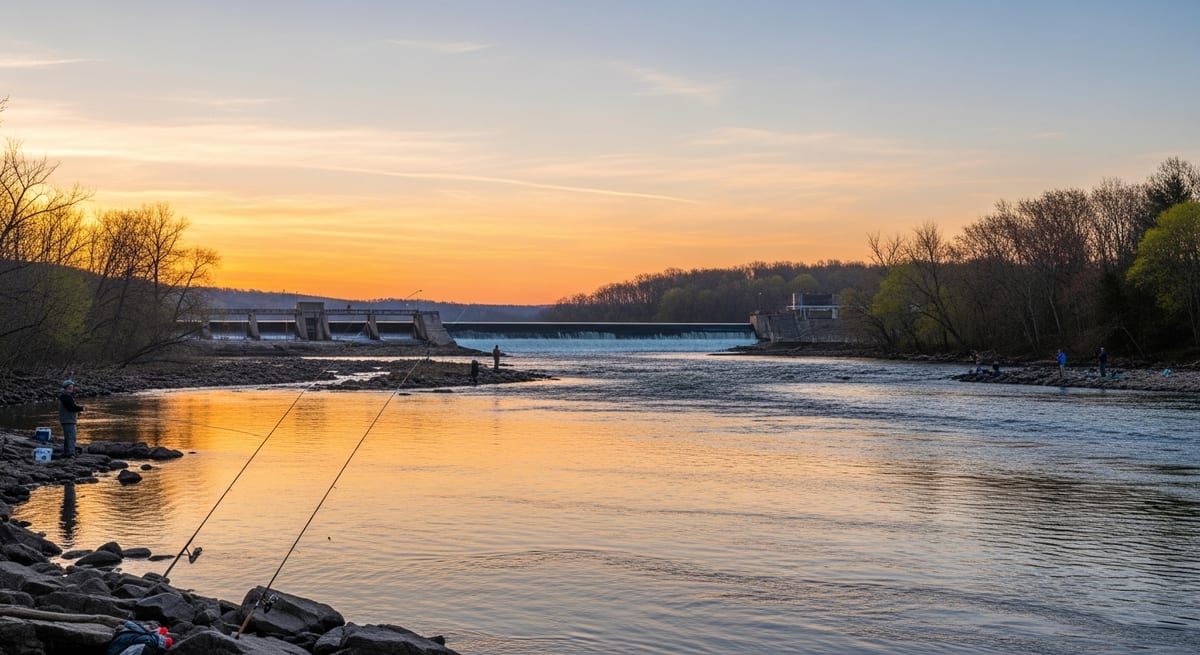
Anglers who fish the Enfield Dam pool during strong-run years report that peak morning sessions can produce 15 to 20 hookups, with roughly a third lost on slack line. Shad regulars on the Connecticut describe that soft-mouth, constant-pressure problem as the defining variable that separates experienced shad chasers from first-timers. Connecticut River shad populations have climbed under ASMFC interstate management since fish-passage infrastructure was expanded starting in the 1990s, with CT DEEP annual escapement estimates reaching several hundred thousand fish in moderate years and higher in strong-run years. The run itself compresses into a window that experienced shad chasers consistently describe as three weeks or less at peak density, water-temperature driven, and easy to miss without tracking CT DEEP bulletins or USGS gauge data in the weeks leading up to it.
The Run Window: Water Temperature, CT DEEP Escapement, and Why Timing Is the Variable
American shad (Alosa sapidissima) are the largest member of the herring family. Roe females regularly reach 4 to 7 lbs and occasionally exceed 10 lbs; bucks run smaller at 2 to 4 lbs. Both sexes return from the ocean each spring to spawn in the rivers where they hatched, and unlike Pacific salmon, many American shad survive spawning and return to spawn again over a 5 to 7 year lifespan. ASMFC interstate restoration efforts have focused heavily on fish-passage infrastructure at dams like Holyoke partly on the strength of that iteroparity: more survivors per cohort means population response to passage improvements is faster than in semelparous species.
The run trigger is water temperature. Shad begin staging in the lower Connecticut when water approaches 55 to 58 degrees and move actively upriver through the 60 to 65 degree range. In most years that window falls between mid-April and late May at the Enfield pool, though CT DEEP annual run reports show year-to-year variability of two to three weeks depending on spring warming conditions. Shad regulars on the Connecticut track the USGS gauge at Thompsonville (station 01184000) as a reliable leading indicator of where the run sits in the temperature sequence. It is publicly available at waterdata.usgs.gov and updated daily.
CT DEEP also posts annual shad bulletin updates during the run. Checking both sources in the two weeks before a planned trip is what experienced Connecticut shad chasers describe as the difference between hitting peak timing and arriving a week too late.
Enfield Dam, Windsor, and the CT River Access Points Shad Regulars Use
Enfield Dam sits at the top of the tidal Connecticut River and is the most concentrated public shad access point in the state. Fish stage in the deep pools below the dam and along the current seams leading to it. CT anglers who fish this stretch consistently describe the upstream current edges, not the slack pools directly below the dam structure, as where the most active fish hold during peak run.
Access points the CT shad community regularly cites:
Enfield Dam pool: the primary CT shad destination. Accessible from the east and west banks below the dam. Wade-fishing the upper pool from the west bank is possible without a boat at most spring water levels.
Windsor Meadows State Park: 4 miles downstream of Enfield. Bank access to current seams that concentrate fish during the early run, before the Enfield pool fully peaks.
Suffield and Agawam Road launch: canoe and kayak launch with access to mid-river holding water that receives less pressure than the Enfield pool. Shad anglers who fish it regularly describe productive sessions when Enfield is crowded at peak run.
Haddam tidal river: the lower tidal Connecticut produces American shad alongside hickory shad (a smaller Alosa species) and early-season stripers. The character differs from upriver pool fishing: wider water, more varied current, and a longer seasonal window.
For anglers willing to cross into Massachusetts, the water below the Holyoke Fish Elevator is what Holyoke regulars describe as exceptional during transit windows. The Army Corps and Mass DFW fish counter for Holyoke is publicly posted online and shows real-time passage counts, which tells you where in the run the fish are before making the drive north.
The Dart-vs.-Flutter Debate: What CT Shad Regulars Actually Throw
Shad darts are the consensus choice among CT River shad chasers: small, dense lead jigs (1/8 to 1/4 oz) with a sloped head that produces a fluttering action on the sink. Color preferences split by conditions. Chartreuse/white and pink/white are the most cited combinations on the Connecticut in clear to lightly stained water; orange and yellow get more credit in overcast light or off-color conditions. Any CT tackle shop in the Enfield-to-Windsor corridor stocks darts during the run, and they are difficult to find before the season opens and nearly impossible to source after it closes.
The tandem rig is standard among Enfield pool regulars: two darts on the same leader, 18 inches apart. The trailing dart (lower, closer to the bottom) accounts for the majority of hookups. The upper dart provides swimming motion and occasionally draws simultaneous double strikes.
The dissent: a portion of CT and Hudson shad anglers prefer small flutter spoons when fish are not responding to darts. A Swedish Pimple 1/8 oz in silver or an Acme Kastmaster 1/8 to 1/4 oz are the most cited alternatives. Community consensus attributes the switch to slow-current situations where the dart's action becomes too subtle; the spoon's larger flash profile compensates.
Gear baseline that shad regulars on the Connecticut describe as appropriate: Rod: 6 to 7 ft light to medium spinning, line-rated 4 to 10 lb Reel: 2000 to 3000 class with a smooth drag. Shad make extended runs, and a rough drag tears hooks through soft mouths. Line: 8 to 10 lb monofilament, or braid with a 6 to 8 lb fluorocarbon leader of 18 to 24 inches Terminal: 1/8 to 1/4 oz shad darts in chartreuse/white or pink/white; tandem rig with 18-inch dropper as the Enfield pool standard
Slack Line and the Hookset: The Presentation Variable Shad Regulars Point To
Shad are migrating upriver rather than actively hunting. They will strike small shiny objects that cross their path at the right depth and speed, but the lure needs to intercept the fish, not the reverse. Getting the dart into the lower half of the water column, where shad typically hold in moderate current, is the first execution variable.
The standard swing presentation: Cast across or slightly upstream at roughly 45 degrees. Count the lure down to depth before beginning the retrieve. Starting the retrieve before the dart reaches the holding zone is a common miss that shad chasers at Enfield describe consistently when they talk about what new anglers get wrong. Retrieve slowly, just fast enough to produce action, and let the current swing the lure through the zone. Most strikes come near the end of the swing.
The hookset and the slack-line problem: Shad mouths are soft, and the hook pulls easily on a hard strike. Shad regulars on the Connecticut consistently attribute a large share of lost fish to two causes: hard upward strikes that tear through soft mouth tissue, and any slack line during the fight. The consensus recommendation is a firm lift-and-reel hookset rather than a sharp upward strike. Maintaining reel pressure through the acrobatic jumps, which American shad make multiple times on light tackle, is what experienced shad anglers describe as the critical execution variable.
Slow periods are part of the pattern. Community reports from the Enfield pool during off-peak days within the run describe stretches of 40 to 60 casts between hookups. During a heavy migration push, consecutive-cast hookups are reported.
The Hudson River Run: Access Points, Hickory Shad Bycatch, and How It Differs from the Connecticut
The Hudson River shad run overlaps with prime striped bass season. That combination makes the mid-Hudson productive in spring and means shad anglers are often sharing current seams with bass fishermen working the same water.
Hudson access points NY DEC and shad regulars cite:
Catskill: bank access below the Rip Van Winkle Bridge. Deep current seams hold shad and often stripers simultaneously during the spring run.
Kingston: multiple NY DEC fishing access sites along the west bank. The area around the Kingston-Rhinecliff Bridge is cited frequently in Hudson shad community reports.
Newburgh-Beacon: good mid-river access from the Newburgh waterfront, with bank access and boat launches that see significant shad pressure at peak run.
Hickory shad bycatch on both rivers: both the Connecticut and Hudson carry hickory shad (Alosa mediocris), a smaller Alosa species that runs slightly earlier than American shad, typically averages 1 to 2 lbs, and takes shad darts aggressively. CT anglers fishing the Enfield pool in early April frequently encounter hickories before the American shad push peaks. As of CT DEEP 2025-2026 regulations, hickory shad in CT inland and tidal waters carry no size minimum and no bag limit. Verify current-year regs at ct.gov/deep before keeping fish, as shad regulations are subject to change under ongoing ASMFC stock assessment cycles.
CT DEEP Possession Limits and What 2025-2026 Regulations Say About American Shad Harvest
CT anglers should verify American shad possession limits and any size rules directly with the CT DEEP 2025-2026 Inland and Marine Fishing Guide, available at ct.gov/deep, before keeping fish. American shad regulations on the Connecticut River have been adjusted multiple times since 2015 as the ASMFC interstate shad stock assessment has evolved. A regulation assumed from a prior season may not reflect current rules.
Shad roe (the egg sacs from roe females) is typically covered under the same regulations as the fish itself. Verify with CT DEEP before harvest if roe is the objective, particularly for roe-only trips targeting female fish.
For anglers fishing north of the CT/MA state line near Holyoke or Hadley Falls: Massachusetts DFW regulations apply and differ from CT rules. Check Mass DFW separately before fishing that water.
The ASMFC American shad stock assessment (available at asmfc.org) provides the broader interstate context for understanding why Connecticut River possession limits are set where they are. The most recent assessment documents the population trajectory and the interstate management logic that has shaped Connecticut-specific rules in recent years.
Planked Shad, Shad Roe, and the Y-Bone Reality
American shad have a documented place in Connecticut food history going back centuries. The Connecticut River shad fishery was commercially important to river towns from Old Saybrook north through Enfield well into the 20th century, and spring shad bakes were a community tradition along the river. The culinary challenge is the Y-bone structure: shad carry a secondary skeleton with Y-shaped intramuscular bones running through the fillet in a pattern unlike most common finfish, which makes casual filleting produce a mouthful of small bones.
Two traditional approaches to the Y-bone problem:
Professional shad boning: a knife technique that removes the Y-bone structure intact when done correctly. It requires practice and is much easier to learn from video demonstration than from written description. Anglers who have developed the skill describe it as taking several fish before the sequence becomes reliable. Search 'traditional shad boning technique' before the season if harvest is the intent.
Connecticut planked shad: the fillet is traditionally secured to a green hickory plank and slow-cooked for 6 or more hours over hardwood coals. The extended low heat dissolves the small intramuscular bones. This is the historic Connecticut River preparation. Several Connecticut River towns have held public shad bake events in recent years, continuing a tradition that goes back to at least the 19th century along the lower Connecticut.
Shad roe is sautéed traditionally in butter with onions and bacon. It is available from CT fish markets during the run without fishing. Essex and Old Saybrook-area markets have historically carried it at peak season, and it is worth seeking out even for anglers who do not fish the species.
EVERY SATURDAY MORNING
Weekly fishing intelligence
Nationwide conditions, what's biting, and honest gear deals. One email, no noise.
No spam. Unsubscribe anytime.