
Shore Casters From Watch Hill to Niantic Report the Big-Cow Window Runs 10 Days Earlier in Warm Falls Than Most CT Anglers Plan For. What ASMFC Tag Returns, NOAA Sea Surface Data, and the Northeast Shore Community Reveal About Tracking the Migration Before It Peaks
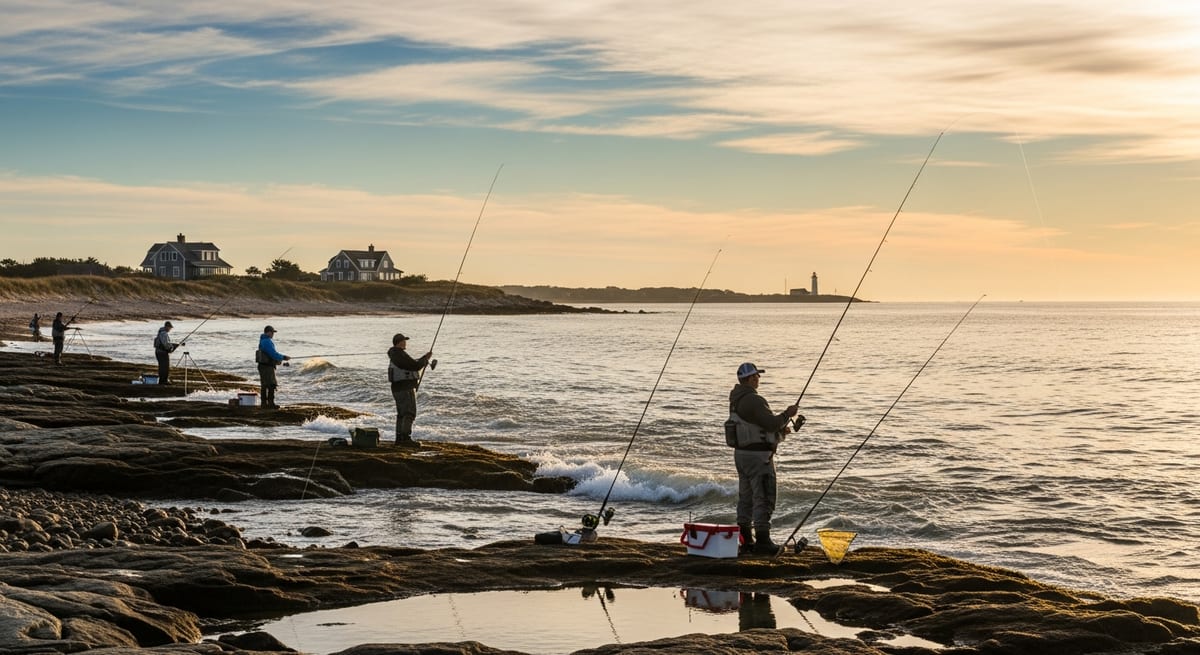
ASMFC tag return data shows striped bass tagged in Chesapeake and Hudson River tributaries are recovered at Connecticut coastal access points anywhere from late September through mid-November. A spread that CT shore communities have tracked for years as the difference between a three-week run and a seven-week one. The exact window in any given year is driven less by the calendar than by two converging signals: when Atlantic menhaden schools concentrate on the CT coast, and when NOAA buoy data at the shoreline crosses the 63-65°F threshold that triggers staging behavior. Shore casters at Black Point and the Connecticut River mouth who watch both signals consistently report they are positioned 7-10 days ahead of anglers who wait for word that fish are 'showing' before they rig up.
Why the Bunker Schools Move Before the Stripers Do
The fall striper migration is a foraging migration, not just a temperature response. Atlantic menhaden, peanut bunker in their juvenile fall form, school along the CT coast beginning in late September, and shore communities consistently report that years with dense bunker concentrations hold fish longer and produce more quality-size stripers at shore-accessible spots.
AMSFC menhaden stock assessments since the mid-2010s have documented a partial recovery of Atlantic menhaden along the Northeast coast. CT shore regulars who have fished the fall run across multiple seasons report that this recovery has coincided with more consistent bait concentrations from Niantic Bay west through the Sound, though individual seasons vary significantly based on where juvenile menhaden school in a given year.
The practical implication, as anglers at Rocky Neck and Hammonasset State Beach have described it: scout for bunker activity first, then set up for stripers. Visible bait, surface dimpling, gulls working low over the water, or dark patches moving under a flat surface, is a more reliable real-time indicator than any regional forecast.
Reading the 63°F Line: The NOAA Data CT Shore Communities Actually Use
Sea surface temperature tracking is the most consistently cited tool in CT shore angler communities for timing the fall run. The threshold most commonly referenced: when NOAA buoy readings along the CT coastline drop from the 65-67°F range into the 61-63°F range, stripers that have been feeding throughout Long Island Sound begin staging and pushing south.
NOAA's nowCOAST viewer and the National Data Buoy Center, with stations at the Race, New London Ledge, and Block Island Sound, are the sources CT shore communities reference most often. This transition typically occurs in the second or third week of October in average years. In warm falls, when September sea surface temperatures remain above 68°F into early October, shore communities report the run is often compressed into a shorter, later window that catches anglers off guard.
Shore casters at Black Point (East Lyme) and the Connecticut River mouth jetties describe a rapid 4-5°F drop over five to seven days as the trigger that produces the most concentrated staging behavior before fish push south. A gradual cooling, by contrast, often produces a more drawn-out and diffuse run with fewer quality fish at any given access point on a given day.
What Cape Cod and Watch Hill Report Usually Predicts the CT Arrival
The geography of the migration means Massachusetts and Rhode Island shore communities see the run before Connecticut does. Anglers fishing Cape Cod's outer beaches and Monomoy typically report peak fall action roughly three to four weeks before the CT coast sees it. Watch Hill, RI and the Charlestown Breachway generally report peak activity 10-14 days ahead of the Niantic Bay and Black Point area.
CT anglers who follow Rhode Island shore reports describe using those accounts as a preparation timeline. When Watch Hill casters report consistent large-fish contacts on outgoing tides, CT shore anglers treat that as a 10-14 day leading indicator for their own shoreline, enough time to check gear, stock fresh bait, and arrange tide-window commitments.
The migration does not move as a single front. ASMFC tagging data shows stripers from different spawning populations, primarily Chesapeake and Hudson River fish, which together make up the substantial majority of the recreational catch in CT, can overlap in the same waters during the fall. CT shore communities report that the first wave through is often composed of smaller fish; the larger stripers often follow a week or more behind, particularly in years when the temperature drop is gradual rather than sharp.
The 'Cow Window': What CT Shore Communities Describe as the Quality Period
Within the broader fall run, CT shore communities identify a narrower window as the quality period for large fish. Anglers who have fished the run consistently describe this window as typically 10-18 days, occurring somewhere between late October and early November in most years, though warm falls push it later and occasionally into the first week of November.
During this period, night tides from two hours before peak outgoing through two hours of incoming are described as the most productive across most CT shore spots. Rocky outpoints, river mouths, and any structure that concentrates current are where consistent large-fish reports cluster. At the Connecticut River mouth in Old Saybrook and Old Lyme, regulars report that the sandbar along the east jetty face produces reliably on outgoing tides when bait is swept through; the incoming tide shifts productive water to the west jetty.
The consensus among shore anglers who target this window deliberately: large presentations are warranted. Bunker-colored swimbaits in the 8-10 inch range, large darters, and metal-lip swimmers are the choices most often cited in reports from anglers specifically targeting quality fish during the peak October window rather than schoolies.
What Experienced Anglers Report Switching To After the Peanut Bunker Clear Out
By early November in most years, peanut bunker schools have pushed off the CT coast or been significantly thinned. CT shore communities report that this transition, often identifiable when gulls stop working inshore water and visible surface bait disappears, calls for a setup change.
Anglers fishing Rocky Neck State Park and the Black Point rocky outcroppings describe switching to herring-pattern lures, sand eel imitations, and squid profiles once the peanut bunker have moved on. Fish that remain in CT waters after the main bunker push are typically feeding on smaller, deeper-dwelling bait species rather than the dense surface schools that defined October conditions.
Late-season regulars at the Race and in the deeper cuts east of Niantic Bay report that presentations worked near bottom produce more consistently after the bunker push ends. Bucktail jigs with soft plastic trailers, fished on a slow bounce along structure, are cited more often in November reports than the higher-action swimbaits that dominate October accounts. The fish are still there; the approach that reaches them has typically shifted.
The ASMFC Slot, the CT Season Framework, and What Shore Communities Describe About Large-Fish Release
Striper regulations on the CT coast have changed multiple times under ASMFC Amendment 7 and subsequent management actions. Always verify the current 2025-2026 Connecticut season dates, slot size limits, and daily bag limits directly with CT DEEP Marine Fisheries before going out, regulations are subject to further revision and vary from prior seasons.
The regulatory framework CT shore communities have operated under in recent seasons involves a slot limit designed to protect large breeding females. The same large cows the fall migration concentrates on the CT coast. Shore anglers who follow ASMFC management discussions note that striped bass remain under active rebuilding pressure, and that the slot approach specifically targets reducing harvest of the most reproductively valuable fish.
Anglers who regularly release large stripers describe consistent practices: keep the fish in the water whenever possible, use a dehooker or long-nosed pliers for rapid hook removal, support the fish horizontally rather than hanging it vertically by the jaw, and revive until it swims strongly before releasing. Shore communities note that large fish caught in the cool water of late October and November typically revive more quickly than fish handled earlier in the season, but that fish exhausted by a long fight still need deliberate revival time regardless of water temperature.
EVERY SATURDAY MORNING
Weekly fishing intelligence
Nationwide conditions, what's biting, and honest gear deals. One email, no noise.
No spam. Unsubscribe anytime.