
Surf Fishing for Striped Bass in Connecticut: A Complete Technique Guide
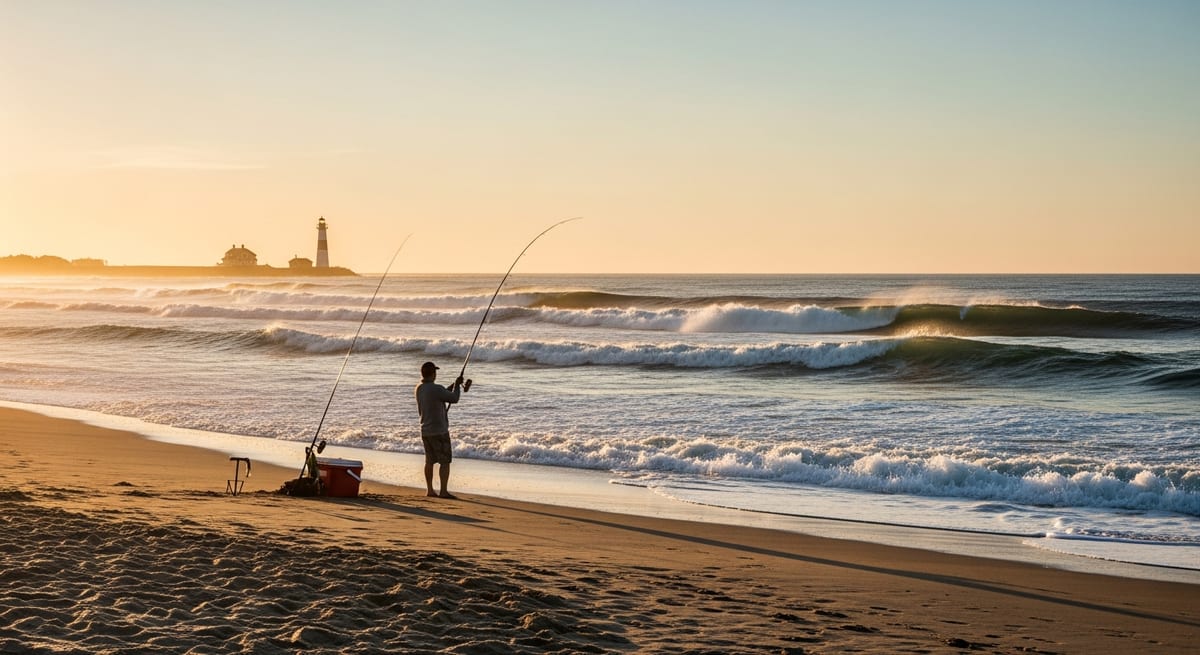
At Old Saybrook's Connecticut River jetty in May, migrating stripers stack so thick during the peak spring run that anglers fishing plugs from shore routinely find 20-pound class fish within casting range, no boat required. No guide fees, no captain's chair. Just you, the darkness before dawn, a sandy beach or a rocky point, and the moment when something big takes your plug and the drag screams. Connecticut's coastline gives you excellent surf access, from the sandy flats of Hammonasset to the rocky points at Watch Hill and the jetties flanking New Haven Harbor.
Reading the Water: Where Stripers Feed from Shore
Surf fishing is fundamentally about reading the water and finding where fish are likely to be. Stripers in the surf are feeding. They're using structure and current to ambush baitfish, and you need to put your offering where that's happening.
Points and headlands: Rocky points that extend into the Sound create current seams as the tide flows past. Stripers typically position on the downcurrent edge of these seams to intercept bait swept past by the current. Rocky points at dawn and dusk during a running tide are your highest-percentage spots.
Jetties and breakwaters: Jetties create current, hold mussels and crabs, and provide edge structure that stripers patrol. Fish the tip on an outgoing tide when current is moving off the end of the structure. Fish the sides on a flooding tide when bait is being swept along the rocks.
Beach structure: On sandy beaches, look for cuts and channels between sandbars (the water appears darker/deeper), points where sandbars end and gaps form, and troughs running parallel to shore. These are the feeding lanes. Whitewater where waves break over a submerged bar is often productive. Many anglers find stripers working the edges of breaking waves consistently.
Creek mouths and inlets: Anywhere water drains from salt marshes on an outgoing tide concentrates baitfish and draws stripers. The mouth of any CT tidal creek at low outgoing tide is worth exploring.
Night fishing: Large stripers are far more accessible from shore at night than during the day. Daytime surf fishing tends to catch smaller fish; bigger fish that hold in deep water during daylight often slide into the shallows after dark. Dawn (the hour before and after sunrise) and dusk are typically the most productive windows. Night fishing in the dark is effective but requires knowing your spot well before dark.
Timing: Tides and Seasons
Tides matter more than almost anything else in surf fishing. Stripers feed in moving water. They use current to ambush bait. Dead slack tide (high or low) is typically the slowest fishing. Many experienced CT surf anglers find the bite sharpest roughly 2-3 hours into the outgoing or incoming tide, though the exact window varies by location and structure.
The specific best tide varies by spot. A point that holds current on an outgoing tide may be dead on the incoming. Learn your spots during different tidal stages and keep notes.
Seasons in Connecticut:
Spring run (typically mid-April-mid-June): Stripers migrate north following bunker (menhaden) schools. They arrive along CT's coast and the spring run often produces solid shore fishing as fish are actively feeding. Smaller "schoolies" (under 28 inches) tend to arrive first; larger fish follow the bunker.
Summer (late June-August): The best surf fishing typically shifts to early morning and late evening or night as daytime action often slows in the heat. In some years, striper blitzes on CT beaches occur when bunker schools push close to shore, surface-feeding fish drive bait toward the beach and any plug cast into the melee gets crushed.
Fall run (September-November): Often the best fishing of the year for shore anglers. Stripers feed aggressively as they begin migrating south, and big fish are frequently accessible from shore. October is typically peak season for large fish on CT beaches and rocky points.
Winter (December-March): Stripers are largely gone from CT waters by December. A few fish may linger into December in the eastern Sound near the Race, but winter surf fishing is not productive here.
Plugs, Lures, and Bait
Swimming plugs (jointed and straight): The classic striper plug is a large swimming lure. The Bomber Long A, Sebile Magic Swimmer, Yo-Zuri Crystal Minnow, and similar styles create a natural swimming action retrieved at a slow-to-medium pace. Work them along current seams, near structure, and through breaking waves. Colors: black, dark olive, and white work at night; natural bunker/herring colors during daylight.
Metal lips / classic wood plugs: The Danny plug, the Canal Special, and similar metal-lip swimmers are legendary striper lures in the Northeast surf. They swim very close to the surface with a wide wobble. Work these in lighter surf and near the surface around structure.
Poppers: Surface lures that create a loud popping splash. Deadly during blitzes and when fish are actively feeding on the surface. The Atom Popper, Gibbs Pencil Popper, and Yo-Zuri Hydro Popper are CT surf staples. Cast into feeding fish and work with sharp pops followed by a pause.
Soft plastics: Large paddle-tail swimbaits (7-9 inch, on 2-3 oz jig heads) are highly effective for surf stripers, particularly at night or when fish are holding deep near structure. Work them on a slow retrieve just above the bottom. White and chartreuse at night, natural baitfish colors during the day.
Bait fishing: Chunk bunker (menhaden) or whole soft clam on a circle hook, cast out and left on the bottom, catches stripers reliably, particularly effective for large fish. Use a fish finder rig (sliding egg sinker above a swivel, 24-inch fluorocarbon leader to a 7/0 circle hook). The circle hook allows the fish to turn and self-hook, don't set the hook hard, just reel up steadily when the rod loads up.
Surf Fishing Gear
Rod: A surf rod, typically 9-11 feet long with a medium to medium-heavy action. The length provides distance casting and helps keep the line above wave action. For lure fishing: a 10-foot medium-heavy rated for 1-4 oz. For bait fishing: a 10-11 foot medium-heavy rated for 3-8 oz. St. Croix Mojo Surf, Lamiglas X-11, and Penn Prevail are popular mid-range options.
Reel: A large spinning reel in the 6000-8000 size range. You need line capacity for long casts and the power to stop a 30-pound fish in the wash. Penn Battle III and Shimano Stradic SW are solid mid-range picks; Van Staal is the premium option favored by serious CT surf anglers.
Line: 30-40 lb braided mainline with a 30-50 lb fluorocarbon or monofilament shock leader (15-20 feet long). The shock leader absorbs the stress of casting heavy plugs and fish surging at the rod tip in the surf. Tie the leader-to-braid connection with an FG knot or Albright knot. These must pass cleanly through rod guides on a long cast.
Waders and surf gear: Chest waders extend your range significantly. On rocky points, neoprene waders with wading boots provide warmth and grip. On sandy beaches, hip boots are sufficient for most conditions. Always wear a wading belt outside your waders, if you go down in breaking water, it limits how much floods in fast.
Safety: Never turn your back on the ocean. Sneaker waves on rocky points are real and fast. Fish alone only during daylight if you know the spot well, surf fishing at night is best done with a buddy, or at minimum with someone knowing your location and expected return time.
Best Surf Fishing Spots in Connecticut
Hammonasset Beach State Park (Madison): Connecticut's largest public beach, miles of sandy shore, good parking, and reliable striper fishing during the spring and fall runs. The western end near the river mouth is particularly productive.
Rocky Neck State Park (East Lyme): Rocky shoreline with solid current flow. One of the better rocky-point surf fishing spots in the state and accessible to waders.
Harkness Memorial State Park (Waterford): Open lawn park on the Sound with good access to a varied coastline. Less crowded than Hammonasset, worth the drive for anglers who want elbow room.
Stonington Breakwater: The stone breakwater at Stonington Harbor extends into water with strong current flow. Walk the breakwater on an outgoing tide. One of the most productive striper shore spots in eastern CT.
New Haven Harbor jetties: The jetties at the mouth of New Haven Harbor hold fish throughout the season. More urban setting, but serious fishing, don't overlook it.
Old Saybrook / Fenwick: The jetty at the mouth of the Connecticut River is one of the most famous striper spots on the CT coast. Spring and fall migrations concentrate fish at this funnel point, and it consistently produces larger fish than the sandy beach spots up the shore.
Watch Hill area (CT/RI border): The rocky points around Watch Hill and Napatree Point are excellent fall striper spots, also the same water that holds false albacore and bonito in September and October.
EVERY SATURDAY MORNING
Weekly fishing intelligence
Nationwide conditions, what's biting, and honest gear deals. One email, no noise.
No spam. Unsubscribe anytime.