
CT's Largest Stripers Aren't at Hammonasset or Niantic Bay at Noon. They're There After Dark. What the Shore Community Reports About Night Tides, Lures, and the 2024 Slot Rules.
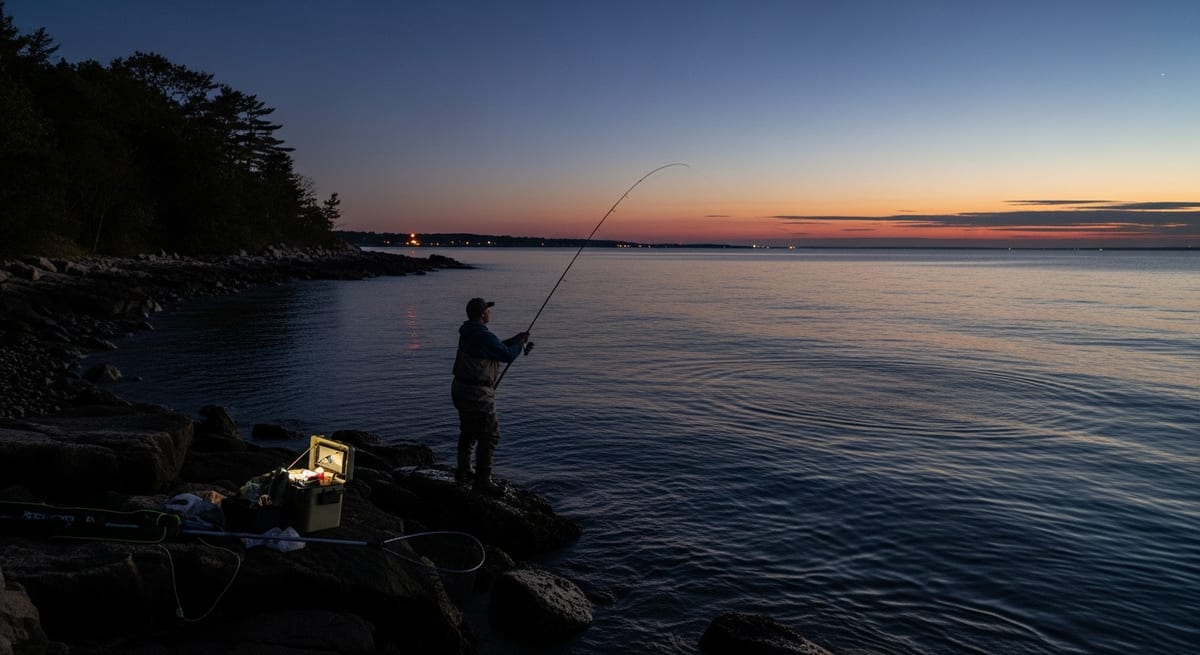
Anglers fishing the Hammonasset Beach State Park shore access during July new-moon tides consistently report that 30-inch-plus bass don't show until well after 10 PM. A pattern echoed across multiple summers on CT Stripers Online and consistent with DEEP tagging observations from the Sound. Large striped bass are fundamentally nocturnal feeders through the summer months along the Connecticut shoreline. They hold in deeper water through the day and push into flats, creek mouths, and beach structure after dark to feed on bait concentrated by the incoming tide. If you've been fishing CT stripers in daylight and coming up empty, the timing shift, not the location, is usually the missing variable.
Why CT Shore Anglers Fish After Midnight
Striped bass are ambush predators with eyes built for low-light conditions. In summer, when water temperatures warm and midday sun is overhead, large bass hold in deep, cool water, lethargic, not feeding, and largely out of reach of shore anglers.
After sunset, two things shift. The shallows cool toward a range where stripers feed more actively, cT Stripers Online members fishing the Niantic Bay shoreline have noted that surface temps there typically drop several degrees between noon and midnight in July. And the low-light conditions remove the wariness about shallow-water exposure that keeps big fish off accessible structure during the day.
The temperature range most often cited for peak striper feeding is roughly 55-68°F, though ASMFC biologists note that's a typical observed range rather than a hard biological trigger. What CT shore anglers consistently report is that tide phase matters as much as temperature: fish in moving water produce far better than fish sitting in still water at any reading.
Moon phase: New moon and the nights surrounding it are the traditional first choice. Minimal ambient light keeps bass less wary in the shallows. Full moon nights can produce, especially when clouds diffuse the light, but the new moon window is what most CT night anglers target first.
Weather: Overcast nights generally outperform clear, star-lit nights for the same reason as moon phase. Light rain can be excellent; heavy rain or lightning is a reason to leave.
Baitfish behavior reinforces the pattern. Sand eels, silversides, and juvenile bunker are frequently observed near the surface after dark in calmer water, cT anglers working the Millstone outflow stretch report surface concentrations not present during afternoon hours. Whether this reflects disorientation or predator pressure is debated, but the community observation is consistent: bait visible near the surface at night means stripers are likely below.
Night Windows at CT's Key Shore Access Points
Not all CT shore access fishes equally well at night. Spots that produce consistently share a common structure: current-swept points, creek mouths where tidal water floods a flat, or hard structure adjacent to a drop. Plan to arrive 2-3 hours before high tide on the incoming.
Hammonasset Beach State Park offers miles of open beach with no permit required. The east end near the marsh outlet pushes bait against the beach structure on the incoming tide. CT Stripers Online members note mid-July and September as the most productive windows; confirm the access road gate schedule with the park before a late-night trip.
Niantic Bay and the Niantic River mouth concentrate bait on the incoming in a way the local charter community has documented for years. The river mouth area near Hole-in-the-Wall access sees consistent night activity through July and August.
The Housatonic River mouth at Milford is a perennial night-fishing producer, cT DEEP has tagged stripers in the lower Housatonic during fall run monitoring, and shore access off the Milford boat launch and adjacent shoreline puts anglers directly in the staging current.
The Thames River estuary in the New London area runs deeper with stronger tidal current, which holds fish through more of the tide cycle than flat-beach access. Public shoreline near Fort Trumbull State Park gives shore access to the tidal channel without a boat.
The Millstone Nuclear Power Station outflows off Waterford produce warm-water structure that holds stripers well into fall when other shore spots have slowed. The adjacent public fishing access at Millstone is a documented local producer during fall night windows.
Race Point on the eastern CT shoreline fishes the tidal rip at peak current flow. Experienced anglers consistently recommend fishing the last two hours of the ebb and first hour of flood from accessible shoreline rather than wading the main current after dark.
What the CT Shore Community Reaches For at Night
The consensus among regular CT night-tide anglers is that dark colors outperform bright ones, black and dark purple swimmers create the most visible silhouette against a lighter sky from a bass's upward-looking perspective. White runs close behind in churned or stained water.
Subsurface swimmers: The Danny Plug, Yo-Zuri Hydro Swimmer, and larger wooden swimmers are the traditional night striper offerings on the CT shoreline. Slow, steady retrieves just under the surface. You're fishing by feel. The take registers as resistance before you see anything.
Topwater: The Gibbs Pencil Popper and Gibbs Bottle Plug are the CT standards for walk-the-dog night presentations. Slow the retrieve significantly from daytime pacing. The sound and surface disturbance are what trigger strikes. The Hogy Epoxy Jig is a subsurface swimmer and jigging lure, not a surface presentation; anglers who want walk-the-dog action at night typically reach for the Gibbs Pencil.
Bucktail jigs: A 1-2 oz white or chartreuse bucktail with a Gulp! grub trailer works in the Housatonic and Thames current situations where bouncing bottom near structure produces when swimmers don't.
Soft plastic eels: Slug-Go and similar eel profiles on weighted hooks move naturally in slower-current beach situations with minimal rod action. Niantic-area charter captains rely on these heavily through the late-summer window.
Live and rigged eels: Live and rigged eels consistently rank highest among what CT night anglers use for large bass. Hook a live eel through the jaw on a 5/0 circle hook on a fish-finder rig or free-line it in slack water. The community consensus on CT Stripers Online is that eels separate themselves on flat-calm, low-current nights when swimmers and topwater aren't producing.
The 2024 Slot Rules Apply at Midnight Too
CT striper regulations tightened substantially with the 2024 ASMFC emergency action. These rules apply at all hours, and CT DEEP enforcement occurs at night-access shore spots.
Current CT striper slot (2024): One fish per day in the 28-35 inch slot. A second fish is allowed only if it measures 55 inches or longer. The previous framework, one fish at 28-inch minimum with no upper limit, is no longer in effect. The 2024 emergency action was specifically aimed at protecting larger, spawning-class fish in the 35-54 inch range that were being disproportionately harvested.
Measuring at night: The 35-inch upper slot limit is a common source of errors in low-light conditions. Carry a measuring board or bump board you can use with a headlamp. CT DEEP has flagged night-fishing measuring accuracy as a compliance concern in its regulation materials.
Circle hooks on bait rigs: If you're fishing live eels or cut bait, circle hooks reduce deep hooking substantially. Most fish you'll encounter in the slot will be released. A clean hook exit matters for survival.
Verify current rules before every trip. Striper regulations have changed mid-season in recent years and may change again. The authoritative source is CT DEEP Marine Fisheries at ct.gov/deep. Forum summaries and third-party articles, including this one, should always be confirmed against the current posted regulations before you leave.
What Changes When You're On the Water After Dark
Night fishing on the CT shoreline carries real hazards, and the shore community has developed a consistent set of practices around them.
Wading: Move slowly and use a wading staff. The algae-covered rocks at Hammonasset or the rip-rap along the Thames estuary that were easy to read at noon are invisible at midnight. Felt-soled waders or carbide-studded wading boots help on coastal CT rock. The consistent advice from experienced CT night waders: don't wade alone in fast tidal current after dark.
Lighting: A red headlamp preserves night vision far better than white light. Use red mode for rigging and moving; switch to white only when you need to see clearly. White light resets your night vision for 10-15 minutes after you turn it off.
Footwear for structure: Screw-in cleats or jetty shoes are standard among anglers who fish the Niantic jetty or rocky stretches near Race Point. Standard wading boots on wet jetty rock in the dark are a fall risk.
Communication: Let someone know where you're going and when to expect you back. Night fishing is solitary; that's worth accounting for before you leave the car.
Dry bag for your phone. A wave-soaked rock on the CT shoreline at night isn't hypothetical. It's a matter of when. Your phone in a soaked pocket is the navigation and emergency device you no longer have.
Boats at night: A PFD worn, not just stowed aboard, is the standard for small-boat night fishing on Long Island Sound. You're harder to see and harder to find after dark. Most CT charter captains running night trips require PFDs be worn at all times.
EVERY SATURDAY MORNING
Weekly fishing intelligence
Nationwide conditions, what's biting, and honest gear deals. One email, no noise.
No spam. Unsubscribe anytime.