
CT's Public Ponds Hold Largemouth and Smallmouth in Every Region. What Bass Fishing Communities Report About Starting Gear, Structure, Seasonal Timing, and the 12-Inch Limit New Anglers Most Often Miss.
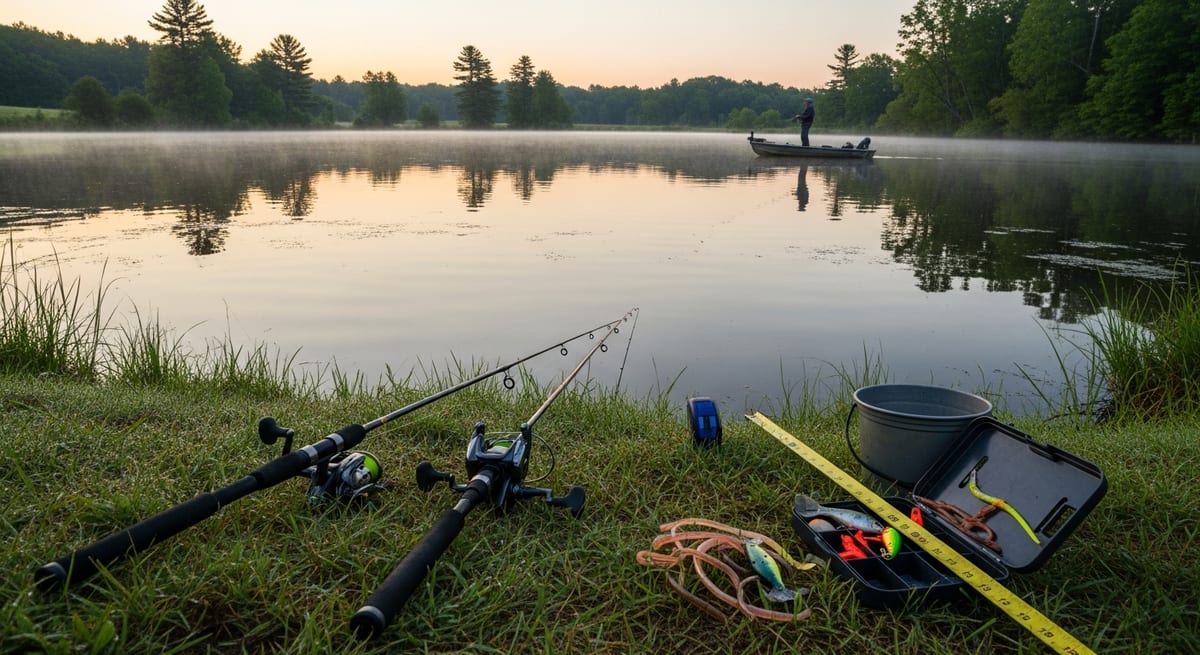
CT's DEEP access records document largemouth bass in hundreds of public ponds and reservoirs across the state, more publicly fishable water than most new anglers realize is within a short drive. Bass fishing forums and CT angling communities consistently rank largemouth as among the most approachable freshwater species to target: widely distributed in public water, willing to strike simple lures, and catchable on an entry-level spinning outfit without a boat.
What Entry-Level Gear Actually Catches CT Bass
CT bass forums frequently debate gear, but the consensus among anglers who started on local ponds is consistent: a $50-$60 spinning rod and reel combo catches bass. Anglers who upgraded to more expensive setups often report the main gain is comfort and durability, not catch rates.
Rod: A 6.5-7 foot medium or medium-heavy spinning rod handles most bass lures from 1/4 oz up to 3/4 oz. The range that covers spinnerbaits, crankbaits, and soft plastics.
Reel: A 2500-3000 size spinning reel. Shimano, Daiwa, and Penn all make options in the $30-$70 range that CT anglers report holding up well across multiple seasons.
Line: 15-20 lb braided line with a 10-15 lb fluorocarbon leader (18-24 inches, tied with an Alberto or FG knot) is the setup most experienced CT bass anglers have converged on. Braid offers sensitivity and strength; fluorocarbon is nearly invisible in water. Anglers new to the Alberto knot often start with 10-12 lb monofilament. It fishes well and simplifies the learning curve.
Hooks: For soft plastics, a 3/0 offset worm hook covers most presentations. For finesse rigs, 1/0-2/0 thin-wire hooks. CT anglers fishing weedy ponds consistently rate the offset worm hook as the single most-used piece of terminal tackle.
Five lures CT bass forum regulars recommend for beginners:
- 1/4 oz chartreuse or white spinnerbait
- 3/8 oz white or chartreuse buzzbait
- Crankbait in shad or crawfish pattern (1/4-3/8 oz)
- 5" straight worm in Junebug or Watermelon Seed (Texas rigged with 3/0 offset hook)
- 3/8 oz white or chartreuse jig with matching trailer
These five cover every major bass technique and fish effectively across CT's mix of weedy ponds, rocky reservoirs, and clear lakes.
Structure Over Open Water: Where CT Largemouth and Smallmouth Hold
Bass are structure-oriented. They don't cruise open water randomly. Anglers across CT pond fishing communities report that the highest-percentage spots are predictable once you understand what bass are relating to.
Docks and boat houses: Shade draws baitfish; baitfish draw bass. Anglers fishing pressured ponds like Bantam note that dock shade holds fish through midday when open-water activity slows. Cast parallel to docks and work the shadow line with a worm or jig.
Weed edges and lily pads: Vegetation concentrates baitfish and gives bass ambush cover. CT kayak anglers consistently report the outside edge of weed beds as more productive than the interior. Bass break from cover to chase prey along that transition. Weedless presentations work best here: Texas-rigged worms and spinnerbaits with large blades.
Rocky points and riprap: Bass use current breaks at rocky points and the rocky faces of dam riprap year-round. Smallmouth in particular hold tightly to rock, cT anglers targeting smallmouth at lakes like East Twin and Lillinonah report rocky shorelines and underwater ledges as more reliable than open flats.
Laydowns and submerged wood: A fallen tree in 3-8 feet of water is among the highest-probability spots on any CT pond. Forum regulars recommend targeting multiple levels of the same laydown separately. The base, mid-trunk, and branch tips each hold fish at different stages of the day.
Channel edges and depth transitions: Where shallow water drops into deeper water is a travel corridor and a feeding zone. CT bass anglers report fish moving shallow to feed in low light and retreating to depth transitions once the sun is high or fishing pressure builds.
Four Rigs That CT Bass Anglers Teach Beginners First
Texas Rig: Thread a plastic worm on an offset hook with the point buried in the plastic, then peg a bullet weight above the hook. The result is fully weedless. It fishes through lily pads, laydowns, and the weedy edges common on CT ponds without hanging up. Cast near cover, let it sink on a semi-slack line, and work it in slow hops along the bottom. CT bass fishing communities consistently rank this as the most important rig to learn first; it accounts for more consistent production across varied water than any other single setup.
Spinnerbait: A forgiving technique that works across water clarity and depth. Cast near structure and reel at a pace that keeps the lure just above the bottom or through mid-depth. The blade provides vibration and flash that works well in the stained water common on CT warmwater ponds. Anglers fishing weedy reservoirs report that a single willow-leaf blade configuration snags less in heavy cover than other setups.
Crankbait: Cast and reel. The lure dives to its rated depth and wobbles. CT bass anglers use crankbaits to cover water quickly when locating fish. Depth-appropriate runners matter: shallow divers near weed edges, medium divers along rocky points and depth transitions.
Topwater: Cast near cover at first light or last light. Work a buzzbait at the speed that keeps it on the surface. Let a walking plug sit momentarily after it lands, then walk it side-to-side with slack-line rod twitches. Anglers fishing CT ponds at dawn in late May and June report topwater as particularly productive over bass still holding shallow in the post-spawn window.
Water Temperature Triggers Matter More Than the Calendar
CT anglers who track water temperature consistently report that seasonal windows shift with conditions. A cold spring can push the productive window two to three weeks later than a warm one.
Spring (April-May): Pre-spawn bass feed aggressively in shallow water warming toward 60°F. Community forum reports identify dark-bottom coves and north-facing banks as the first areas to warm and produce. Spawn begins when water temperature reaches approximately 60-65°F. The range most commonly cited in CT bass fishing discussions and general fisheries literature. Bass move to shallow gravel and hard-bottom areas to nest; bites during active nesting tend to be defensive rather than feeding-motivated.
Summer (June-August): CT bass forum regulars note early morning and late evening as the consistent topwater windows. Midday bass move to shade under docks or retreat to depth. A worm or jig worked slowly along the bottom in 10-15 feet near structure is the consensus midday technique on CT warmwater lakes.
Fall (September-November): Feeding accelerates as water cools. Anglers fishing CT ponds in October often report their strongest action of the year. Bass chasing baitfish schools into the backs of coves and along shoreline points. Shad-colored crankbaits and swimbaits match the forage bass are targeting.
Winter (December-March): Bass are sluggish and holding deep. CT anglers who fish cold-water bass report slow, finesse presentations, drop shot or shaky head near deep structure, producing on patient days, with long intervals between bites.
CT Regulations, Public Access, and the Waters New Anglers Use Most
Regulations every new angler needs before the first trip: CT's statewide regulation for largemouth and smallmouth bass sets a 12-inch minimum length limit with a 6-fish daily creel limit (combined largemouth and smallmouth). Most waters are open year-round. An annual CT Inland Fishing License is required for anglers 16 and older; licenses are available through DEEP's online portal and at license agents statewide. Some designated waters carry special or trophy-pond restrictions, confirm current rules at ct.gov/deep/fishing before heading out, particularly for smaller or lesser-known ponds.
CT's DEEP mapping tool documents public access points across hundreds of publicly fishable ponds, lakes, and reservoirs spread across every county. The following are among the waters CT bass fishing communities most often recommend for new anglers:
Lake Lillinonah: Spanning Southbury, Newtown, Brookfield, and Bridgewater, Lillinonah holds both largemouth and smallmouth across a varied mix of coves, rocky arms, and depth transitions. The Georges Hill boat launch in the Newtown/Southbury area is the most commonly referenced access point. Anglers targeting smallmouth report the rocky arms productive through fall; largemouth tend to concentrate along dock lines and weedy coves in summer.
Bantam Lake (Litchfield): CT's largest natural lake by surface area, with consistent largemouth fishing along weed edges and dock lines. The town boat launch off Bantam Road provides car-top and trailer access. CT bass forum regulars note Bantam's lily pad edges as productive from mid-May through early fall, with early-morning topwater a reliable approach in July and August.
East Twin Lake (Salisbury): Clear water with quality largemouth and smallmouth. Access via the town launch off Twin Lakes Road. The clarity makes fluorocarbon leaders more important here than on stained ponds. Anglers who fish it frequently report that downsizing line diameter makes a noticeable difference.
Mashapaug Lake (Union): An underrated eastern CT bass fishery with relatively low pressure compared to more trafficked lakes. DEEP maintains public access on the south shore. Anglers who fish it regularly note the rocky points on the north end as reliable smallmouth water through the fall.
Moodus Reservoir (East Haddam): A productive mid-state option known to local bass anglers. Public access is available via DEEP-maintained launch sites; confirm current access and any applicable seasonal restrictions at ct.gov/deep/fishing before the trip.
EVERY SATURDAY MORNING
Weekly fishing intelligence
Nationwide conditions, what's biting, and honest gear deals. One email, no noise.
No spam. Unsubscribe anytime.