
CT Impoundment Bass Regulars on Candlewood, Bantam, and Lillinonah Report Docks Hold the Biggest Midday Fish. What Community Reports, DEEP Freshwater Regs, and Summer Thermocline Patterns Show About Fishing Under Cover
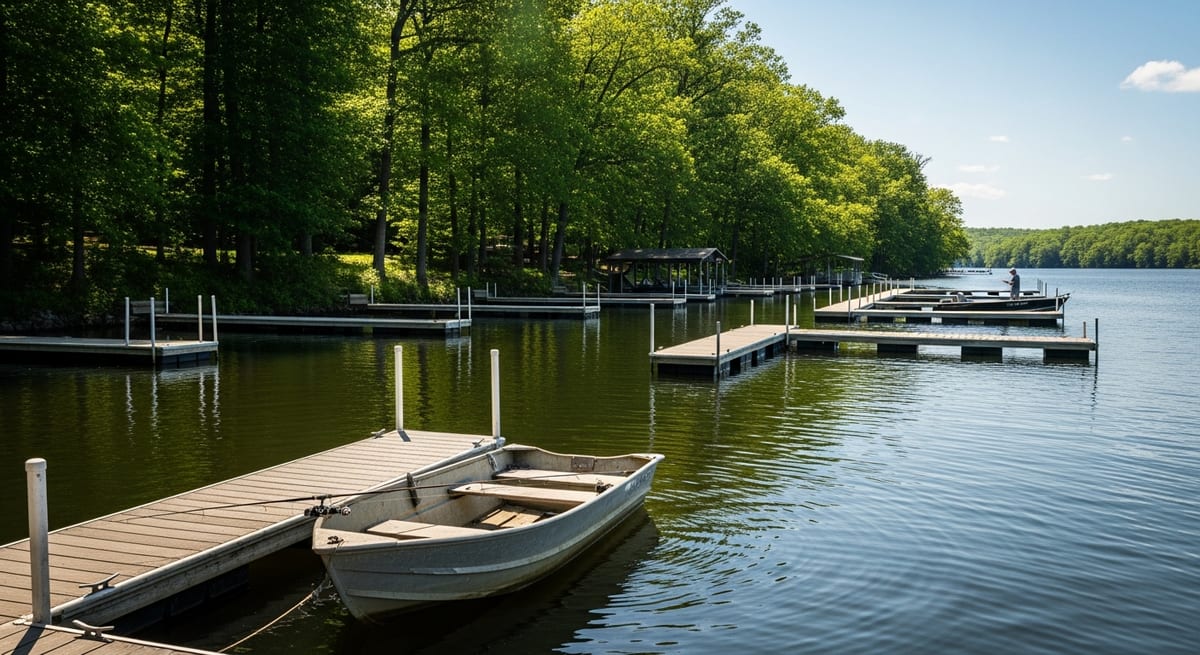
Candlewood regulars fishing the residential coves off Route 39 consistently report that the back third of a shaded dock, not the end closest to open water, is where the largest largemouth set up by mid-morning. The same pattern surfaces on Bantam Lake and Lake Lillinonah: once surface temperatures push past 80°F, bass that spent April on shallow flats tend to stage under dock cover. Water temperature directly beneath a shaded dock on a clear July afternoon can run several degrees cooler than adjacent sun-exposed water, enough to shift where fish are willing to hold through the heat of the day. What follows aggregates what CT impoundment anglers report about dock positioning, skipping technique, and the access etiquette that keeps relations with shorefront homeowners civil.
Why CT Impoundment Docks Concentrate Summer Bass
The dock bite on Candlewood, Bantam, and Lillinonah follows a consistent summer logic: shade, structure, and depth access. Dock decking blocks direct sunlight. Anglers who have tracked surface temps on still July afternoons report the difference between shaded dock water and adjacent open water can reach 4 to 6 degrees Fahrenheit, enough to change where bass are willing to hold. Pilings and dock hardware give bass vertical elements to relate to and ambush from. What separates the most productive docks from ordinary ones is depth access: a dock positioned at the edge of a depth transition, where fish can stage beneath the structure and move to deeper open water without much lateral travel, holds fish more consistently than one planted on flat, featureless bottom at uniform depth.
Reading Which Docks Are Worth Fishing on CT Lakes
Not every dock holds fish equally. On Candlewood and Lillinonah, floating docks with multiple flotation barrels and boat lifts are reported to hold fish more reliably than fixed single-platform docks. The extra hardware creates additional mid-water structure that bass relate to, particularly when horizontal crossbeams and cables form a near-complete canopy. Long docks that extend toward deeper water tend to hold more fish than short ones anchored in the shallows. Docks on north-facing banks, which stay in shade through the morning hours, are reported to attract fish earlier in the day on clear days when the sun-side bank is already heating. On Bantam, community reports note that docks adjacent to rocky shoreline or natural brush transitions offer double structure. The consensus on dock-back positioning: the shadiest, most sheltered point of the dock, farthest from open water and closest to shore, is consistently where the largest fish holds. Cover the outer pilings first, then work inward, rather than running straight to the back and spooking everything underneath.
The Skip Cast: Getting Lures to the Back of the Dock
Placing a lure at the back of a dock under a low deck clearance requires skipping, a flat sidearm cast that sends the lure skimming across the water surface. It is the core dock fishing skill, and CT impoundment regulars report it takes most anglers dedicated practice sessions before the mechanics become reliable. The fundamentals: use a sidearm or low-angle cast rather than an overhand motion. Release the lure when the rod tip is parallel to the water and aimed directly at the open water in front of the dock opening. The lure should land flat and skip toward the back on contact. Spinning gear is the standard starting point. A 7-foot medium spinning rod with 15 to 20 lb braid and a fluorocarbon leader gives enough control to develop the feel before moving to baitcasting. For lure selection in the skipping phase, flat, dense, and low-profile baits skip most predictably: finesse jigs in the quarter-ounce range, lightweight tubes on a one-eighth-ounce jig head, and unweighted or lightly weighted soft plastics all work well.
What CT Dock Regulars Throw and When
Finesse presentations tend to outperform reaction baits on heavily fished docks. Bass holding in shade are in a visually alert, deliberate mode, and the CT impoundment community consistently leans toward a short list of targeted setups. Drop shot rigged 10 to 12 inches above the weight: shake it beside a piling and dock bass often take it without committing to a chase. Tube jigs (2.5 inch, one-eighth-ounce head) remain a long-standing CT dock standard that falls naturally past pilings; green pumpkin and smoke are reported as top producers on Candlewood and Bantam across multiple seasons. Shaky head with a finesse worm (one-eighth to three-sixteenth ounce) is widely cited as the go-to on pressure-fished docks where fish have seen everything else, standing the worm on the bottom in place beneath the structure. For active fish that won't commit to stationary bait, a small underspin (quarter-ounce, small blade) worked horizontally at mid-water between pilings draws bites when slower presentations stall.
Timing the Dock Bite Through the Summer Season
Dock regulars on CT impoundments report the midday window, roughly 10 AM to 2 PM on sunny days, as the most reliable period. That runs contrary to what many anglers expect. When the sun is overhead, fish tend to concentrate under cover in predictable positions, which makes dock locations easier to read than during the diffuse early-morning bite. In the early morning hours, bass may be shallower on adjacent shoreline structure before retreating to dock shade as the sun climbs and temperatures rise. Night fishing around illuminated docks draws a different pattern entirely: dock lights attract insects, which draw baitfish into the lit edges, and bass stage beneath the light-dark transition. Night dock fishing is a consistent warm-weather report from CT lake communities, particularly on Candlewood where residential dock density is high and light patterns are well-established. The overall productive window typically runs from late May through September, with the midday concentration pattern most pronounced once consistent daytime air temperatures have settled above 85°F.
CT Regs and Dock Access: What the DEEP 2025-2026 Freshwater Guide Establishes
The DEEP 2025-2026 Connecticut Freshwater Fishing Guide sets a 12-inch minimum length for largemouth and smallmouth bass statewide, with a 5-fish daily creel limit. Those rules apply regardless of whether the fish is caught in open water or beneath a dock structure. On the question of access itself: in Connecticut's navigable waters, the water column is generally treated as public, meaning anglers can legally fish beneath a dock without the landowner's permission. The dock surface, dock lines, cleats, and any personal property on the dock remain private property. Touching, tying to, or using the dock structure without permission is not permitted. That said, Connecticut does not have a single codified statute specifically addressing dock proximity in all contexts, and riparian rights nuances vary by water body. For questions about specific lakes, DEEP's Inland Fisheries Division is the authoritative resource. The practical standard among the CT impoundment community: maintain visible clearance from private docks, never cast across or onto the dock surface, and treat any homeowner request to move on as final. The fishing access and community relations that exist on lakes like Candlewood and Bantam depend on anglers maintaining those standards consistently.
EVERY SATURDAY MORNING
Weekly fishing intelligence
Nationwide conditions, what's biting, and honest gear deals. One email, no noise.
No spam. Unsubscribe anytime.