
The Docks on Candlewood and Lillinonah Hold Bass Nine Months of the Year. Most CT Anglers Only Fish Them in July.
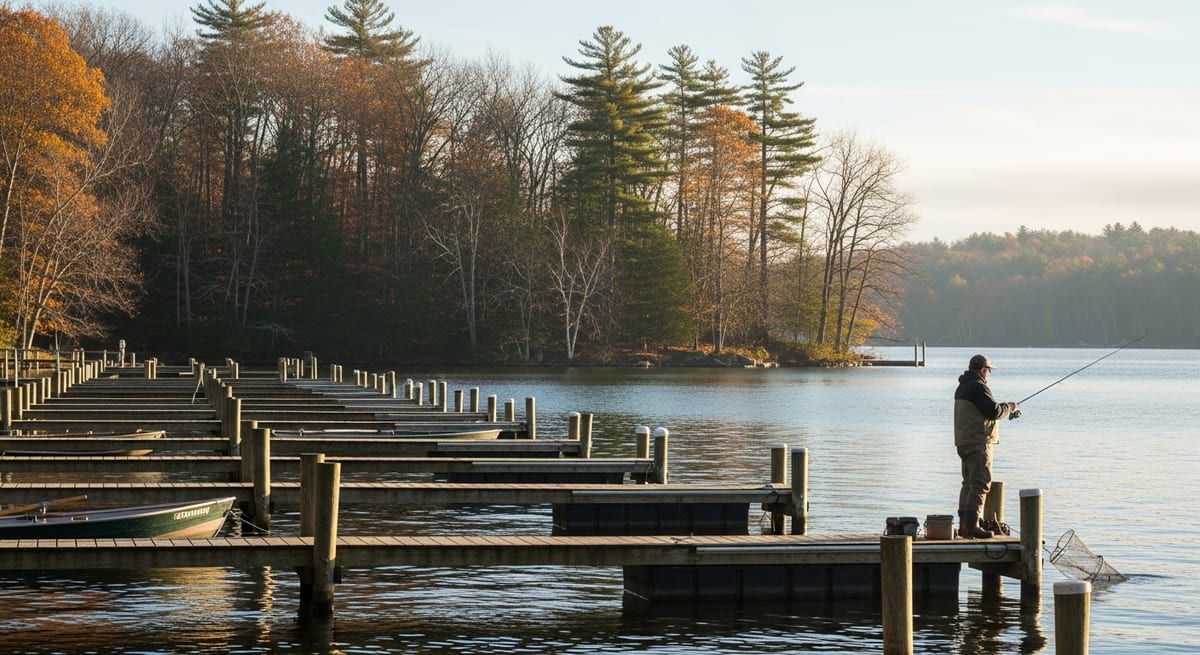
CT anglers who fish the dock rows on Lake Lillinonah and Candlewood in early April report largemouth already holding under structure while most of the bass fishing community is still waiting for warmer water. Dark-stained dock wood absorbs solar heat faster than open water, and bass find that temperature differential before they find most other cover. On Bantam Lake. The largest natural lake in CT. The same dock-first spring pattern holds, and it repeats on the back end through October turnover. The dock bite doesn't disappear in summer; it just gets crowded. CT bass anglers who work dock water consistently describe the structure as underrated in spring, reliable through the heat, and largely abandoned by fall, which is when some of the most consistent topwater and jig fishing of the year happens in the same shaded piling corners.
What CT Dock Bass Are Actually Reacting To
Dock-holding bass in CT aren't staging there randomly. The structure creates layered advantages that persist across seasons, which is why the same docks on Lillinonah, Candlewood, and Lake Zoar tend to hold fish year after year.
Shade shuts off the pressure. On July afternoons when open-water bass are pushed deep, dock shade concentrates fish in predictable, fishable locations. The deepest shade, under the center of a larger floating dock, tends to hold the better fish.
Pilings create a room with corners. A bass positioned behind the far piling has multiple ambush angles and a clear line to whatever baitfish are working the structure. That geometry makes dock fishing productive even when bass aren't actively feeding. They're positioned to capitalize on anything that enters their zone.
Temperature is the early-season trigger. Dark wood absorbs solar heat meaningfully faster than surrounding water. In April, dock-adjacent areas can run measurably warmer than open water. A differential CT anglers who fish early spring consistently describe as the difference between finding active fish and not.
Baitfish do the work. Bluegill, perch, and shiners use dock structure for the same reasons bass do. When the forage is present and holding, the bass follow, and the structure keeps both in the same predictable locations.
Three Presentations CT Dock Fishers Default To
The pitch is where most CT dock anglers start. Grip the jig or weight with your non-rod hand, load the rod by pulling back while keeping the tip low, then release. The lure swings forward and slides under the dock with minimal surface disturbance. Anglers working the dock corridors on Candlewood report it as the most versatile approach for any dock with accessible clearance.
The skip handles the places a pitch can't reach. A sidearm cast aimed at the water surface skips a flat-profiled lure. A Ned rig mushroom head, flat-bodied soft plastic, or lighter jig, deep under floating docks and into tight corners. The technique takes time to develop; dock fishers on Lillinonah's floating sections say it separates consistent producers from anglers who only ever work the outer edges.
The parallel presentation often gets overlooked entirely. Rather than casting head-on at a dock, position at one end and cast the length of it. Anglers fishing Bantam Lake's dock-heavy north coves report this approach producing more contact than perpendicular casts. The lure stays in productive water longer and presents to any fish holding along the dock, not just those at the outermost edge.
What's Consistently Producing on CT Dock Structure
Flipping jig (3/8 oz, craw trailer): The starting point for most CT dock anglers on pressured lakes. Pitch to the far corner of the dock. The piling furthest from open water, and let it fall on slightly slack line. Most bites come on the initial drop. Anglers working Lillinonah and Lake Zoar report this approach producing mid-day fish in summer when open-water activity has largely shut down.
Ned rig (3/16-1/4 oz mushroom head, stick worm tail): Skips well into tight dock spaces and holds up in the clear-water conditions common on Candlewood. The standing tail presents like stationary prey on the bottom, effective when bass are holding rather than chasing.
Drop shot: Useful when fish are suspended mid-column rather than on the bottom. A soft plastic rigged typically 10-18 inches above the weight, adjusted up or down depending on where fish are suspending, keeps the bait in front of fish that won't commit to dropping down to meet a jig.
Small swimbait (3-4 inch paddletail, light jig head): Works when bass are in an active feeding mode and running baitfish through the structure. Retrieved just under the dock surface, it imitates a baitfish moving through the zone. CT dock anglers active on public lake forums note this presentation is often overlooked on docks where jig fishing has become predictable to the fish.
Crappie Stack on the Same Pilings
Crappie use dock structure as heavily as bass, and are often the first sign that a dock is worth extended time. In CT, crappie typically begin staging near dock pilings in mid-spring, with timing varying by water temperature each season. As of spring 2026, check current CT DEEP size and possession limits before keeping fish; crappie regulations can change and vary by waterbody.
A 1/32-1/8 oz crappie jig, any soft plastic body on a light hook, fished tight to the pilings on a slow vertical fall or under a small float is what CT panfish anglers default to when crappie are present. Black/chartreuse and white/chartreuse are the most consistent colors in typical CT water clarity conditions.
When you find one crappie under a dock, stay. Unlike bass that spread along a dock's length, crappie school tightly around specific pilings. Anglers who regularly fish the dock-heavy arms of Lillinonah and Lake Zoar report five to ten fish from the same two pilings as a normal outcome when crappie are actively holding. If the school moves off, try the adjacent dock before abandoning the area.
EVERY SATURDAY MORNING
Weekly fishing intelligence
Nationwide conditions, what's biting, and honest gear deals. One email, no noise.
No spam. Unsubscribe anytime.