
Candlewood and Bantam Regulars Report Bass Pull Out of Shallow Cover After Cold Front Passage and Stack on Deep Timber Points. What CT Impoundment Communities and Housatonic Smallmouth Anglers Reveal About the 48-Hour Recovery Window and the Finesse Setups That Still Draw Strikes
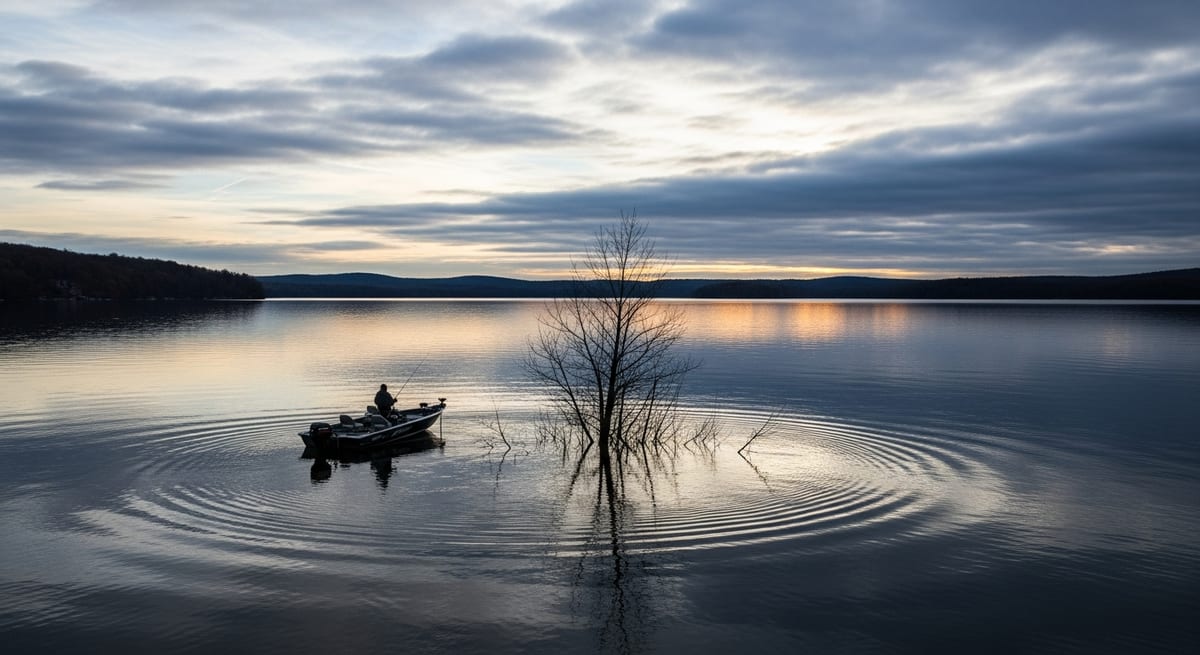
Anglers fishing Rocky Point coves and the Mound on Candlewood Lake report bass that were holding in 3 to 5 feet of grass-line structure the day before a cold front passes become difficult to locate the following morning, but the fish rarely leave the area. Impoundment regulars describe running electronics along the same main-lake points and finding fish stacked tight to timber edges and channel drops in 12 to 15 feet. On Bantam Lake, the post-frontal repositioning that communities describe is consistent enough to anticipate rather than diagnose. Post-frontal conditions rank among the most reliably difficult in CT freshwater fishing, but understanding where bass move and adjusting presentations accordingly makes the difference between a fishless trip and a slow, productive one.
What the Barometric Spike and Cleared Skies Do to CT Bass
A cold front changes several environmental variables at once, and bass respond to all of them. Barometric pressure rises sharply after frontal passage, and anglers report that rapid pressure climbs, particularly the bluebird-sky signature of a departing system, coincide with the most pronounced bass shutdowns they observe through the season. The mechanism fisheries biologists most commonly cite involves swim bladder adjustment during rapid changes in water-column pressure, making vertical movement uncomfortable for bass in the hours following a front.
Water temperature in shallow CT impoundments like Bantam can drop 2 to 4 degrees Fahrenheit in the 24 hours following a fall or early-spring front, reducing bass metabolic rate and feeding aggression. The third variable is light: post-frontal skies over Connecticut are often dramatically clearer than pre-storm overcast, and that increased light penetration drives bass out of exposed shallow flats into deeper cover. Candlewood regulars describe the shift as fish moving from open weed edges and mid-column feeding into dense structure where light is reduced and water is deeper.
Where CT Bass Move on Candlewood, Bantam, and the Housatonic After a Front
Bass reposition predictably after a front on CT waters, and impoundment communities report enough consistency in the pattern to know where to start looking before the boat is in the water. Deeper structure on CT impoundments: Candlewood anglers describe bass moving from 4 to 6 foot grass transitions and rocky shoals to 10 to 15 foot timber edges, main-lake points, and channel intersections. The fish sit on the bottom and hold tight rather than suspending or roaming. On Bantam, where the water column is shallower overall, regulars note that even a shift from 6 to 10 feet changes catchability significantly, with fish in the shallower zone showing noticeably less willingness to strike. Dense cover on DEEP public access waters: CT bass communities describe post-frontal fish pulling into the thickest available structure. On Bantam Lake, accessible via the state boat launch on West Shore Road, that means the densest remaining milfoil mats in the north basin. On Lillinonah, dock corners and laydown timber near the creek-arm mouths. On Moodus Reservoir, DEEP-access shore anglers note that post-frontal fish stack under dock platforms and submerged brush on the western bank. These fish are not actively hunting. They are waiting for a bait to reach them. Shaded sides of structure: Post-frontal light in CT winters and early spring hits at a low angle, and Candlewood regulars report the shaded north and northwest faces of points produce better than sun-exposed sides after a front clears, often by a significant margin.
The Finesse Setups CT Impoundment and River Anglers Rely On Post-Front
The consensus among Candlewood and Bantam regulars is that post-frontal bass will not chase. A bait moving at normal retrieve speed through their zone gets ignored; the same bait delivered directly to them at roughly half speed sometimes gets eaten. Community anglers describe slowing every presentation by about half compared to what worked the previous day as the single most consistent adjustment. Ned rig on deep timber edges: Impoundment communities report the ned rig as the top CT post-frontal producer across most seasons. A 2.5 to 3-inch ElaZtech stick bait on a mushroom head weighted 1/16 to 3/32 oz, dropped to the bottom on a point where electronics show fish holding, then barely inched forward every 20 to 30 seconds. Anglers describe strikes on post-frontal fish as subtle pressure rather than aggressive takes, which means rod tip sensitivity matters more than usual. Drop shot for suspended fish: Housatonic smallmouth communities report that a drop shot rig, with a 1/4 oz weight 12 to 18 inches below a small worm or minnow profile, keeps a bait in the strike zone of suspended fish longer than any sinking presentation. Downsizing the whole setup: CT club-circuit anglers who fished post-frontal tournaments in the 2024-2025 season report consistently that stepping down line weight, hook size, and bait size draws more bites from fish that are present but reluctant to commit. Moving from a 5-inch Senko to a 3-inch version on lighter fluorocarbon regularly outperformed standard setups when bass were in post-frontal lockdown. CT DEEP's 12-inch minimum size on largemouth and smallmouth bass applies year-round on most impoundments, and post-frontal fish brought up slowly from 12 to 15 feet on light finesse tackle need careful handling before release.
Reading the 48-Hour Recovery Window on CT Waters
CT bass communities describe the post-frontal recovery as gradual rather than abrupt, and the pattern anglers report is roughly consistent across Candlewood, Bantam, and the Housatonic. The first 12 to 24 hours after a front passes are the most difficult, with high pressure and northwest winds keeping fish locked down in deep structure. The 24 to 48 hour window sees gradual improvement as bass acclimate to the new pressure baseline, particularly when temperatures stabilize. Returning overcast as a trigger: Regulars on both Candlewood and Bantam note that cloud cover returning after a post-frontal high begins pushing fish back toward shallower structure before the next incoming system arrives. On a CT 7-day forecast, this typically appears as the trailing edge of a high-pressure ridge 2 to 3 days after frontal passage. Pre-front timing as the better window: The pre-frontal feeding period, specifically the afternoon before a cold front arrives when pressure is still falling and overcast builds, outproduces the equivalent time slot 24 hours later by a meaningful margin according to CT tournament communities and club anglers who fish both windows. When schedule flexibility exists, the afternoon before the front is the stronger choice. Tracking the next system: The most dramatic bite improvement typically arrives when the next low-pressure system approaches from the west, as falling pressure triggers active feeding behavior. CT regulars who monitor NOAA 7-day forecasts for the next approaching trough time their return trips more effectively than those waiting for conditions to simply improve on their own.
Why Housatonic Smallmouth Recover From Fronts Before Candlewood Largemouth
CT anglers who fish both largemouth impoundments and smallmouth rivers report a consistent difference in post-frontal response between the two species, and the pattern influences how communities allocate time after a front passes. Largemouth in CT's weedy impoundments, including Candlewood, Bantam, and Lillinonah, depend heavily on shallow vegetated habitat that becomes uncomfortable under intense post-frontal light. With their primary holding structure exposed and uncomfortable, largemouth typically shut down harder and for longer after a front than smallmouth in moving water do. Smallmouth on the Housatonic and Farmington have different options. River communities in the Derby-to-Shelton stretch of the Housatonic describe deeper mid-river pools, shaded undercut banks, and the soft-water edge of current seams as natural buffers. Fish that were holding in riffles and transitions move into slower, deeper pools, but remain catchable on drop shots and small jigs worked slowly along current breaks. CT anglers who fish the middle Housatonic describe post-frontal smallmouth as reluctant but present, a meaningful distinction from the harder shutoff largemouth communities describe on impoundments under the same conditions. In the 2024-2025 season, anglers who rotated between Candlewood for largemouth and the Housatonic for smallmouth in the 24 to 48 hours after frontal passage consistently reported better results from the river portion of the trip. Largemouth recovery on CT impoundments typically follows by another 12 to 24 hours as conditions rebuild toward the next incoming system.
EVERY SATURDAY MORNING
Weekly fishing intelligence
Nationwide conditions, what's biting, and honest gear deals. One email, no noise.
No spam. Unsubscribe anytime.