
The Bait CT Impoundment Bass Won't Refuse After a Cold Front Doesn't Move Much at All. What Candlewood, Bantam, and Lillinonah Anglers Report About Drop Shot Rigs, Post-Front Suspended Bass, and Finesse Presentations in Clear Water
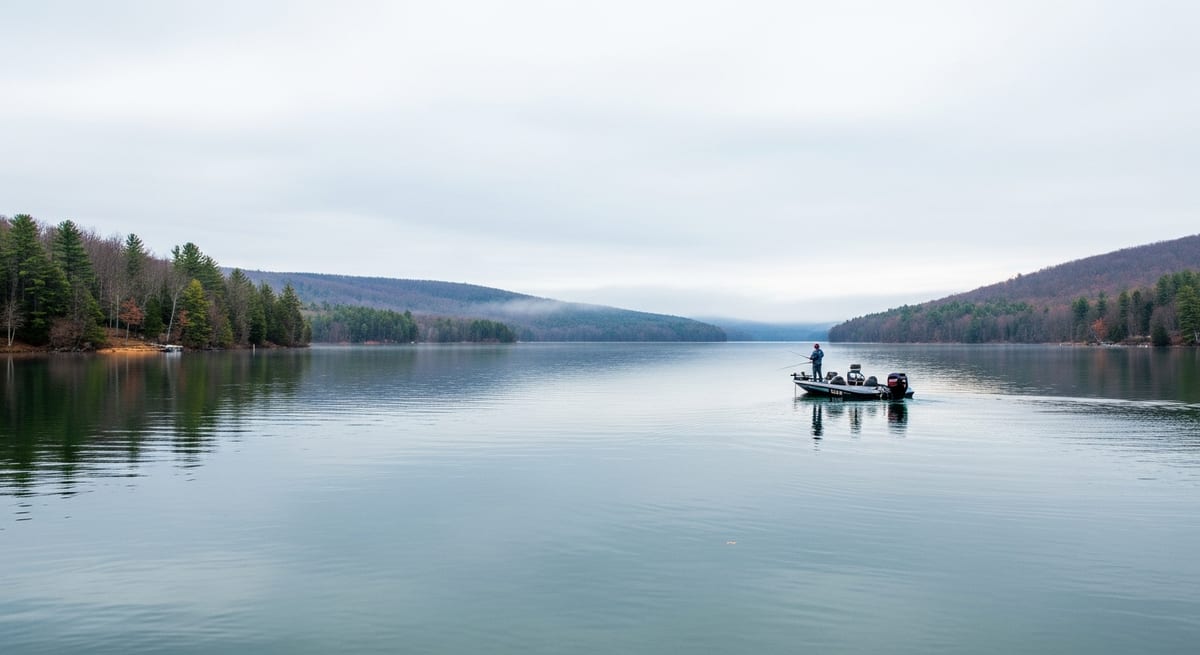
Bantam Lake bass that actively tracked baits all morning will often stop committing entirely within hours of a cold front passing through, and CT impoundment anglers report the same pattern on Candlewood and Lillinonah: fish become visible on sonar but won't chase anything with forward motion. The drop shot rig addresses that specific problem by holding a soft plastic at a fixed depth in the water column, quivering it in place, and asking nothing of the fish except that it close a few inches of distance. The technique arrived in the Northeast through tournament circuits that popularized it in the late 1990s and early 2000s, drawing heavily on Japanese finesse methods refined for clear-water fisheries. CT bass communities have since settled on it as the default finesse approach for post-front impoundment fishing, pressured clear-water ponds, and any situation where moving baits draw follows without commitments.
How the Rig Holds a Bait in the Strike Zone Without Moving
A drop shot places the hook 6 to 18 inches up the leader from the weight, which sits on the bottom. The bait hangs in the water column at that fixed height, quivering and responding to the slightest rod-tip input but not drifting away from the fish.
The difference from a Texas rig or Carolina rig is that both of those keep the bait near the bottom plane. When bass suspend off the bottom, which CT impoundment anglers report happens regularly on Candlewood's deep basin edges and Bantam's mid-lake humps during post-front conditions, a bottom-dragging rig falls through the strike zone entirely. The drop shot stays in it.
CT bass anglers who fish the deep transition zones on Lillinonah describe the core advantage this way: the fish does not have to decide to move toward the bait. The bait is already at its depth.
Building the Rig: What CT Impoundment Anglers Typically Use
Attach the hook to the main line using a Palomar knot, leaving a tag end of 12 to 18 inches below the hook. This tag end becomes the leader to the weight. Threading the tag end back through the hook eye from the front angles the hook point upward, which is widely considered the correct orientation for proper bait presentation.
Clip a drop shot weight to the end of the tag end. Most drop shot weights use a swivel-clip design that allows fast swaps between sizes. CT anglers fishing Bantam's clearer open-water sections typically run lighter weights to minimize bottom disturbance, while those fishing Candlewood's windier main-lake sections report that slightly heavier weights keep the rig stable in surface chop.
Hook sizes around #1 and #2 are commonly paired with 4-inch finesse plastics across CT impoundments, though anglers fishing smaller profiles in pressured water often size down. These are general starting points; anglers fishing specific CT waters frequently adjust based on observed forage size and the depth they are targeting.
Bait Selection on CT Clear-Water Impoundments
Natural-color straight-tail worms are the baseline across CT's clearer impoundments. Green pumpkin and watermelon work consistently on Bantam and Lillinonah through most of the season. Nose-hook through the very tip so the bait hangs straight and moves freely with any rod-tip input.
The consensus among CT finesse anglers who fish pressured, clear-water spots is that smaller profiles produce more bites than larger ones. On waters where bass have seen consistent pressure, a 3 to 4 inch worm often outperforms a 6 inch version. The drop shot's finesse presentation pairs naturally with compact, realistic shapes rather than bulkier creature plastics.
Finesse minnow profiles add a different fall action for suspended fish. CT anglers targeting smallmouth along the rocky points on Lillinonah in early fall report that baitfish-profile plastics can produce when straight-tails slow down in very clear, post-frontal conditions. The general principle reported across CT communities: match the local forage, fish smaller than instinct suggests, and let the rig generate action rather than compensating with bulk.
Fishing the Drop Shot on Candlewood, Bantam, and Lillinonah
Vertical presentation from a kayak or anchored boat: Lower the rig until the weight touches bottom, hold the rod at roughly 10 o'clock, and work the tip in short, controlled quivers while keeping a slight bow in the line. CT kayak anglers who fish Bantam's deeper coves report this as the most productive approach in 12 to 25 feet when sonar shows fish sitting close to bottom. The bite typically registers as a subtle pressure increase or a slightly heavier feel on the line, not a sharp tap.
Casting to structure: Cast to a point, submerged grass edge, or rock field, let the weight settle, and drag slowly while adding intermittent rod-tip shakes. Anglers fishing Candlewood's rockier eastern shoreline and the boulder-strewn areas near the Danbury arm describe this as the primary bank-accessible approach. The weight telegraphs bottom transitions, and CT bass often stage where hard bottom gives way to softer substrate.
Line setup: CT impoundment anglers typically run 10 lb braid on spinning gear with a 6 to 8 lb fluorocarbon leader, or straight 6 to 8 lb fluorocarbon when fishing lighter setups. The braid transmits vibration from the bait through to the rod; the fluorocarbon leader reduces line visibility at the hook end. In Bantam's clearest sections, finer leader material is frequently reported to increase commitments from pressured bass in post-front, high-visibility conditions.
Three CT Conditions Where the Drop Shot Becomes the First Rig Out
Post-front lockdown: A pressure drop combined with cold air is one of the most consistent bite-killers on CT impoundments. CT bass communities across Candlewood and Bantam report that post-front fish retreat to basin edges and deep structure, where they show on sonar but won't commit to any presentation with lateral movement. A slow-shaking drop shot positioned just above suspended fish often produces bites when all moving baits get follows without strikes.
High-clarity conditions: Bantam, the western zones of Lillinonah, and CT's smaller natural ponds carry low turbidity for much of the year. In clear conditions, bass have more time to assess approaching baits. The consensus among CT finesse anglers is that the drop shot's subtle, largely stationary presentation generates commitments that more aggressive rigs struggle to close in clear water.
Visually confirmed suspended fish: When sonar on Candlewood's offshore humps shows fish holding 8 to 12 feet above a 22-foot bottom, rigs designed to reach the bottom sink through the strike zone entirely. Setting the drop shot leader to match the depth offset shown on sonar keeps the bait at fish level without guesswork. CT anglers who fish mid-lake structure on Candlewood and Lillinonah describe this sonar-to-leader calibration as one of the technique's most direct practical advantages over bottom-contact rigs.
The Spinning Setup CT Impoundment Anglers Run for Drop Shot Work
A medium-light spinning rod in the 6'10" to 7' range with a fast tip is the most commonly reported setup across CT impoundment communities. Sensitivity in the rod's tip matters more than power rating for this technique. Drop shot bites on CT impoundments often register as subtle pressure rather than a sharp thump, and a rod that deadens those signals converts fewer strikes into fish.
A 2500-series spinning reel provides the drag control and line capacity for most CT impoundment situations. Spooling with 10 lb braid and attaching a 2-foot fluorocarbon leader via double uni-knot or a small swivel gives both sensitivity and reduced line visibility at the hook end.
CT anglers fishing Bantam and Candlewood in fall often run the lightest leader they can manage comfortably. The fluorocarbon's near-invisibility in clear water is reported to matter more on pressured CT impoundments than in stained-water fisheries where line visibility is less of a factor. Bass in most CT freshwater bodies are subject to minimum size and daily creel limits under DEEP regulations; anglers are advised to confirm current limits in the annual DEEP Angler's Guide before the season.
EVERY SATURDAY MORNING
Weekly fishing intelligence
Nationwide conditions, what's biting, and honest gear deals. One email, no noise.
No spam. Unsubscribe anytime.