
Gardner Lake and Coventry Lake Bass Anglers Report the Dawn Window Closes by 8 AM in July. What CT Summer Thermal Patterns and Community Reports Reveal About Dock Lines, Deep Structure, and Presentations That Outlast the Heat
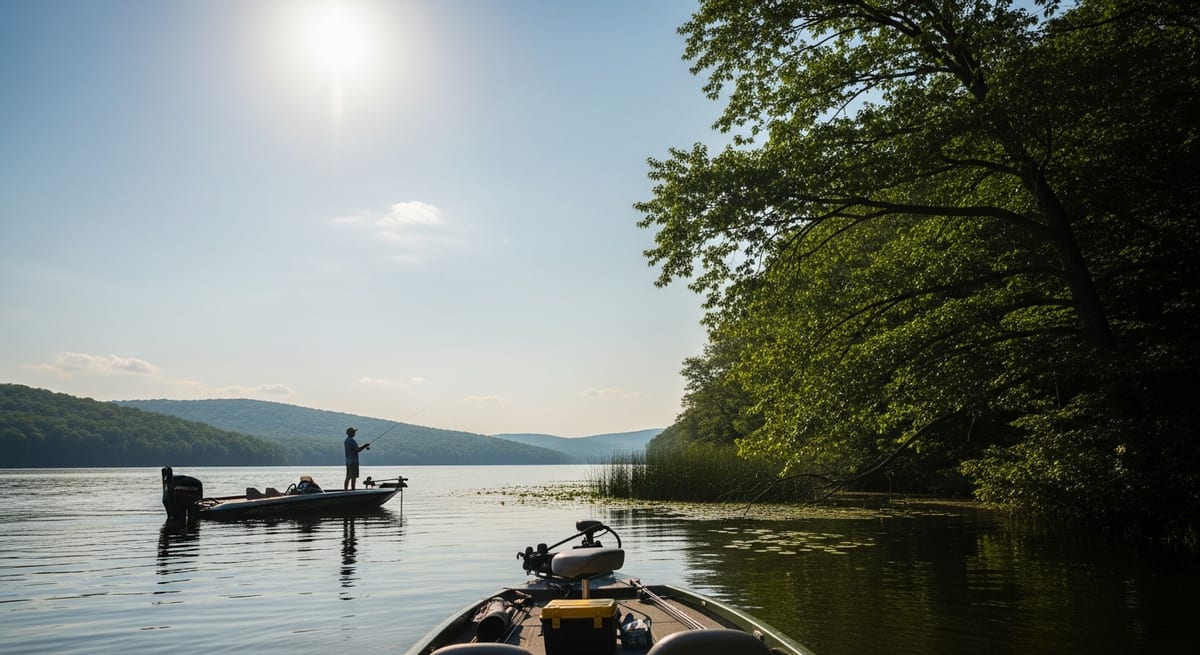
Anglers who fish Gardner Lake and Coventry Lake in eastern Connecticut report that by 8 AM in July, the morning topwater bite is already over and the fish that were chasing surface lures along the shallow flats have moved down to a depth band most visiting anglers are not set up to target. CT DEEP freshwater monitoring has documented surface temperatures in several southeastern CT lakes consistently reaching 80-84°F by mid-July in a typical year, a threshold that compresses the productive feeding window into a 90-minute slot that regulars on these waters treat as non-negotiable. Community reports from eastern CT bass anglers through the 2024 season describe a pattern that holds across multiple years: summer bass in Connecticut are findable, but the timing and depth window that produces at 6:30 AM is completely different from what produces at noon, and anglers who do not adjust between those windows go home with far less to show for it.
What Lake Stratification Does to CT Bass Location
CT DEEP freshwater program monitoring shows that many of the state's shallow-to-mid-depth lakes stratify meaningfully by late June. The warmest surface layer in several southeastern CT lakes regularly tops 80°F by mid-July, with the thermocline (the band where water temperature drops sharply with depth) forming at varying points depending on the lake's depth and basin shape.
Candlewood Lake, with its deeper northern basin, typically develops a thermocline somewhere in the 15-25 foot range. Shallower lakes like Coventry Lake and Gardner Lake stratify at tighter depths. Anglers who monitor water temperature with handheld probe thermometers report the thermocline sitting as shallow as 10-12 feet on some eastern CT lakes during a hot summer.
Below the thermocline, dissolved oxygen often drops too low to support sustained bass activity. Above the surface layer, temperatures reduce feeding efficiency. Bass and their forage concentrate in a narrow productive band near that temperature boundary, and the band can be thin on a shallow lake in August.
The practical implication, repeated in CT bass fishing community reports: summer fishing rewards depth discipline over water coverage. Identifying the productive thermal band on a specific lake on a specific day matters more than any lure selection.
Eastern CT Waters: Gardner Lake, Coventry Lake, and Moodus Reservoir
Anglers who regularly fish eastern Connecticut describe consistent summer bass staging patterns across several publicly accessible lakes:
Gardner Lake (Salem/Montville): Gardner Lake regulars describe a productive submerged structure zone along the western shoreline where the bottom transitions from 8 feet to 18-20 feet. Summer bass hold along this drop edge. The state boat launch off Route 85 in Salem provides the primary public access point. Anglers report consistent dock-line fishing along the developed northern shoreline during midday heat, with bass staged under floating dock sections in water ranging from 10-12 feet.
Coventry Lake (Coventry): Community reports on Coventry Lake describe the lake's relatively shallow profile (maximum depth around 28 feet) as placing the thermocline within reach of anglers working deeper shoreline points. The public launch off South Street is the primary access. Largemouth reports from the 2024 season indicate that creek-mouth structure at the lake's southern end holds fish through the hottest weeks of summer.
Moodus Reservoir (East Haddam): Moodus receives consistent attention from the eastern CT bass community for its submerged timber and stump fields, which anglers describe as productive summer holding structure. The main basin drops into the 20-25 foot range, giving bass a viable thermal retreat when shallows spike. CT DEEP has referenced Moodus in bass creel context in past freshwater survey documents. Public access via the East Haddam town ramp off Bashan Road.
For current regulations on all three waters, CT DEEP publishes the Connecticut Inland Fishing Guide at ct.gov/deep. Bass regulations across most inland CT waters (5 fish per day, 12-inch minimum) apply to these lakes, but always verify the current season's guide before fishing.
The 90-Minute Morning Window: Presentations and the Transition Signal
The consensus among CT bass anglers who fish summer consistently is that the most reliable topwater and shallow-water bite runs from first light to roughly 7:30-8:30 AM, with overcast mornings extending the window and bright, windless mornings closing it faster. Regulars on Gardner and Coventry describe this window as the one they plan around, not the one they happen to catch.
During this window, topwater presentations produce in 2-6 foot flats adjacent to deeper water. Poppers, buzzbaits, and walking baits in the 3-4 inch range account for most surface reports. The transition zone from shallow flat to the first depth drop is where CT anglers report the most concentrated action.
Point structure that falls quickly to 12-15 feet is a recurring theme in summer reports from eastern CT lakes. Bass on these transitional points can move vertically with minimal energy expenditure as temperatures rise, and anglers who work these edges rather than flat shallow cover typically extend their productive morning window.
A reliable transition signal described in community reports: topwater follows without commitment and short strikes indicate the window is closing. Switching to a fast-moving subsurface lure worked 3-5 feet down (swimbait, spinnerbait, or swim jig) typically extends the bite another 20-30 minutes before fish fully shift to midday holding positions.
Midday Heat: Dock Lines, Cold Seeps, and Deep Finesse
From roughly 9 AM through late afternoon on hot summer days, CT bass anglers who continue fishing report shifting to three categories of structure and presentation:
Dock shade: Dock fishing is the most consistently cited midday technique on lakes like Gardner and Coventry. Bass use dock shade as a temperature and light refuge. Anglers describe the most productive targets as deep-water dock sections (pilings in 8-12 feet), floating dock edges, and back corners under permanent dock structures. A weighted senko or a 3/8 oz jig flipped directly under dock sections is the most-reported technique for this pattern.
Cold water seeps: Anglers on several CT lakes describe locating spring-fed coves or tributary mouths that run noticeably cooler than surrounding water. These spots tend to concentrate bass and forage when the main lake heats up. A small thermometer dropped near a suspected spring confirms the temperature differential. CT DEEP sometimes notes spring-influenced sections in individual lake survey documents available through the DEEP website.
Deep finesse: The most cited midday technique across CT bass community reports is a dropshot rig or shaky head worked slowly in the 15-22 foot zone along main lake points, channel edges, and submerged timber. Four-inch straight worm profiles and small creature baits in natural colors account for most reports. For hard bottom between 15-25 feet, anglers describe a football jig in the 1/2-3/4 oz range as the primary alternative to finesse rigs.
Channel edges: Lakes with submerged creek channel structure, including Moodus Reservoir, provide consistent midday holding areas. Anglers describe fish stacking along channel edges in 18-25 feet during peak heat, rarely moving far until evening temperatures drop.
What Experienced CT Summer Bass Anglers Do Differently
Anglers who consistently produce summer bass in Connecticut describe several adjustments that community reports suggest separate productive outings from frustrating ones:
They monitor depth temperature, not air temperature. CT bass anglers who carry handheld water thermometers report that the productive thermal band can be surprisingly thin in midsummer on shallow lakes, sometimes only 3-5 feet wide. Air temperature and sky conditions at launch are much weaker predictors of fish location than what the thermometer reads at 15 feet versus 20 feet on that specific lake.
They fish transition edges, not the deepest available water. The consensus from forums covering Gardner Lake and eastern CT waters is that summer bass stage on structure edges: the drop where 8 feet becomes 18 feet, the line where sunlight cuts along a dock, the outside edge of a submerged timber field. A dropshot worked across a point from shallow to deep often produces before one fished in static deep water.
They treat wind as a summer asset. Anglers on larger CT lakes report that wind-generated surface mixing breaks up stratification in shallower areas and pushes forage against windward banks. On days with consistent wind, the windward shoreline's mid-depth zone (6-12 feet) frequently outfishes calm-water deep structure during midday hours, based on reports from Candlewood and Moodus regulars.
They use two-window timing in July. The most efficient approach described across CT summer bass communities: fish from first light through 8 AM, leave, and return at 6 PM for the evening window. The late evening bite mirrors the morning pattern, with bass pushing back into shallows for the last 60-90 minutes of light. Fishing straight through peak midday heat produces fewer fish than two focused windows on either side of it.
EVERY SATURDAY MORNING
Weekly fishing intelligence
Nationwide conditions, what's biting, and honest gear deals. One email, no noise.
No spam. Unsubscribe anytime.