
CT Reservoir Bass Go Deep When Surface Temps Cross 75°F. What Candlewood, Lake Lillinonah, and Gardner Lake Regulars Report About Summer Ledge Fishing, Thermoclines, and Presentations Below 15 Feet
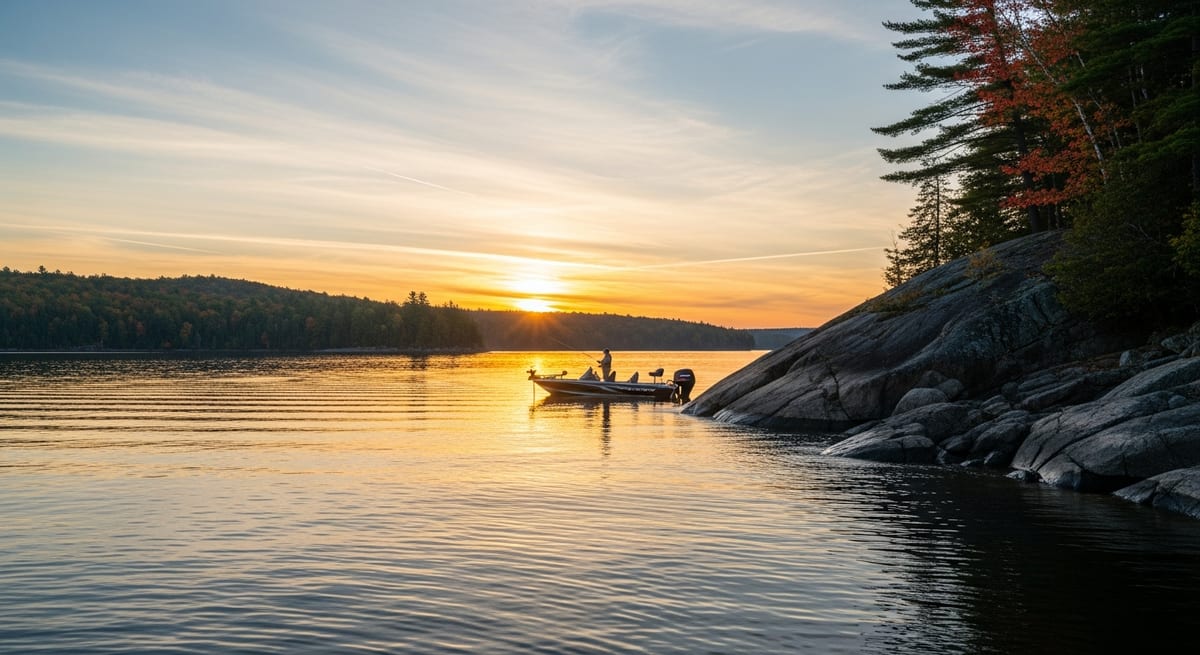
CT reservoir bass anglers tracking depth patterns on Candlewood and Lake Lillinonah describe a consistent summer shift: around the third week of June, when surface temperatures push past 74-76°F, bass that spent spring in 8-12 foot flats slide off into 18-28 feet and largely stay there until September. The move tracks the thermocline, a temperature boundary that typically stabilizes at 18-24 feet in CT's larger impoundments by mid-July. The 40-55°F zone below it is too cold for active feeding; the 65-72°F band just above it is where fish hold. CT DEEP electrofishing surveys in major impoundments have documented this seasonal depth shift across multiple seasons, noting that adult largemouth relocate to deeper structure when dissolved oxygen in the upper water column declines under sustained summer heat. Anglers who adjust their depth targets for that transition stay on fish through August.
The Thermal Trigger: When CT Reservoirs Stratify
Timing matters more than technique on CT summer bass. Regulars on Candlewood Lake, which drops to roughly 80 feet at its deepest, report that the productive deep bite typically begins around the July 4th weekend and holds through late August, tracking surface water temperature rather than calendar date.
The rough threshold anglers reference: surface temps holding above 74-76°F for more than a week almost certainly means bass are below 15 feet. The thermocline on CT's major impoundments typically sets between 18 and 24 feet in July. Fish mark just above this boundary, often in the 15-22 foot range, where oxygen is adequate.
On smaller impoundments like Bantam Lake (max depth around 25 feet), the dynamics differ. CT anglers who fish both Bantam and Candlewood note that Bantam's shallower profile means less stratification room. Fish may hold anywhere from 12-20 feet rather than committing to a tight depth band. Gardner Lake in Salem, at roughly 56 feet maximum, falls between these extremes. Understanding which water you're fishing determines how precisely you can target a thermocline layer.
CT DEEP's Inland Fisheries unit publishes temperature profile data for key impoundments, and several Connecticut bass clubs, including the Candlewood Valley Bass Club, have incorporated this data into their seasonal trip reports.
Where Candlewood, Lillinonah, and Gardner Lake Bass Set Up in July
Summer bass on CT reservoirs aren't randomly distributed in the deep water column. Community reports from anglers on these waters consistently describe the same types of structure:
Main lake points with deep breaks: On Candlewood, points that swing from 10 feet to 25-30 feet concentrate largemouth and smallmouth along the break. Anglers fishing the Rocky Point area and the main basin's western shoreline points describe working the 18-22 foot contour with drop-shots and heavy jigs through August, marking fish on the sonar before making a cast.
Submerged ledges: Lake Lillinonah and Lake Zoar, the Housatonic River impoundments in western CT, contain ledges from the original river valley topography. The consensus among regulars on these waters is that the most productive ledges sit in the 18-26 foot range, where they transition from rock to softer bottom. Anglers describe this transition edge as the exact feature that holds fish, not the ledge face itself.
Flooded timber: Lillinonah's older sections hold standing timber in 18-30 feet of water that CT DEEP survey data confirm holds adult largemouth through summer. Regulars describe targeting the shaded face of individual trunks rather than fishing through timber broadly, noting that one specific tree at 22 feet can hold multiple fish while adjacent timber a few yards away is empty.
Channel edges and isolated humps: Gardner Lake holds several mapped underwater humps that rise from 40 feet to the 18-22 foot range. Community reports from eastern CT bass clubs describe these as high-concentration spots in summer, with fish staging on the deep side of the hump rather than on top.
What CT Anglers Fish When They're Below 15 Feet
The CT bass fishing community has developed clear preferences for summer deep-structure presentations through collective trial on these specific waters:
Drop-shot: Consistently named by Candlewood and Lillinonah regulars as the highest-percentage technique for fish holding in 15-25 feet. A 1/0 finesse hook with a 4-5 inch finesse worm on a 1/4-3/8 oz drop-shot weight, suspended 10-14 inches above the sinker. Anglers who fish this rig on Candlewood's deep points describe a vertical presentation with the boat positioned over the mark rather than a cast-and-drag approach, noting that maintaining contact with the sinker on the bottom is what distinguishes a properly fished drop-shot from an ineffective one.
Football jig: Preferred on Candlewood's rocky points and hard-bottom ledges. A 1/2-3/4 oz football head with a craw trailer, dragged slowly along the break. Community reports from Candlewood bass anglers suggest the football jig outperforms finesse presentations when fish are actively feeding rather than neutral, with the larger profile generating harder strikes.
Heavy Carolina rig: A 3/4-1 oz sinker ahead of a 2-3 foot fluorocarbon leader and a creature bait, dragged along Lillinonah's ledge edges. CT anglers describe this as a search technique for covering a depth contour to find where fish are positioned before committing to a vertical presentation.
Deep-diving crankbaits: On channel edges and long-tapering points where casting parallel to the break is possible, a crankbait reaching 16-20 feet on a long cast with 10-12 lb fluorocarbon covers water quickly. Anglers on Candlewood describe burning a Strike King 6XD or Rapala DT-16 along the 18-20 foot contour to locate active fish, then switching to finesse presentations once a productive section is identified.
Reading CT Reservoir Structure on Sonar
On reservoirs with significant depth variation, particularly Candlewood and Gardner Lake, electronics are the difference between finding fish and spending a summer guessing. The approach CT regulars describe:
Map before fishing. Anglers on Candlewood who run down-imaging or side-scan passes on unfamiliar sections before making a cast report significantly better results. A 10-minute slow scan at 3-5 mph reveals ledge breaks, timber, and hard-bottom transitions that don't appear on topo charts. The consensus is that skipping this step costs more time than it saves.
Identify the thermocline on the display. Most modern fish finders show the thermocline as a visible layer, typically a faint horizontal band on down-imaging. On CT impoundments in July, that band typically appears at 18-24 feet. The productive depth is just above it.
Read marks relative to structure. A sonar mark suspended 6-12 inches off the bottom on a timber snag at 22 feet is a high-confidence target. CT bass anglers who fish deep water describe learning to distinguish bass marks (typically large, distinct arcs or flat marks close to bottom or structure) from baitfish clouds or noise returns.
Waypoint discipline. The Candlewood Valley Bass Club trip reports consistently emphasize marking every productive spot, not just when fish are caught but when strong marks appear. Summer bass on CT reservoirs often return to the same structure day after day. A waypoint from a July trip on Lillinonah's main ledge is worth checking again in August.
Line and Weight Choices for 15-28 Foot CT Water
Several adjustments that CT deep-structure anglers describe as non-obvious to anglers transitioning from shallow-water bass fishing:
Fluorocarbon as mainline for drop-shot. On CT's clearer impoundments, including Candlewood and Gardner Lake, anglers who fish straight fluorocarbon mainline at 12-15 lb report fewer refusals than those using braid-to-leader setups. The density of fluorocarbon also helps the rig sink faster in the 18-25 foot range without requiring heavier weights.
Braid-to-leader for jigs and Carolina rigs. For heavier contact presentations, 20-30 lb braid to a 15-20 lb fluorocarbon leader provides sensitivity that mono cannot match at depth. CT anglers who made the switch describe detecting bottom composition changes, gravel versus soft mud, that they were missing on mono, and note those transitions are often where fish hold on Lillinonah's ledges.
Don't underweight for depth. A common error anglers describe when moving from shallow to deep water is using a 1/4 oz drop-shot weight that drifts rather than holds vertical in any current or wind. CT reservoir anglers fishing Candlewood's main basin in summer typically run 3/8-1/2 oz.
Match the rod to subtle bites. Deep-structure bites in warm water often register as a slight weight increase or a sideways line movement, not a tap. CT anglers fishing Lillinonah timber describe using a 7-foot medium-heavy fast-action graphite rod specifically for detecting the difference between the sinker dragging bottom and a bass picking up the bait above it.
EVERY SATURDAY MORNING
Weekly fishing intelligence
Nationwide conditions, what's biting, and honest gear deals. One email, no noise.
No spam. Unsubscribe anytime.