
CT BASS Federation Nation Regulars on Candlewood, Bantam, and Lillinonah Report First-Tournament Anglers Consistently Lose Weight on Livewell Decisions, Not Technique. What Club-Circuit Entry Points, DEEP Minimum-Size Rules, and Open-Tournament Formats Reveal About Breaking Into Connecticut Competitive Bass Fishing
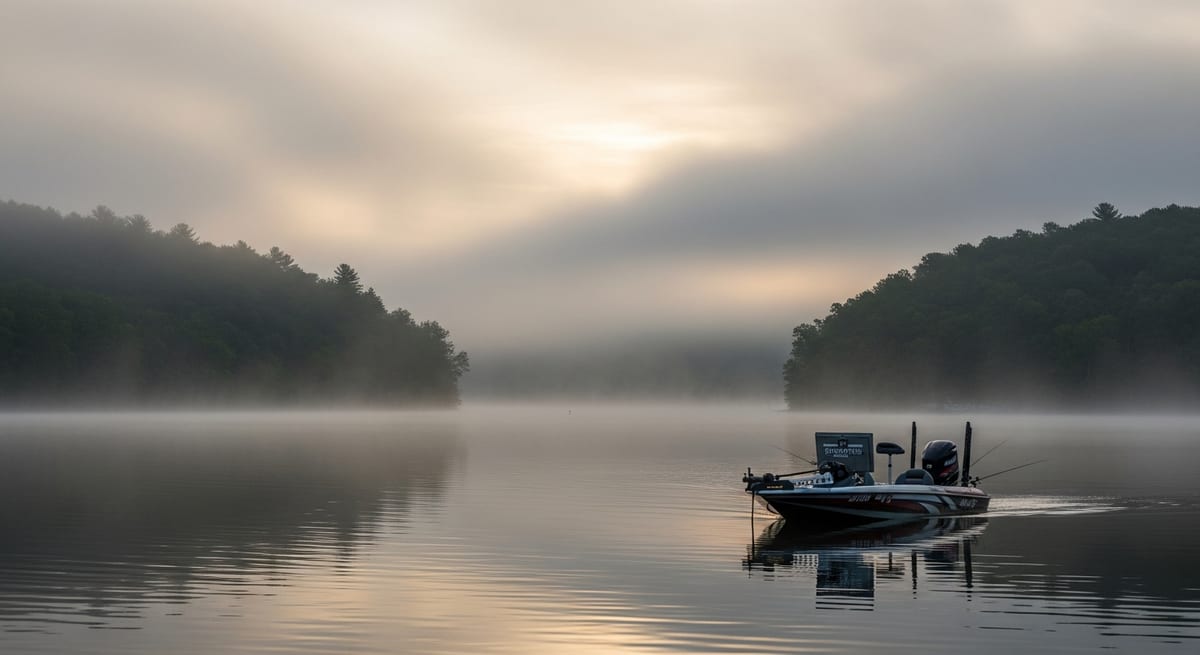
Regulars in the Candlewood Bass Club describe the same pattern in first-time tournament entrants every spring: hours of pre-tournament preparation focused on specific fishing spots unravel when those spots don't produce at first light, and the reactive decision-making that follows costs more weight than technique gaps do. Connecticut's impoundment bass circuit, centered on Candlewood, Bantam, Zoar, and Lillinonah, provides one of the more structured entry paths into competitive bass fishing in the Northeast. Club-circuit veterans across these lakes consistently flag two variables that first-year tournament anglers underestimate: livewell management under summer heat, and culling decisions in the final hour of competition.
How CT's Club-Circuit Entry Structure Works
Connecticut's tournament entry structure breaks into roughly three tiers, and club regulars broadly recommend progressing through them rather than jumping immediately to open events.
Club tournaments are the most accessible starting point. The Connecticut Bass Federation Nation and lake-specific clubs running events on Candlewood, Bantam, and Zoar regularly include newer competitors in their formats. Most club events use two-person boat pairings, which regulars describe as reducing the pressure of a first competitive weigh-in and building situational judgment faster than solo events do. Entry fees for club events often run in the $20-50 range.
Regional open tournaments are public-entry events with more competitive fields and entry fees typically in the $75-200 range. CT BASS Federation Nation affiliated qualifiers and regional open circuits occasionally place Connecticut impoundments on their schedule. Club veterans report that anglers entering opens before accumulating several club events tend to find the field gap larger than anticipated.
One-day sweepstakes are smaller events run by marinas and tackle shops on specific lakes, typically in the $25-50 range. These provide a middle step between club practice and formal circuits, particularly on smaller impoundments like Bantam and Lillinonah where the competitive field is more contained.
The Format and DEEP Minimum-Size Rules That Apply Across CT Events
Most Connecticut bass tournaments follow a catch-weigh-release format. Each two-person team keeps fish alive in the livewell through a fishing period, typically six to eight hours, then presents their catch at a designated weigh-in location.
Standard limits: tournament limit is typically five fish per team, though rules vary by event and should always be verified on the specific tournament sheet. Club circuit participants describe the culling process, releasing the smallest keeper when a larger fish comes aboard, as requiring continuous weight estimation throughout the day rather than a single end-of-day decision.
DEEP minimum size: Connecticut's statewide minimum for largemouth and smallmouth bass is 12 inches, and that floor applies in tournament settings as well. Anglers who have brought borderline fish to club weigh-ins report that the committee review process and potential disqualification creates pressure that recreational fishing doesn't replicate. Standard practice among experienced CT tournament anglers includes measuring tight fish in the livewell before making culling decisions.
Dead fish penalty: the typical structure across CT club events is a 0.25 to 0.50 lb deduction per dead fish presented at weigh-in. Club regulars consistently identify livewell mismanagement, not poor technique, as the most common reason a competitive bag finishes below the money.
Big bass: most CT club events separately award the single heaviest individual fish of the day, independent of team totals.
Pre-Tournament Practice on CT Impoundments
Practice-fishing the tournament lake one to two days before the event is standard operating procedure among CT club competitors. Anglers who skip pre-fish on Bantam or Lillinonah, both compact impoundments where familiarity with dock-line positions, timber fields, and channel drop-offs matters, report that limited lake knowledge translates into missed positioning throughout the competitive day.
What club veterans describe from practice days: identify multiple producing areas, not a single primary spot. Candlewood's 5,420 acres span multiple distinct basins, and single-area dependence leaves a team exposed to any front passage, boat traffic surge, or water temperature shift. Anglers who pre-fish multiple depth zones and cover types consistently describe better adaptability than those who arrive committed to one area.
Map preparation complements water time. CT club anglers who review contour detail from LakeMaster or Navionics before arriving report better orientation on impoundments with complex channel structure. Zoar and Lillinonah both run through the flooded Housatonic River basin, and the original river channel position affects where bass stage at different water temperatures across the season.
Gear check: club circuit regulars describe the livewell aeration and recirculation system as the most critical pre-event equipment review. A medium-heavy baitcasting setup in the 7-foot range is the consensus starting point among CT club anglers for the dock-line and structure presentations common on Connecticut impoundments. Mid-event mechanical failures, whether livewell or electronics, are among the most costly problems a team can encounter on tournament day.
Livewell Standards and the Dead-Fish Penalty on CT Tournament Water
Livewell management is where club-circuit veterans on Connecticut impoundments most consistently separate experienced tournament anglers from first-year competitors. The consensus across CT BASS Federation Nation participants and club regulars is that most fish presented dead at weigh-in die from heat stress in the livewell, not from the hook.
Temperature management: when livewell water temperature approaches the 75-78 degree range, typical on Candlewood and Bantam during July and August events, CT tournament anglers describe bag ice carried in a separate cooler as standard equipment. A fish listing in the livewell is the first visible indicator of temperature stress and requires immediate attention.
Aeration: continuous recirculation or aerator operation on warm days is standard across CT club circuits. Passive livewells without active aeration struggle to maintain oxygen levels with a full limit of bass aboard during summer temperatures. Tournament rules at many CT club events require a functioning aeration system; verify requirements on the specific event sheet.
Additive use: products such as Rejuvenade or Sure Life Please Release Me are in wide use among CT club regulars. Anglers who describe consistent live-release records at weigh-in, particularly in events held between Memorial Day and Labor Day, typically include additive dosing as part of their standard livewell setup from the first fish.
Connecticut's 12-inch minimum intersects with culling decisions: measuring borderline fish in the livewell before releasing them protects against accidentally releasing a legal fish and against presenting a sub-legal fish at weigh-in.
Tournament Day Sequencing on Connecticut Impoundments
Tournament-day decision-making differs from recreational fishing in ways that club regulars on Candlewood, Bantam, and Zoar describe consistently. Commitment to pre-fished areas matters more in the early hours than it does during casual outings: anglers who abandon pre-fished spots at first light because fish aren't immediately responding report higher rates of under-performing their practice results than those who give a pre-fished area 30-45 minutes before reassessing.
Culling management: experienced CT tournament anglers describe culling as a continuous calculation after reaching a limit, not a single decision made once. Keeping a running mental weight total and knowing the size of the smallest fish in the livewell allows faster, more accurate culling decisions under time pressure.
Mid-morning pattern adjustment: if primary setups aren't producing by mid-morning, club veterans report that waiting past roughly 10 AM to switch approaches often leaves insufficient time to build a recovery weight. Pre-spawn and post-spawn pattern shifts on Connecticut impoundments, particularly on Candlewood and Bantam in April through June, can move quickly with weather and light conditions.
Return time management: CT tournament anglers consistently describe the late-session decision to chase a single large fish past the practical return window as the most avoidable loss category in competitive fishing. Late arrival penalties, typically elimination regardless of catch in standard club and federation formats, can erase a strong bag. Confirming the exact return cutoff time and a navigation route to the weigh-in site is part of standard pre-event preparation.
What Club-Circuit Veterans Report About Consistent Finishers Versus First-Year Anglers
The patterns CT BASS Federation Nation and club-circuit veterans describe in consistent finishers on Connecticut impoundments are operational and specific. Three distinctions come up repeatedly in club retrospectives across Candlewood, Bantam, Zoar, and Lillinonah events.
Preparation depth: anglers who consistently finish in the money pre-fish with backup patterns built in. Club regulars describe first-year tournament anglers as typically arriving with one primary area and no contingency. When that area doesn't perform, the reactive searching that follows costs more time and focus than the strategy gap alone would have.
Fish welfare investment: club veterans describe consistent finishers as anglers who treat livewell management with the same attention they give rod selection and presentation choice. Ice, additives, aeration checks, and regular fish-condition monitoring are part of the standard setup from launch, not improvised responses to a visible problem. First-year anglers who treat the livewell as a passive container report higher dead-fish penalties and lower weight outcomes regardless of how well they fished.
Time management under competitive pressure: the decision to leave fish and return to weigh-in on schedule is a skill CT club regulars describe as developing across events rather than arriving pre-formed. First-year tournament anglers who haven't experienced a real cutoff deadline tend to underestimate the margin needed, particularly on large impoundments like Candlewood where a run from the northern end takes real time in rough conditions.
The consistent message from club-circuit accounts across Connecticut: first-season tournament results are most useful as a diagnostic. Identifying which specific execution variables cost the most weight is the primary output a first-year competitor should be extracting from early events.
EVERY SATURDAY MORNING
Weekly fishing intelligence
Nationwide conditions, what's biting, and honest gear deals. One email, no noise.
No spam. Unsubscribe anytime.