
CT Anglers Who Move from Shore to a Boat on Candlewood, Lillinonah, and LIS Report the Same Positioning Mistakes That Cost Fish. What Charter Communities, DEEP Boating Regulations, and Impoundment Regulars Reveal About Anchoring, Reading Water, and the Access Advantage Shore Anglers Don't Have
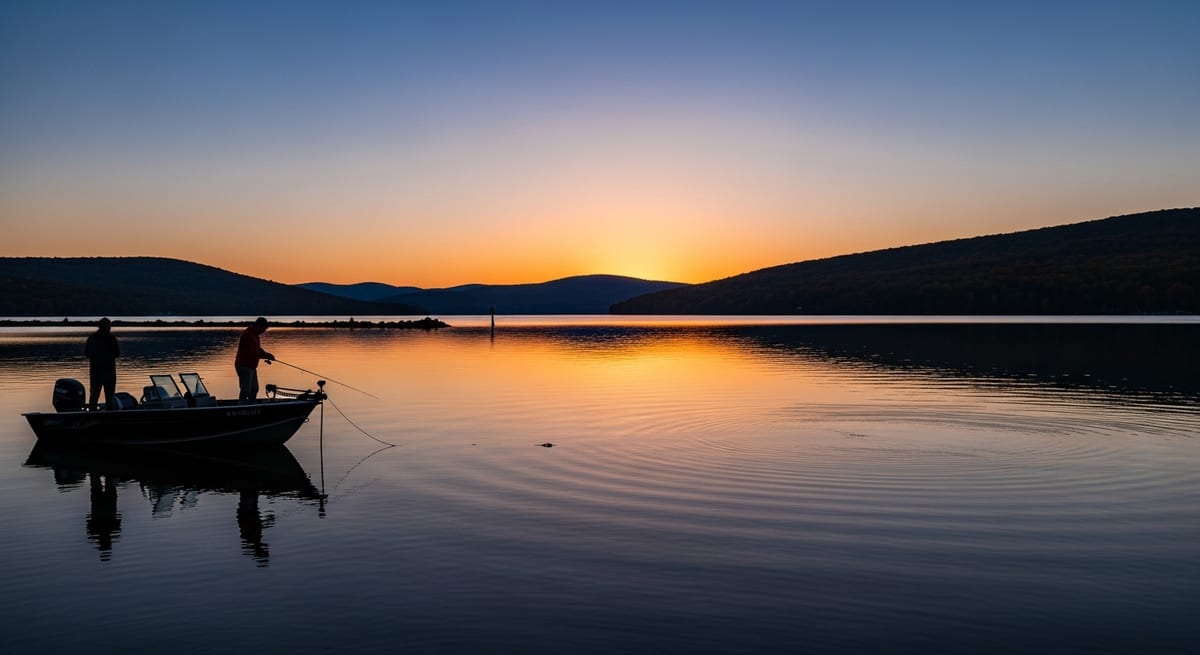
Anglers who fish Candlewood Lake or Lake Lillinonah from a boat for the first time consistently report the same positioning mistake: they fish the bank the same way they did from it, casting toward shore from 30 yards out rather than tight to it, and working parallel to structure they could have reached from the launch ramp. Charter guides on LIS and Candlewood regulars in CT bass communities describe this as the most common early error. They fish from the hull the way they fished from the bank, and the boat's actual positioning advantage goes unused. That advantage is access to water shore anglers cannot reach: the 25-foot drop-off humps in Candlewood's main basin, the channel bends through the Farmington arm, the rocky reefs a quarter-mile off the central CT coast on Long Island Sound. Getting to that water and staying on it requires understanding how a boat moves, what CT DEEP regulations require on the water, and how to keep the hull positioned once the fish are below you.
What CT DEEP Requires Before You Leave the Dock
Connecticut DEEP requires one Coast Guard-approved PFD per occupant on every registered vessel, plus one Type IV throwable device (ring buoy or seat cushion) in addition to the wearable life jackets. First-time boat anglers borrowing a hull from a friend or renting from a Candlewood marina often don't check both boxes. Inspections at Candlewood's launch ramps during peak season have turned up both gaps.
Kill switch/lanyard: Connecticut law requires kill-switch lanyard use on equipped vessels. Attach it to your wrist or PFD before starting the engine. On a small bass boat on Bantam or Candlewood, a fall overboard with the engine running puts a driverless hull into every other angler on the water.
Boating safety certification: CT DEEP requires operators under age 16 on motorized vessels to have completed a DEEP-approved boating safety course. All PWC operators face the same requirement regardless of age. The certification requirement catches some first-time boat anglers who borrowed a vessel without knowing which rules attach to the operator rather than the owner.
Registration: All motorized vessels on CT waters must be registered with CT DEEP, with registration numbers displayed on both sides of the bow. Out-of-state registered boats have a 60-day window before CT registration is required.
Weather: Afternoon thunderstorms build rapidly over western Connecticut's reservoir systems in summer. LIS anglers and Candlewood regulars both report the same pattern: check the forecast at launch and again mid-morning, and return to shore at the first sound of thunder. CT DEEP's boating safety resource at ct.gov/deep is the authoritative source for current regulation summaries.
Boat Control on Candlewood, Bantam, and LIS: Wind, Current, and Why the Hull Won't Stay Put
The largest fishing advantage a boat provides is precise positioning relative to structure. The challenge is that the boat does not hold position without active management.
On CT impoundments: Candlewood, Bantam, and Lillinonah are wind-dominated systems. The prevailing southwest wind in summer pushes boats northeast, often directly toward the bank being fished parallel to. Candlewood regulars describe anchoring upwind of a target point, deploying enough rope to settle on the productive edge, and waiting out lulls rather than chasing the spot with a trolling motor and spooking fish holding in 10 feet of water.
Anchor scope: The standard rule is 7:1 rope to depth. In Candlewood's 15- to 25-foot offshore zones, that means 105 to 175 feet of rode. Many first-trip boaters underestimate this and wonder why the anchor drags after 5 minutes.
On LIS and tidal rivers: The Connecticut River mouth, Niantic Bay, and the Thames estuary near New London all involve tidal current that changes the anchoring feel from CT lake fishing. LIS charter community practice for striped bass is to anchor well up-current and let the bait work through a rip or channel seam, rather than casting upstream and retrieving against the current.
Trolling motor: A bow-mounted electric trolling motor lets CT impoundment anglers hold position or move along a weedline without engine noise. Most Candlewood and Bantam bass boats fish with foot-pedal trolling motors for hands-free control while casting. First-time boaters on jon boats without a trolling motor typically find Bantam more manageable for learning boat control than Candlewood's more exposed main basin.
Natural drifting over Candlewood's submerged timber fields or Lillinonah's mid-lake structure is a deliberate technique, not just a failure to anchor. Let the wind carry the hull over a suspected school, then power back upwind and repeat the drift.
Fishing With a Partner: How CT Boat Anglers Divide the Hull
Fishing from a boat with a partner requires coordination that solo shore fishing does not prepare for. CT bass anglers who pair-fish Candlewood and Lillinonah during CABA club events describe working out casting zones as one of the first things to settle before lines go in.
Bow and stern division: One angler fishes from the bow, one from the stern. On a specific bank or structure edge, the bow angler typically has the better casting angle to the target. Rotating positions on longer trips is standard courtesy among Candlewood regulars working the eastern shoreline's submerged timber.
Casting zones: Each angler operates in roughly a 180-degree arc in front of them. Casting behind toward a partner's zone is the most common source of tangles on a two-person boat. On a small jon boat or aluminum bass boat, the kind most first-time CT boat anglers use when fishing with a friend or renting from a Candlewood marina, the casting arcs overlap quickly if nobody thinks about it first.
Call your casts: Verbal communication prevents collisions on small hulls. 'Going long at the dock piling' or 'casting right toward the fallen oak' keeps both lines tracking. Candlewood regulars who fish the Squantz Cove arm describe this as automatic after a few trips, but it takes deliberate effort early on.
The Shore Angle a Bank Angler Cannot Take: How to Use a Boat's Position
Shore fishing's most productive pattern is casting parallel to structure rather than out into open water. A boat reverses the geometry: position the hull parallel to a CT shoreline and cast directly into the bank, retrieving the lure away from it and through the productive shallow zone for the full retrieve.
On Candlewood's rocky northwest shore above Squantz Cove State Park, anglers who work tight to the boulder fields from a boat describe a clear positioning advantage. A shore angler at that access point faces thick vegetation and steep rock that prevents the parallel cast. From a hull 15 feet off the bank, casting directly into the shoreline rock piles and working the lure through the shallow-to-deep transition is straightforward.
Deep structure access: The defining advantage of boat access on CT waters is reaching offshore structure that shore anglers cannot fish. The Farmington arm of Candlewood concentrates largemouth bass on channel structure in summer heat. The mid-lake humps in Bantam's northern basin hold smallmouth through July and August when the shallows warm past holding temperature. Anglers who fish these spots describe them as reliably holding the largest fish in the system during the summer heat window, and they require a boat and sonar to locate and fish systematically.
Reading Sonar on CT Impoundments and LIS: What the Screen Shows in These Waters
Most fishing boats have a depth finder or sonar unit. The screen shows water depth, bottom composition, and fish in real-time, but what it shows is specific to the water being fished. CT anglers reading Candlewood or LIS are interpreting different bottom signatures than anglers on a Midwestern walleye lake.
Bottom composition on CT impoundments: A hard, distinct bottom return on Candlewood often indicates the rocky ledge systems along the western and northwestern shoreline. A soft, diffuse return in the 20- to 30-foot zone frequently reflects silt bottom over former agricultural land flooded when the reservoir was impounded in the late 1920s. Bantam's grass lines appear as a mid-water return above the actual bottom, vegetation signatures that largemouth tend to hold tight to through summer.
Fish arches: Individual fish appear as arches or inverted U-shapes as they pass through the transducer cone. CT bass anglers report that suspended arches over the submerged timber in Candlewood's upper arms often represent white perch schools mixed with bass. Worth dropping a vertical presentation before moving on.
Thermocline: CT impoundments stratify in summer. A horizontal band mid-screen, often appearing at 18 to 25 feet on Candlewood during July and August, marks the thermocline between warmer surface water and cooler water below. Anglers who fish Candlewood's main basin in late summer report that targeting fish marked 5 to 8 feet above that band, rather than blind-casting the shallows, consistently outproduces surface presentations through the heat window.
Sonar interpretation is water-specific. Reading CT impoundments accurately takes hours of fishing while watching the screen and comparing what the unit shows to the fish that come up on the line.
EVERY SATURDAY MORNING
Weekly fishing intelligence
Nationwide conditions, what's biting, and honest gear deals. One email, no noise.
No spam. Unsubscribe anytime.