
CT's Best Trolling Doesn't Happen at 2 mph. What Candlewood and Barkhamsted Anglers Have Figured Out About Speed, Depth, and Lure Selection by Species.
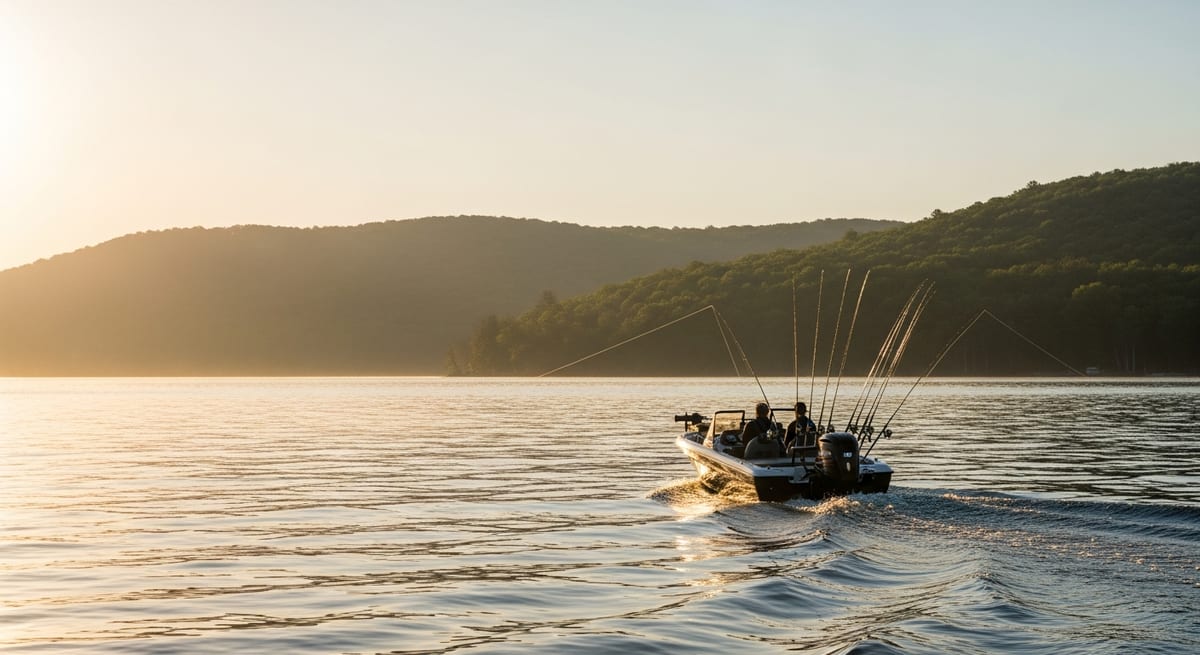
DEEP's annual spring stocking pushes thousands of brown and rainbow trout into Barkhamsted Reservoir's main basin between late March and mid-May, and the anglers who find them consistently aren't working the shoreline. They're trolling the open basin at around 1.5 mph, covering water that shore casters and anchored boats simply can't reach. On Candlewood Lake, the same principle applies to walleye: fish suspending at 35 to 45 feet in open water are most efficiently intercepted by a moving boat tracking a contour. Trolling, on CT's larger lakes and reservoirs, is primarily a coverage method, and understanding it as such changes how you approach both the setup and the water.
Which CT Lakes Reward Trollers, and for Which Species
Not every Connecticut water fishes well for trolling. The technique earns its keep on larger, open-water bodies where fish suspend horizontally at a preferred depth, which describes several of CT's most-fished reservoirs.
Candlewood Lake is the most frequently discussed CT trolling destination for walleye. Anglers who fish Candlewood walleye regularly describe working the 35-to-45-foot contour in the eastern arm during the pre-dawn to early morning window in spring. The consensus leans toward strikes coming along depth transitions rather than over flat bottom. The lake's size, over 8 miles from end to end, makes trolling a practical necessity for covering productive structure efficiently.
Barkhamsted Reservoir (West Branch Reservoir) draws serious troll-targeting for brown and rainbow trout, particularly in the weeks following DEEP's spring stocking. DEEP's annual freshwater stocking list, published on their website, tracks the timing and volume of Barkhamsted releases, and the fish that come from those releases tend to disperse through the open basin rather than stacking near structure. Experienced Barkhamsted trollers report trout typically suspended between 10 and 25 feet early in the season, progressively deeper as surface temperatures rise through June.
Lake Zoar, the Housatonic impoundment along the Monroe-Oxford line, draws trollers in spring for largemouth bass and trout. Anglers who troll Zoar note its irregular bottom, depth transitions happen quickly, and tracking contour changes carefully is part of what separates a productive pass from a blank one.
Bantam Lake in Morris draws Sutton spoon trollers targeting trout each spring and is one of several CT lakes where the traditional slow troll consistently outperforms casting in early season.
CT DEEP's current freshwater fishing regulations apply to all of these waters. Impoundment-specific rules, including bag limits and size minimums for walleye on Candlewood, can differ from the general statewide baseline. Checking the published regulations for the specific lake before a first trip is standard practice among experienced CT boat anglers.
Rigging for CT Reservoirs, without a Downrigger
Most CT anglers who troll Barkhamsted or Candlewood start without downriggers. The basic setup handles most spring and early summer fishing on these lakes.
Rod: A 7-8 foot medium or medium-light rod with a slower action. Softer tips absorb head shakes and are more forgiving on light-wire hooks. A common source of lost trout when the rod is too stiff for the species.
Reel: A level-wind baitcasting reel with a line counter (Penn Squall, Daiwa Sealine are common choices in CT tackle discussions) is the upgrade most experienced trollers recommend first. Knowing exactly how much line is out is what makes a productive pass repeatable. A spinning reel works for lighter applications but complicates consistent line management.
Line: 10-15 lb monofilament covers most CT freshwater trolling situations. Mono's stretch provides a buffer on hook sets and runs, which matters more for trout than for walleye. Braid shows up in specialized setups, primarily lead core work on deeper Candlewood passes, but isn't the right starting point.
Leader: 3-6 feet of fluorocarbon, two pounds lighter than your main line. A barrel swivel between main line and leader is worth the extra connection point, line twist accumulates quickly when trolling, and the swivel slows it significantly.
Basic rig: Main line → small barrel swivel → 4-foot fluorocarbon leader → lure.
Lures CT Trollers Actually Reach For, sutton Spoons, Crankbaits, and the Depth Question
Sutton spoons have been a trout trolling standard on Barkhamsted, Bantam, and other CT lakes for decades. The kind of lure that local tackle shops continue to stock not out of nostalgia but because the regional demand stays consistent. At slow trolling speeds (1.2-1.8 mph), a Sutton 44 or Sutton 55 at 50-80 feet of line typically covers the spring trout suspension depth on Barkhamsted. Anglers who fish Bantam Lake describe Suttons as their default before experimenting with anything else for troll-targeting trout. A small attractor flasher ahead of the spoon adds action in the stained post-rain water common on both lakes. Williams and Thomas spoons are also regularly mentioned by Northeast trout trollers as reliable alternatives in the same speed range.
Crankbaits are the standard Candlewood walleye setup. Manufacturer diving-depth specs are a useful starting point, but experienced Candlewood trollers note that actual dive depth varies enough by speed and line diameter that verifying against sonar is the more reliable approach. Two lures labeled "dives to 15 feet" from different manufacturers can behave noticeably differently at the same speed.
Depth by line length: Letting out more line does put lures deeper. The line angle becomes more gradual as length increases. The gain isn't linear and varies enough by lure design and speed that experienced CT trollers typically calibrate a specific lure at a specific speed rather than relying on a general formula.
Lead core line (color-coded in 10-yard segments) offers a low-cost path to reaching deeper zones without a downrigger. As a rough working reference at moderate speeds, each 10-yard color typically adds several feet of depth, though the actual figure can shift meaningfully between 1.5 and 2.5 mph. Anglers who run lead core on deeper Candlewood passes tend to treat the color system as a relative depth index rather than a precise measurement.
Speed, S-Curves, and What the Productive Pass Actually Looks Like
Track actual speed-over-ground with a GPS unit or app, not throttle position alone. Wind and current affect effective speed enough to matter. A Candlewood troll that produces in calm morning conditions can go quiet when afternoon wind picks up, often because the effective speed has drifted outside the productive range without any throttle change.
Candlewood walleye trollers generally work 1.8-2.2 mph. Barkhamsted trout trollers typically fish slower: 1.2-1.8 mph, with many reporting that trimming speed by 0.2-0.3 mph during a slow stretch triggers more strikes than switching lures.
S-curves through promising water are a consistent recommendation among CT boat anglers who troll seriously. As the boat arcs, the inside rod's lure slows and drops; the outside rod speeds up and rises. The change in lure action at the apex of the turn produces a disproportionate share of strikes. Anglers who work Candlewood's eastern arm describe systematic S-curves along the 35-foot contour as more productive than straight passes, particularly during spring walleye windows.
Log productive passes. Trollers who have fished the same CT lakes across multiple seasons report that specific zones produce under similar conditions year after year. GPS position, speed, lure, line length, time of day, and water temperature, keeping that record is how a one-off good pass turns into a repeatable pattern rather than a lucky morning.
EVERY SATURDAY MORNING
Weekly fishing intelligence
Nationwide conditions, what's biting, and honest gear deals. One email, no noise.
No spam. Unsubscribe anytime.