
CT Anglers on Candlewood, the Housatonic, and the LIS Surf Report the Six Hours Before a Frontal Arrival Consistently Outfishes the Post-Storm Recovery Period, what NOAA Pressure Trends, USGS River Gauges, and CT Fishing Communities Reveal About Reading Weather for Connecticut Waters
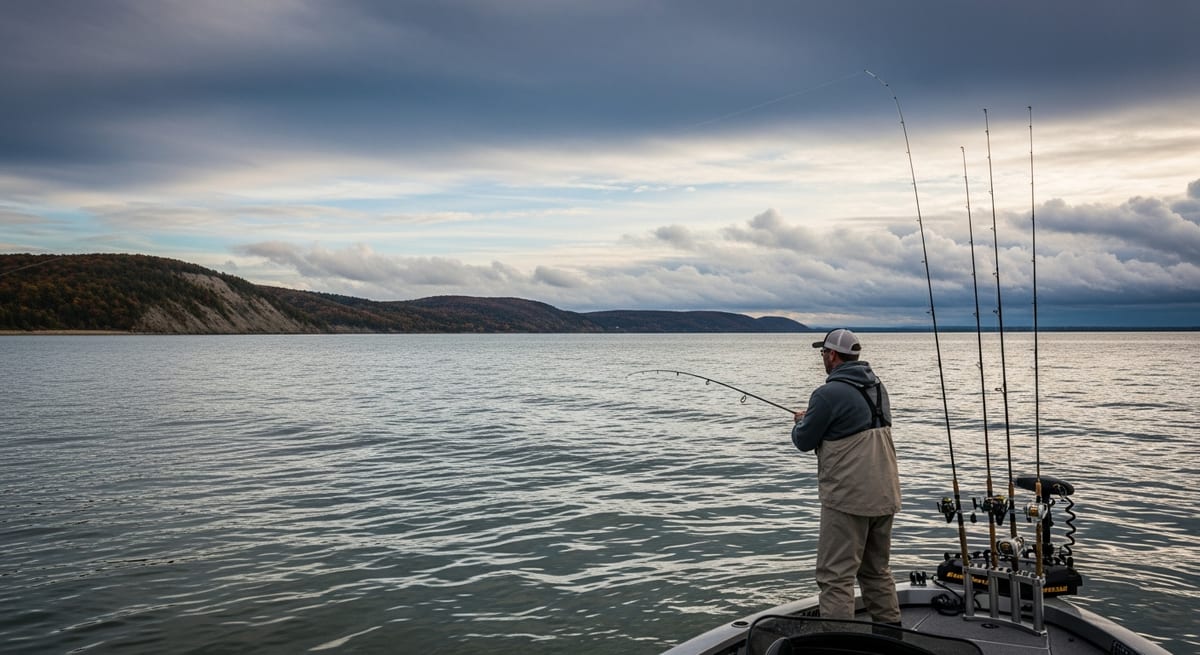
Anglers who regularly fish Candlewood Lake through winter and the Housatonic River corridor in spring consistently report that the six hours before a frontal system arrives produce more fish than the three recovery days that follow. Most weekend anglers schedule around the storm, not ahead of it. Weather shapes fish behavior across every Connecticut fishery, from the USGS-gauged Farmington River to the NOAA-buoyed western Long Island Sound, through pressure shifts, wind-driven bait movement, rain-triggered runoff, and temperature windows that differ by species. The CT bass, striper, and trout communities report distinct patterns for each of these variables, and several free public data sources make it possible to check conditions before you launch.
The Pressure Drop: Why the Pre-Front Window Gets Reported So Consistently on CT Waters
Barometric pressure is the atmospheric variable Connecticut freshwater communities mention most often when explaining unusually good or poor fishing days. The pattern reported repeatedly by Candlewood and Bantam bass anglers is consistent: feeding activity tends to increase as pressure falls ahead of an incoming system. Anglers who track conditions on those impoundments describe the roughly 6-to-12-hour window before a frontal arrival as often the most productive stretch of the week.
The post-frontal period inverts that pattern. When a cold front passes and pressure rises sharply with clearing skies and dropping temperatures, bass and other freshwater predators on Connecticut impoundments are widely reported to suspend in deeper water and reduce active feeding. CT bass communities describe these conditions as among the most challenging of the year on inland water.
LIS surf communities note that stripers are somewhat less sensitive to pressure swings than freshwater predators. Tidal current and bait position often override atmospheric effects at coastal access points like Niantic Bay and Hammonasset, where a strong falling tide with bait present can produce regardless of what the barometer did 18 hours earlier.
On the Housatonic and Farmington, stable high-pressure periods tend to produce consistent nymphing windows without the volatile activity swings tied to pressure change. The direction of the pressure trend is the useful signal, not any single reading. A basic barometer app tracking millibars over a 12-hour window is enough to identify which phase you are entering. Note: specific millibar threshold values sometimes cited online as hard feeding triggers vary significantly between sources and lack consistent validation for Connecticut species. CT communities use pressure trend as a planning signal, not a precise threshold.
After the Cold Front: What Candlewood, Bantam, and CT Trout River Communities Report Post-Passage
Cold fronts receive more discussion than any other weather event in Connecticut fishing communities, and the post-frontal pattern on freshwater impoundments is one of the most consistently reported topics in CT bass forums and club records. The standard sequence: a front moves through with strong wind and rain, temperatures drop measurably, the sky clears, and pressure rises. In the period following passage, CT bass anglers on Candlewood, Bantam, and Lillinonah report fish suspending in deeper water and becoming largely unresponsive to aggressive presentations.
Finesse techniques tend to get the most attention in post-frontal freshwater conditions. CT bass communities mention slow-retrieved drop shots, small ned rigs, and tube jigs worked deliberately in deeper structure as the approaches that still produce when surface activity shuts down. The recovery window before feeding resumes varies by species, front intensity, and season, and CT community reports do not converge on a single timeframe.
Trout respond differently. CT fly fishing communities report that the Farmington and Housatonic TMAs often fish well in post-frontal conditions, particularly when colder, clearer water brings river temperatures closer to optimal trout ranges. The Farmington River Anglers Association and Housatonic Fly Fishers both note that post-front clarity can improve nymphing visibility and bring fish onto the feed on both rivers.
LIS stripers also show a different pattern from impoundment bass. Shore casters at Niantic Bay, the Housatonic mouth, and Old Saybrook report that tidal movement and bait position typically matter more than post-frontal pressure for striper activity along the Connecticut coast.
Wind on CT Impoundments and the LIS Coast: What Sets Up the Productive Shorelines
Wind creates surface current that moves bait, and concentrating bait along predictable structure is one of the most reliable patterns on Connecticut impoundments. On Candlewood and Bantam, anglers regularly note that the windward shoreline receives wind-driven baitfish and invertebrate accumulation. Points jutting into the lake against a sustained wind are frequently mentioned in CT bass club reports as productive structure when the wind is up.
Wind direction carries a temperature signal on Connecticut freshwater. Southwest winds typically arrive with warmer air masses and more stable conditions in southern New England. North and northwest winds following a cold front signal dropping temperatures and slower impoundment fishing conditions.
On the LIS coast, wind direction shapes surf conditions differently by species. Offshore winds blowing from the CT shoreline toward Long Island tend to flatten surf and improve water clarity at access points including Hammonasset State Beach, Harkness Memorial, and Bluff Point. LIS surf communities report stripers often feed aggressively in moving, turbid conditions driven by onshore wind, while bottom species tend to favor calmer water. Strong northeast winds at Niantic Bay and the Housatonic mouth can make shore access difficult while creating productive rip lines just offshore for those with boat access.
For river anglers on the Farmington and Housatonic, sustained wind is primarily a presentation concern rather than a fish-behavior factor. Current dynamics on moving water typically override surface wind effects on fish positioning.
Rainfall and CT Rivers: What Farmington, Housatonic, and Coastal Inlet Communities Report
Rain produces two distinct phases for Connecticut fishing, and the relevant one depends on intensity and the watershed involved. Light rain is widely reported as a positive condition on CT freshwater. Reduced surface glare, diffused light, and surface disturbance make predators in shallow water less wary. CT bass communities on Rogers Lake and Pachaug Pond regularly mention light-rain sessions as productive. Trout on the Farmington and Housatonic often feed more actively under overcast, light-rain conditions that match the low-light surface activity typical of larger fish.
Heavy rain shifts the equation significantly, particularly on streams and rivers. USGS gauge data on the Farmington River at Tariffville (available at waterdata.usgs.gov) shows height and turbidity in near real-time after significant rainfall. When gauge height spikes and turbidity rises, river trout typically move off main current and hold tight to slower margins and eddies. CT fly fishing communities report that darker, high-vibration presentations including weighted streamers and heavily dressed nymphs produce better in stained water than lighter patterns effective during clear conditions.
For freshwater impoundments, heavy rain brings runoff through drainage ditches and tributary mouths. Fish often move away from these direct inflow zones temporarily. After rain clears and water settles, the same inflow areas can concentrate washed-in invertebrates and baitfish and become productive again.
At coastal inlets including the Niantic River, the Housatonic mouth, and the Connecticut River outlet at Old Saybrook, heavy freshwater inflow from rainfall shifts salinity in the mixing zone. CT coastal communities report some species avoid this zone temporarily, while stripers staged near inlet mouths often respond to the disrupted bait activity that follows heavy rainfall. The USGS Connecticut River gauge at Middle Haddam (01184000) gives a useful upstream read on how much freshwater is pushing toward Old Saybrook before a tidal fishing session.
Temperature Windows by Species: CT Water Data and Community-Reported Ranges
Water temperature determines fish metabolism, and knowing the commonly cited optimal ranges for Connecticut target species makes seasonal timing more systematic. These ranges appear consistently in CT fishing communities and regional fisheries resources. They are general benchmarks, not precise thresholds, and on-the-water conditions vary by waterbody and year.
Largemouth Bass (Candlewood, Bantam, Lillinonah): CT bass communities most often cite 65-to-78 degrees as the range where feeding is most active and predictable. Below 50 degrees, impoundment bass metabolism slows markedly and fish become largely inactive. Above 85 degrees, bass on Candlewood and Bantam typically pull to deeper, cooler structure during daylight hours, a pattern CT summer bass communities note consistently in July and August.
Striped Bass (LIS, Housatonic mouth, CT River): LIS communities and ASMFC tagging research both associate stripers with cooler preferred temperatures than freshwater bass. The commonly cited active range runs roughly 55-to-68 degrees, which aligns with the fall migration timing CT shore casters track closely as cooling water draws migratory fish into coastal CT range through October and November.
Brown and Rainbow Trout (Farmington TMA, Housatonic TMA): CTFA resources and Farmington River Anglers Association guidance consistently note that trout stress increases above 68 degrees, and voluntary catch-and-release suspension is recommended above 70-to-72 degrees. USGS temperature gauges on both rivers give real-time readings. The Farmington at Tariffville gauge (01187300) and the Housatonic near Bulls Bridge are the most-referenced stations among the CT fly fishing community.
Yellow Perch (Candlewood, Gardner Lake, Rogers Lake): Cold-tolerant and active through temperatures that slow most other CT species considerably. CT winter fishing communities report perch feeding actively at 38-to-55 degrees, a range that covers the ice-fishing season on the larger CT impoundments.
What CT Fishing Communities Check Before Launching: Free Data Sources Worth Bookmarking
CT anglers who report the most consistent results across seasons typically run through a consistent set of pre-trip checks. None of these require paid tools or subscriptions.
Barometric pressure trend: Weather Underground and the NOAA forecast discussion for your target zone both show pressure trend over 12-to-24 hours. The direction of change is the useful planning signal. Falling ahead of a system, stable in high pressure, and rising after frontal passage each call for a different approach on CT waters.
Recent frontal passage: The National Weather Service 7-day history shows when the last significant cold front moved through your area. If a front arrived within the last 24-to-48 hours, CT impoundment bass and inland trout fishing communities generally report tougher conditions. The LIS surf and tidal river communities often report a less severe impact from post-frontal pressure shifts.
USGS stream gauge: For Farmington River fishing, the gauge at Tariffville (01187300) gives current flow, height, and temperature. For the Housatonic TMA, the gauge near Bulls Bridge is the standard reference among the CT fly fishing community. Turbidity after rainfall and temperatures approaching stress thresholds for trout are both visible in the live data.
NOAA Buoy 44039 (western LIS): Sea surface temperature and wave height for LIS planning, available at ndbc.noaa.gov. LIS surf communities use SST and wind data from this buoy alongside the forecast when planning sessions at Hammonasset, Bluff Point, and Niantic Bay.
DEEP 2025-2026 Fishing Guide: Size limits, possession limits, and closed-season regulations for both freshwater and marine species. The post-front and temperature stress conditions covered above sometimes coincide with when voluntary release is the appropriate call for fish health. The DEEP guide is the authoritative reference for what the regulations require.
EVERY SATURDAY MORNING
Weekly fishing intelligence
Nationwide conditions, what's biting, and honest gear deals. One email, no noise.
No spam. Unsubscribe anytime.