
Getting Started with Boat Fishing in Connecticut: Everything You Need to Know
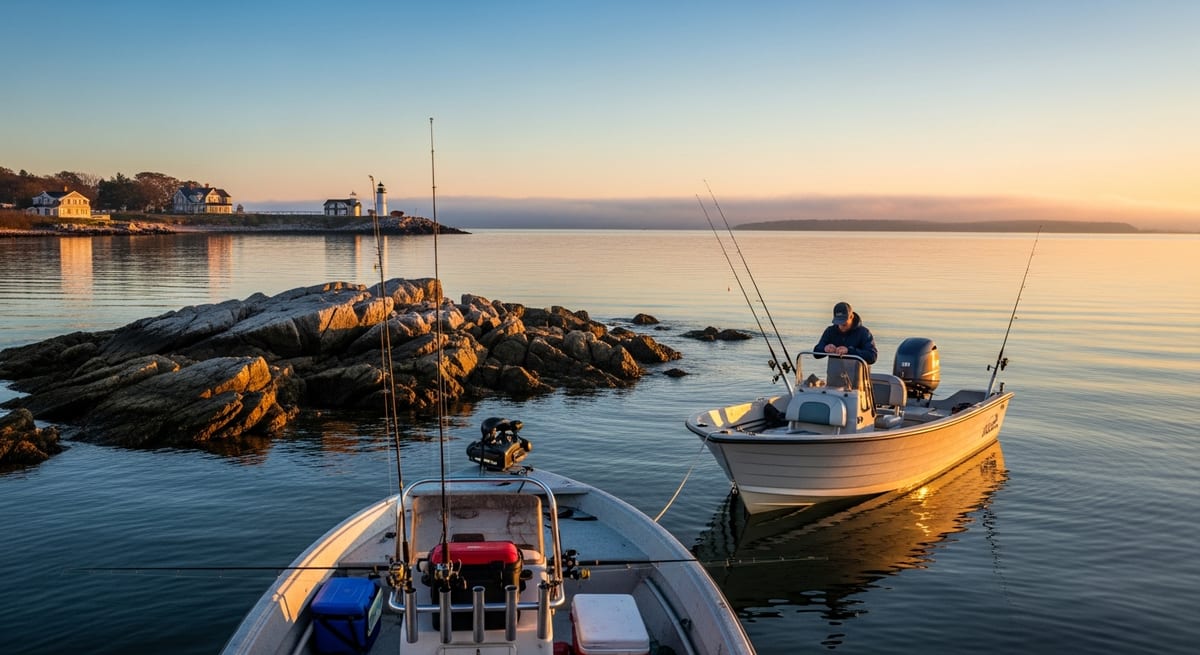
Fishing from a boat opens up water that shore anglers can never reach. In Connecticut, with its mix of freshwater reservoirs, river systems, and Long Island Sound. A boat multiplies your options dramatically. But launching a boat for the first time has a learning curve: registration, launch ramp etiquette, safety requirements, and knowing where you're actually allowed to go. Here's the straightforward rundown.
Connecticut Boat Registration Requirements
Any motorized boat must be registered in Connecticut before it's put on state waters. Registration is handled by the CT DMV (not the DEEP). You'll need proof of ownership (bill of sale or title), your identification, and the registration fee.
Registration is renewed annually (or every 2 years depending on the class). Carry the registration card on the boat while on the water.
Hull Identification Number (HIN): All registered boats have a 12-character HIN on the transom. New boats come with one; old boats without a HIN may need one assigned through the DMV.
Non-motorized boats: Kayaks, canoes, and rowboats used without a motor don't require registration in Connecticut (as of current law). If you add a trolling motor, registration is required.
Federal documentation: Large vessels may be federally documented (USCG documentation) rather than state registered. If your vessel has USCG documentation, you don't need state registration but still need a state decal for CT waters (requirements vary, verify with CT DMV).
Fees: Current CT boat registration fees are based on vessel length. Check the CT DMV website for current fee schedules. They're updated periodically.
Fishing Licenses from a Boat
A boat registration does NOT include a fishing license. Every angler aboard must have a valid Connecticut fishing license (or be license-exempt, under 16, CT residents over 65 with free senior license, etc.).
Inland vs. Saltwater:
- Freshwater fishing license: Required for all freshwater species in CT ponds, lakes, and rivers
- Marine recreational fishing license: Required separately for saltwater fishing (or combined with freshwater)
- Combined licenses are available and the most cost-effective for anglers fishing both fresh and saltwater
Federal license requirements: If you fish federal waters (3+ miles offshore in the Atlantic), some species (like striped bass, bluefish, menhaden) require registration with the federal Recreational Fishing Registry, which is typically free.
Get licenses at ct.gov/deep or at any licensed agent (most bait shops, some Walmart locations, sporting goods stores). Carry your license on the water.
Required Safety Equipment
Connecticut law (and federal law) requires specific safety equipment on all boats:
Life jackets (PFDs): One Coast Guard-approved PFD per person aboard, sized appropriately. Children under 13 must WEAR their PFD at all times while the boat is underway. Adults must have one accessible, but it's strongly advisable to wear one. Inflatables count but must be worn (not stowed) to count for persons required to wear them.
Throwable device: Any boat 16 feet or longer (or any boat with an inboard engine) must carry a Type IV throwable device (a ring buoy or seat cushion-style throwable) in addition to the wearable PFDs.
Fire extinguisher: Required on any boat with an enclosed engine compartment. Most outboard-powered open fishing boats with a built-in fuel tank also require one. Check your specific boat type.
Sound signaling device: A horn or whistle is required. A simple pea-less whistle meets the requirement.
Navigation lights: Required for operating between sunset and sunrise. Running lights (red/green bow lights, white stern light) and an anchor light if anchored in navigable waters.
Visual distress signals: Required on coastal waters (Long Island Sound). Flares are most common. Three day/night combination flares in date (they expire) meet the requirement.
Registration numbers: Must be displayed on the hull (typically painted or applied near the bow on both sides).
Connecticut Public Boat Launches
Connecticut DEEP operates public boat launches on many state waters. There's typically a daily launch fee or an annual launch sticker. The annual sticker (CT Boat Registration sticker) covers launches at all DEEP-managed launches for the year and is often the better value for regular anglers.
Key freshwater launches:
- Candlewood Lake (multiple launches at Squantz Pond State Park and elsewhere, excellent perch, bass, and walleye fishing)
- Lake Lillinonah, shepaug Dam launch
- Bantam Lake (Morris), state boat launch
- Saugatuck Reservoir, permit required (Aquarion watershed)
- Numerous town-managed launches throughout the state
Key saltwater launches:
- Barn Island WMA (Stonington), eastern CT Sound access
- Ryder's Cove (Chatham via boat only), western Sound
- Town-managed launches in Westport, Norwalk, Milford, Madison, Old Saybrook, and other coastal towns
- Most coastal towns with marine access have at least one public launch, call the town's harbor master for current access and fee information
Launch ramp etiquette: Prepare your boat at the staging area (not on the ramp) before pulling to the ramp. Tie up, load gear, and pull the vehicle and trailer out of the ramp area promptly after launching. Don't be the person blocking the ramp for 20 minutes while 4 boats wait. The unwritten code is: be ready, be quick, be courteous.
Where to Actually Fish From a Boat in CT
Freshwater, reservoirs and lakes: Candlewood Lake for bass, walleye, and perch. Lake Lillinonah for bass and crappie. Bantam Lake for bass and walleye. Barkhamsted Reservoir (West Branch of the Farmington) for rainbow and brown trout. A stunning mountain reservoir fishery. Moodus Reservoir for largemouth bass. Quaddick Reservoir for bass and walleye in northeastern CT.
Connecticut River: The river is fishable by small boat from multiple access points. Walleye fishing in the northern CT River stretches (below Enfield) is excellent. American shad fishing in spring (May) draws boats from throughout the state. Bass fishing throughout the river. Fishing becomes saltwater-influenced south of the Saybrook jetties.
Long Island Sound: The Sound is where CT's biggest fishing opportunities live. Striped bass, bluefish, fluke, black sea bass, porgies (scup), and occasional bluefin tuna. For the Sound, you need a seaworthy vessel, not a small jon boat. A 17-24 foot center console with good power is the standard Sound fishing boat. Check NOAA forecasts before going out; afternoon southwest winds can build quickly in summer.
Smaller salt ponds and tidal rivers: Mystic River, Niantic Bay, the Housatonic River estuary, the Connecticut River mouth, and numerous tidal rivers offer protected saltwater fishing for species like stripers and weakfish that enter these areas in spring and summer. Excellent small-boat or kayak water.
First-Year Tips
Take a boating safety course: Connecticut offers online and in-person courses. New boaters can feel overwhelmed, understanding right-of-way rules, reading charts, and understanding anchoring basics prevents problems. The CT DEEP mandates that anyone born after January 1, 1987 must have completed a boating safety course to operate a motorized vessel.
Know your fuel range: Running out of fuel on the water is avoidable and embarrassing. Carry enough fuel for your planned trip plus 30% reserve. Know where fuel docks are in your operating area.
Get a VHF radio: Especially for Long Island Sound. A marine VHF radio lets you communicate with the Coast Guard, receive weather warnings, and call for help. Channel 16 is the emergency and hailing channel, always monitor it when on the water.
File a float plan: Tell someone where you're going, what vessel you're on, and when you expect to return. If you don't return, they know to call for help. Five minutes of planning prevents major search and rescue resources being deployed days late.
Start on protected water: Learn your boat's handling characteristics, the launch/retrieve process, and navigation basics on a protected lake or river before venturing onto Long Island Sound.
EVERY SATURDAY MORNING
Weekly fishing intelligence
Nationwide conditions, what's biting, and honest gear deals. One email, no noise.
No spam. Unsubscribe anytime.