
How to Start Fishing: The Complete Beginner's Guide
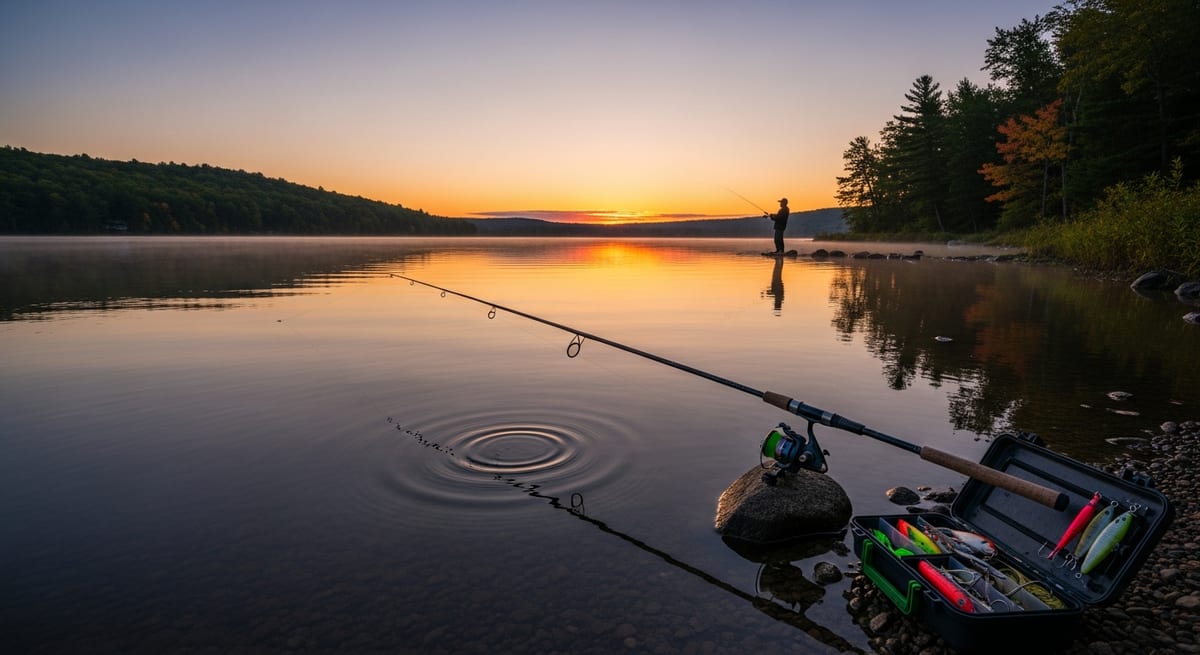
Bluegill and yellow perch at Hopeville Pond in Griswold, CT will bite a worm under a bobber in water as cold as 50°F, meaning your first fish can come in late March, weeks before most beginners think the season has opened. You don't need a premium rod, a boat, or a mentor who grew up on the water. A basic spinning combo, a pack of nightcrawlers, and a bank spot with structure nearby is a legitimate starting point. Your first few outings will be mostly about learning mechanics, reading water, tying knots, recognizing a bite. Gear, locations, and honest expectations are all below.
What You Actually Need (Starter Kit Under $60)
A solid first setup costs under $60. Spending more won't catch you more fish until the mechanics are dialed in.
The rod and reel: A medium spinning combo in the 6-7 foot range. The Shakespeare Ugly Stik GX2 Combo (commonly available at sporting goods stores, though pricing varies by retailer. Shop around before you buy) is genuinely good and nearly indestructible. Medium power, medium-fast action. It will catch everything from panfish to stripers. If you want to step up after your first season, the Penn Battle II spinning combo is a meaningful improvement in drag quality and build over entry-level gear, but the Ugly Stik is the right starting point.
The line: Your spinning reel probably came pre-spooled with monofilament. Use it. 8-12 lb monofilament is fine for learning. When it runs out, replace it with Trilene XL or similar.
Hooks: A pack of Eagle Claw baitholder hooks in size 6 and size 2. Under $3.
Weights (sinkers): A split-shot assortment or a small pack of clip-on weights. You'll need these to get your bait down.
Bobbers: A pack of round clip-on bobbers, 3/4 inch. Optional but helpful when learning.
Bait: Nightcrawlers (earthworms) from your local bait shop or sporting goods store. $3-$4 a dozen. They work on almost everything that swims in freshwater.
License: If you're 16 or older, you need a CT fishing license before you wet a line. About $19 for residents, grab it at the CT DEEP e-license portal in five minutes.
Total gear: around $45-$55. You're ready to go.
The One Knot You Need to Know
There are dozens of fishing knots. You need one: the Improved Clinch Knot.
Tie it like this:
- Thread 6 inches of line through the hook eye
- Wrap the tag end around the main line 5 times
- Pass the tag end through the small loop near the eye, then through the big loop you just created
- Pull the tag end and the main line in opposite directions. The coils should tighten against the eye
- Trim the excess tag end to about 1/4 inch
Practice it at home before your first trip. It feels awkward the first dozen times, then it becomes muscle memory. This knot tests at around 90% of line strength when tied correctly and will hold everything you'll encounter as a beginner.
YouTube "Improved Clinch Knot" if the written steps don't click. It's a 30-second video and worth watching once.
Where to Go for Your First Trip
The best starting point is any public freshwater pond, lake, or river with easy bank access. No boat needed.
In Connecticut, these are solid spots for beginners:
- Hopeville Pond State Park (Griswold): typically receives stocked trout in spring (check CT DEEP stocking reports for current schedules before your trip), with bass and panfish reliable year-round; easy bank access with restrooms on site
- Burr Pond State Park (Torrington): accessible shoreline with bankable structure, consistent bluegill and largemouth from May through October; worth calling ahead or checking recent reports before your first visit
- Black Rock State Park (Watertown): bank access to Black Rock Lake along well-maintained shoreline paths, solid perch and bass fishing, with a paved launch area that makes getting to the water straightforward
Look for: public boat launches you can fish from the bank, state park day-use areas with waterfront, local fishing piers.
Signs you've found a good spot: other anglers are there, there's a dock or pier nearby, you can see baitfish dimpling the surface in early morning.
The most common beginner mistake is casting into dead, open water. Fish hold near structure, docks, fallen trees, rocks, drop-offs, current seams in rivers. Walking the banks quietly and presenting bait near these features will catch far more fish than casting randomly into open water. That adjustment alone matters more than any gear upgrade.
New anglers often skip rainy days, but the fishing-in-the-rain tips guide explains why steady rain on CT freshwater frequently turns a slow afternoon into the day's best window, falling pressure and reduced surface glare both work in the angler's favor.
Basic Setup: Bobber and Worm
This is where you start. It works. The exact setup:
- Clip a bobber 2-3 feet above your hook (adjust depth so your bait is just above the bottom)
- Attach a small split-shot weight about 8 inches above the hook
- Tie the hook using the Improved Clinch Knot
- Thread half a nightcrawler onto the hook, go through the body twice so it stays on
Cast near structure. Let the bobber settle. Watch it. If it goes under, pull back firmly, not violently. You're fishing.
That's the complete setup. Advanced techniques can wait until you've landed a few fish and want to push further.
Reading the Water
Once you've made a few casts, start paying attention to where the fish actually are. A few rules that hold up consistently:
Early morning and evening are almost always more productive than midday, especially from June through August. Fish move shallow to feed in low light.
Shade = fish in summer. Any shaded bank, dock, or tree overhang in warm weather will hold fish. When surface temps climb above 75°F, shade becomes the single best locator on a warm-water pond.
Current edges. In rivers, fish rarely hold in fast current. They hold in eddies, seams, and slow water just off the current. Cast to where fast and slow water meet.
Structure. Docks, fallen trees, rocks, weed edges. Any change in the bottom creates a spot for fish to ambush prey. Cast to these spots rather than open water.
Water temperature. Fish are cold-blooded. Their activity level follows the water temperature. The sweet spot for most Northeast freshwater species is 60-70°F. Early spring (April-May) and fall (September-October) are productive because the water sits in that range and fish feed aggressively before and after the extremes of winter and summer.
What to Expect (Honest Expectations)
You may not land a fish your first trip, or your first few. That's a normal part of the learning curve, and it doesn't mean your setup is wrong.
Many anglers find that being outside, paying attention to the water, and learning to read a spot is satisfying on its own. The catching is part of it, not all of it. The pieces tend to click over time, not in a single outing.
Some first-trip targets that build confidence fast:
- Bluegill/sunfish: found in almost every warm-water pond in the Northeast, bite readily on small worms, fight hard for their size. Perfect for kids and first-timers.
- Yellow perch: school fish; if you find one, you'll likely find a dozen. Great table fare.
- Largemouth bass: in any weedy CT pond. They'll eat almost anything when you're presenting near structure.
Catch-and-release is standard practice for most species until you know the regulations and bag limits for what you're targeting. Check CT DEEP for current rules before keeping anything.
Keep it simple. A basic setup, a spot with fish in it, and enough patience to work through the learning curve is really all you need.
Connecticut Fishing Licenses
You need a fishing license to fish in Connecticut (with some exceptions).
Who needs one: Anyone 16 or older fishing in CT waters (fresh or salt)
Cost (2026): Approximately $19 for CT residents, $40 for non-residents (verify current rates at CT DEEP)
Where to get one: DEEP e-license portal (online, instant), most bait shops, many sporting goods stores
Exceptions: Free fishing days (typically 2 weekends per year, check CT DEEP calendar), private ponds with landowner permission, fishing from a licensed charter boat (captain's license covers you)
Children under 16 do not need a license in CT.
License required for both freshwater and saltwater fishing from shore. Always carry it.
EVERY SATURDAY MORNING
Weekly fishing intelligence
Nationwide conditions, what's biting, and honest gear deals. One email, no noise.
No spam. Unsubscribe anytime.