
Freshwater Fishing in Connecticut: The Complete Beginner-to-Intermediate Guide
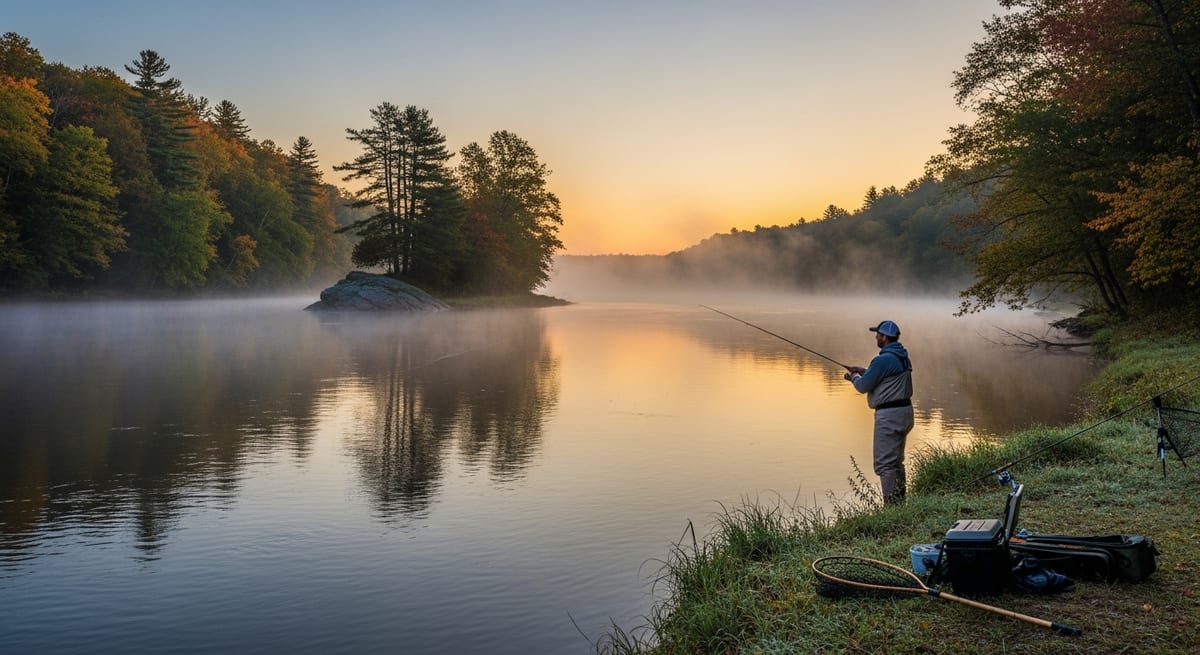
Connecticut has more accessible freshwater fishing than most people realize. The state is densely developed but also has hundreds of lakes, ponds, rivers, and reservoirs. Many with free public access, managed stocking programs, and species ranging from bluegill in a town park pond to wild brown trout in clear Litchfield County rivers. Here's how to get started.
Connecticut Freshwater Fishing License
Anyone 16 or older must have a valid Connecticut fishing license to fish freshwater. There are no exceptions for residents, everyone pays.
Where to get it:
- Online: ct.gov/deep (fastest, prints immediately)
- In person: any licensed DEEP agent. Most bait shops, sporting goods stores, some Walmart and sporting goods chains
- Phone: Connecticut DEEP license office
License types and approximate costs (verify current pricing at ct.gov/deep):
- Resident annual freshwater: The standard license for CT residents fishing freshwater. Approximately $19 for adults.
- Non-resident annual freshwater: For anglers from other states.
- Non-resident 3-day or 7-day: For visiting anglers.
- Combined freshwater + saltwater (marine): If you fish both fresh and saltwater, a combined license is the most cost-effective option.
- Senior license (residents 65+): Free or reduced cost for senior Connecticut residents.
Children under 16: No license required. Connecticut kids fish free.
Carry your license: You must have your license (or your digital license on a smartphone) on your person while fishing. Conservation officers check licenses in the field. First-time violations are typically a warning for residents; fines for repeated violations.
Main Freshwater Species in Connecticut
Largemouth bass: The most popular freshwater target in CT. Found in virtually every pond, lake, and slow river in the state. Spawn in May-June in 2-6 feet of water. Catch year-round; best spring through fall. Minimum size: 12 inches (verify current regulations at ct.gov/deep).
Smallmouth bass: Less widely distributed than largemouth but present in rocky rivers (Housatonic, Connecticut River upper reaches) and clear rocky reservoirs (Candlewood, Lillinonah). Summer is peak season in rivers. Fight harder than largemouth pound for pound.
Rainbow trout: Stocked extensively throughout Connecticut from late March through June. Find them in stocked streams, rivers, and ponds listed at ct.gov/deep. Some waters have holdover populations. Sensitive to warm water, fishing deteriorates in July on most waters.
Brown trout: Stocked in many of the same waters as rainbows, but brown trout are hardier and holdover (survive summer) in cold rivers and reservoirs. The Farmington River has significant wild/holdover brown trout. Best in spring and fall.
Brook trout: Connecticut's native trout. Found in cold, clean, small streams throughout the state, particularly in the Litchfield Hills and northeastern CT uplands. Wild brook trout exist in good numbers in appropriate habitat; also stocked in many waters.
Yellow perch: Abundant in almost every lake with suitable depth and clarity. School fish; once you find them, you can catch many. Excellent eating. Year-round but best in spring and fall.
Bluegill / sunfish: The most abundant panfish in Connecticut. Lives in warm, weedy water throughout the state. Easy to catch; great for beginners and kids. Spring through fall.
Walleye: Less common but present in specific waters (Candlewood Lake, Bantam Lake, Connecticut River, East and West Twin Lakes in Salisbury). Nocturnal feeder; best at dawn and dusk. Good eating.
Chain pickerel: Native Connecticut predator in weedy, slow-water environments. Often caught while bass fishing. Significant size with sharp teeth. Good fight; mediocre eating due to many small bones.
Channel catfish: In the Connecticut River and some other larger waters. Growing in CT fishing culture. Best at night with cut bait. Can reach impressive size.
Common carp: Widely distributed in slow, warm water. Large fish (10-30+ pounds) that fight well on appropriate gear. An underappreciated freshwater target in CT.
Essential Gear for Connecticut Freshwater Fishing
The versatile all-purpose freshwater setup: A 6-7 foot medium action spinning rod paired with a 2500-3000 size spinning reel, spooled with 10-15 lb braided line and a 6-8 lb fluorocarbon leader. This setup handles bass fishing with plastics and jigs, trout fishing with spinners and small lures, and panfish with light jigs and live bait. One outfit, most situations.
For trout-specific fishing: 6-6.5 foot light action spinning rod, 2000 size reel, 4-6 lb monofilament or fluorocarbon. Works for small spinners (Panther Martin, Rooster Tail), small crankbaits, and bait rigs.
For panfish: Ultra-light spinning setup: 5-5.5 foot ultra-light rod, 1000-1500 size reel, 4-6 lb monofilament. Maximizes the fight from bluegill and perch. A $25 spinning combo from Walmart runs this setup adequately.
Tackle to start:
- Size 6-8 hooks
- Small split shot sinkers (assorted sizes)
- Small spring bobbers / floats
- A few small spinners (Panther Martin, Mepps size 1-3 in gold)
- Some jig heads (1/16-1/4 oz) with curly tail grubs
- A box of nightcrawlers from any bait shop
This $30-40 worth of terminal tackle catches the majority of Connecticut freshwater species.
Connecticut Freshwater Fishing Regulations: What You Need to Know
Connecticut DEEP sets freshwater fishing regulations that include size limits, bag limits, season dates, and special regulations for specific waters. Key points:
Size limits: Largemouth and smallmouth bass have a 12-inch minimum size on most waters. Trout have various size limits depending on the water body and designation. Always check the specific water body you're fishing.
Bag limits: Most CT freshwater species have daily bag limits. For example, 5 bass per day is typical on general waters (combined largemouth and smallmouth). Some waters have reduced limits.
Special regulation waters: Some waters have unique regulations, catch-and-release only, fly fishing only, artificials only, or extended seasons. The Farmington River's catch-and-release section is the most prominent example. Always check before fishing a new water body.
Season dates: Some species or waters have closed seasons, particularly around spawning. Trout season has a traditional opening day in mid-April on most waters, but some waters are open year-round.
Where to find regulations: Download the CT DEEP Inland Fisheries Guide at ct.gov/deep at the start of each season. It lists all waters with special regulations, size limits, and bag limits. This document changes from year to year.
The honest advice: The regulations booklet is comprehensive but dense. At minimum, know the statewide defaults for bass and trout, and look up any water with posted signage or significant management attention before fishing.
A Practical First-Day Plan
If you're fishing Connecticut freshwater for the first time, here's the most direct path to catching fish:
Option 1, early season trout: Late March through May is trout season. CT DEEP stocks ponds and streams across the state starting in late March. Pick any stocked water near you (list at ct.gov/deep). Fish a nightcrawler under a small bobber at 3-6 feet depth. You will catch trout. This is the easiest accessible fishing in Connecticut because the stocking is dense and fish are actively feeding.
Option 2, panfish year-round: A town pond, a park lake, any warm weedy water. A small piece of nightcrawler on a size 8 hook, 3-4 feet under a small bobber, near weeds or dock pilings. You will catch bluegill and/or perch. This works in spring, summer, and fall. This is the teaching scenario for kids.
Option 3. Bass fishing May-October: Any lake or pond with bass (most of them). Start with a Texas-rigged plastic worm or a rubber jig worked slowly along the bottom near weeds, docks, and rocky structure. Patience and structure-awareness will produce bass.
Go at first light: The first two hours after dawn are frequently the most productive for all freshwater species. Reduced light, calmer conditions, and active feeding windows make early morning fishing consistently more productive than midday.
Ask a bait shop: Before fishing any unfamiliar water, stop at the nearest bait shop and ask what's biting and where. This is the single highest-value piece of advice in this guide. Local knowledge beats anything written here.
EVERY SATURDAY MORNING
Weekly fishing intelligence
Nationwide conditions, what's biting, and honest gear deals. One email, no noise.
No spam. Unsubscribe anytime.