
Stocked Browns Are Gone By June. CT Anglers Who Fish the Farmington Through Summer Are Targeting Something Else Entirely.
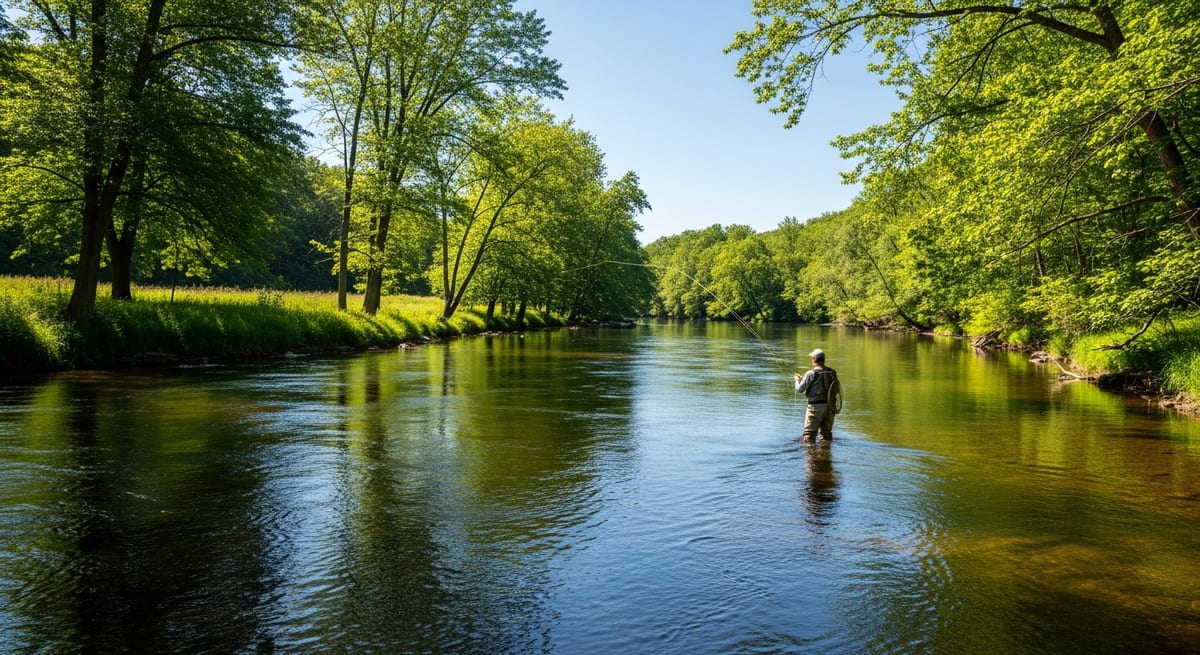
DEEP electrofishing surveys have documented natural brown trout reproduction in the Farmington River's catch-and-release section. A finding that separates it from most stocked Connecticut trout water, where hatchery fish dominate from opener through mid-spring and then disappear. While most CT anglers wrap up their trout season by late May, a smaller group fishes the Farmington, Salmon River, and Shepaug year-round, specifically targeting holdover and wild fish that weren't stocked this season, or last, or possibly ever. Those fish behave, hold, and feed differently than anything that came out of a hatchery truck, and the anglers who've learned the difference are fishing a fundamentally separate game.
Where Holdover Browns Actually Live in Connecticut
Farmington River (New Hartford to Unionville): The Farmington is the center of Connecticut's holdover brown trout fishery, and the catch-and-release fly fishing section below Hogback Dam in New Hartford is where that fishery concentrates. Cold, stable, dam-controlled flows keep summer temperatures in a range that allows brown trout to hold year-round. Anglers who log sessions on the C&R section through July and August report water temperatures that rarely exceed the mid-60s Fahrenheit even in drought years, a condition most CT rivers can't sustain.
DEEP surveys have documented wild brown trout reproduction in this section, though population density varies across survey years and river conditions. Farmington regulars describe a clear behavioral separation: fish holding in the C&R section respond more slowly to obvious presentations, hold tighter to structure, and run larger on average than fish encountered opening week in stocked sections downstream.
Salmon River (Colchester): Below Leesville Dam, the Salmon River holds holdover browns through summer due to cold spring inputs and dam-controlled releases. The fly fishing only section is located primarily in Colchester per DEEP's current regulation maps. Anglers should confirm the specific upstream and downstream limits against the current CT DEEP Inland Fisheries Guide before planning a trip, as the special-regulation boundaries have been adjusted in past seasons.
Shepaug River (Washington/Roxbury): Anglers who fish the Shepaug's upper sections in Litchfield County consistently describe wild and holdover brown trout in cooler, spring-fed stretches, alongside native brook trout in tributary headwaters. Access is limited in places; public access points exist but are worth verifying against the DEEP public access database before making the drive.
Willimantic River (Windham/Mansfield): Gets significant annual stocking and holds browns through the season. Less technically demanding than the Farmington, but anglers familiar with the river's spring-fed pools report holdover fish in those specific stretches through midsummer.
Mad River (Winsted): A smaller Litchfield County river with wild brook trout in upper reaches and brown trout throughout its length. Cold spring inputs keep temperatures manageable; anglers who've fished it in October describe it as underworked relative to the fish it holds.
How to Read a Holdover vs. a Hatchery Fish, and Why the Distinction Changes How You Fish
Connecticut DEEP releases hatchery brown trout annually. Fish raised to catchable size and stocked to provide opener-season opportunity. They're identifiable: brighter coloration that can veer toward orange, fin wear from hatchery conditions, and behavioral patterns calibrated to where they were raised rather than where they're standing. In the first weeks of the season they school loosely, hold in predictable water near release sites, and respond readily to bait on the bottom.
Holdover browns. Fish that survived at least one full season in the river, look and act differently. Their coloration has deepened: dark olive-brown flanks, pronounced black and red spotting, and the yellow-gold tones of a fish that has been feeding on natural food through multiple seasons. Anglers who target holdovers specifically describe a consistent behavioral shift: these fish hold in seams and structure that stocked fish ignore, feed selectively on what's actually in the water, and require more precise drifts to move.
Wild browns: fish born from natural in-river spawning, represent the upper tier of the holdover fishery. The Farmington's C&R section is where CT anglers report the most consistent encounters with fish that have never seen a hatchery, are fully calibrated to the specific water they live in, and are measurably harder to approach and hook than even multi-year holdovers.
The practical difference for anglers targeting holdovers: fish that have made it through one or more winters have processed thousands of angler-cast drifts. Farmington regulars emphasize that presentation drift quality, approach angle, and fly selection all carry more weight once stocked fish clear out. The fish remaining are responding only to presentations that match what's actually moving through the water. A fish that has held in the C&R section through summer and into fall is not going to take a haphazard drift.
When the Holdover Bite Turns On: A Season-by-Season Read
Early Spring (March-April)
High flows dominate. Stocked fish are present in numbers and catchable on nightcrawlers, Power Bait, and small spinners. Holdover fish are in the river but positioned differently. Anglers who target them specifically in early spring work the softer water just off main current seams, back eddies, and the slow inside edges of bends where fish hold without fighting high flows.
Key temperature trigger: water moving into the low-to-mid 40s Fahrenheit activates feeding. Early-season pressure peaks opening weekend and drops through April as less-committed anglers move off.
Late Spring (May-June)
- Mayfly hatches define this window on the Farmington. The Hendrickson hatch (typically late April into early May) and Sulphur hatch (May into early June) drive surface feeding that makes brown trout identifiable and targetable on dry flies.
- Stocked fish thin out through harvest pressure by late May; the fish still present in C&R sections are holdovers and any wild fish.
- Evening spinner falls in May and June are specifically cited by Farmington regulars as the best opportunity to locate large holdover fish by their rise forms before presenting to them.
- Nymphing remains productive through the entire window, particularly with Pheasant Tails, Hare's Ear variants, and emerging caddis patterns timed to local hatches.
Summer (July-August)
The hardest window. Non-tailwater rivers warm past the range brown trout tolerate comfortably, and fish become lethargic and stress-vulnerable.
On the Farmington tailwater, dam-controlled cold releases keep temperatures viable. Anglers who log summer sessions on the C&R section report catches through August, typically fishing the first two hours of daylight before temperatures rise. Focus areas: shaded deeper pools, spring-fed seams, and any section with visible cold-water input.
The consensus among CT trout anglers on non-tailwater rivers: fish the first two hours of daylight in midsummer and stop by mid-morning. Targeting known spring-fed pools and shaded runs gives the best shot at fish that haven't pushed into the deepest, most inaccessible holding water.
Fall (September-November)
Widely described among CT holdover-brown specialists as the best fishing window of the year. Water cools, fish feed aggressively ahead of winter, and large holdovers that have been nearly invisible through summer begin showing in accessible water.
- Streamers, particularly large articulated baitfish patterns and Woolly Buggers in the 3-5 inch range, are the go-to for trophy-class holdovers in this window.
- The fall feeding pattern is specifically predatory: large browns targeting other fish, not insects.
- Brown trout typically spawn in November into early December in Connecticut, though exact timing shifts with water temperature and year. CT DEEP regulations address specific protection windows. Anglers practicing catch-and-release through the fall generally leave actively spawning fish alone regardless of what the regs technically allow.
How Farmington Regulars Approach Fish That Have Seen Every Fly in the Box
Nymphing: The dominant technique among experienced Farmington anglers through most of the season. Euro-nymphing and tight-line styles have become the preferred approach among regulars fishing the C&R section. The direct connection eliminates indicator lag and gives immediate feedback on subtle takes from selective fish. Anglers familiar with the section consistently describe the same holding water: the seam where fast and slow current converge, the soft pocket immediately downstream of mid-channel boulders, and the tail of deeper pools where fish move to feed without exposing themselves in heavy current.
Standard patterns cited consistently among Farmington regulars: Pheasant Tail nymphs in sizes 14-18, Hare's Ear variants, caddis larvae, and midge pupae in sizes 18-22 for the winter tailwater fishery. Dropper rigs with a heavier point fly and lighter dropper are commonly described for reading multiple depth zones in a single drift.
Dry fly fishing during hatches: When visible rises are occurring, fish are identifiable, but approach matters more than pattern. Farmington anglers describe getting into position well downstream, reading the current seam the fish is feeding in, and achieving a drag-free drift matched to that lane specifically. A size 14 Hendrickson during the spring hatch, a size 16-18 Sulphur during evening spinner falls, a size 20-24 midge cluster during winter tailwater midging. Getting the drift right on a rising holdover is a different problem than moving a stocked fish. The margin for error is narrower and the failure modes are more specific. Anglers who've worked the hatch game on the Farmington describe it as the part of CT trout fishing with the steepest skill curve and the longest feedback loop.
Streamer fishing: Fall is the primary window for targeting large holdovers on streamers. Articulated patterns in the 3-5 inch range, stripped or swung-and-stripped through likely lies, are what anglers targeting trophy-class fall browns rely on. CT trout anglers who've shifted to fall streamers describe the predatory aggression of browns in September and October as distinctly different from spring and summer behavior. Fish that ignored size 18 nymphs in August will chase a 4-inch Conehead Bugger in November.
Spinning with small lures: Panther Martin spinners (size 3-5, gold blade) and small Rapala X-Raps are effective on Connecticut brown trout in sections where they're legal, particularly in early spring high water when visibility is reduced. Anglers fishing non-fly-only sections report spinners as consistently productive for both stocked and holdover fish through the opener window. Spinners and hardware are not permitted in fly-only sections, confirm section designations before rigging.
The Regulations That Keep the Holdover Fishery Intact
The Farmington River's special-regulation sections are directly responsible for the holdover brown trout population that makes it worth fishing year-round. The multi-season, catch-and-release requirement in the C&R section is what allows fish to accumulate over years rather than being harvested each spring. Understanding the section structure matters:
Catch-and-Release Fly Fishing Only (below Hogback Dam, New Hartford): Artificial flies only, all trout catch-and-release. No bait, no spinners. This is the primary holdover and wild brown trout section. The boundary markers are present on the water; fish this section regularly and you'll know them.
Trout Management Area (TMA) sections: Parts of the Farmington carry additional special regulations, reduced or restricted harvest and artificial-lure requirements. The specific boundaries and rules within TMA sub-sections have been revised in past seasons, and any simplified description of what's permitted where risks being outdated for the section you're actually standing in.
CRITICAL: Before fishing any section of the Farmington, verify the exact rules for that specific stretch against the current CT DEEP Inland Fisheries Guide or the CT DEEP website. Do not rely on what another angler describes from a prior season. Regulations change, section boundaries shift, and fishing with spinning tackle in a fly-only zone is a violation regardless of what you were told.
Salmon River: The fly fishing only section is regulated separately. Confirm current upstream and downstream limits with the DEEP regulation guide before fishing. The precise boundaries are the detail that matters.
For current stocking schedules, hatch reports, and flow data on the Farmington and other CT trout rivers, the CT DEEP Inland Fisheries webpage and resources like FarmingtonRiverAnglers.org are where regulars go before every trip. DEEP stocking reports are updated as fish are released and give a real-time read on where fresh fish are in the system.
EVERY SATURDAY MORNING
Weekly fishing intelligence
Nationwide conditions, what's biting, and honest gear deals. One email, no noise.
No spam. Unsubscribe anytime.